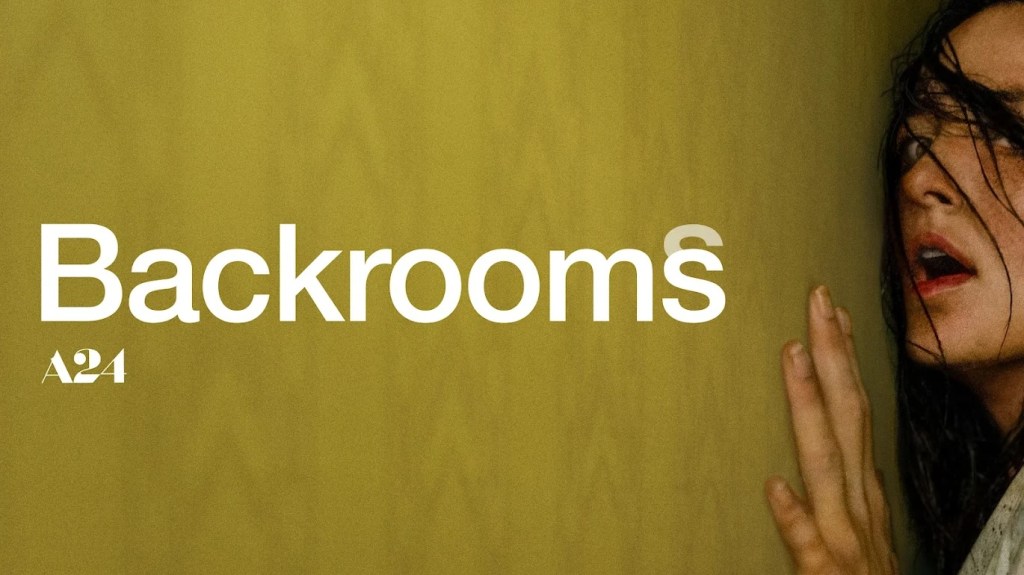
As y’all know, it’s already frickin’ October (not that I’m complaining, mind you; it’s my favorite month), and I realized with alarm that the end of the year would be here before I knew it and I hadn’t yet seen most of the big, talked-about horror movies of 2026. So for the next few weeks I’m going to try as hard as I can to rectify that situation, time permitting.
As you can see, I decided to go with Backrooms first, mostly because it was streaming on HBO Max and because I’d had several friends recommend it to me. Also, I reviewed the Japanese liminal horror film Exit 8 not too long ago, which is almost like a gamified Backrooms (sorta), so I was still kind of in that headspace, if you know what I mean.
Backrooms is the second-highest-grossing horror film of the year (after Obsession, of course, which I will likely get to next), A24’s highest-grossing film ever, and the fifth-highest-grossing independent film (not just horror) OF ALL TIME. You guys probably don’t need me to tell you, but horror is definitely having its moment in the spotlight these past few years, and I am here for it.
I will note that prior to watching the film, I had never seen the web series it was based on (just bits and pieces here and there), though I was passingly aware of the creepypasta origins of the lore and the general premise. I’m not going to go into an extended history of where the whole idea came from because you can use Google just like everyone else (and it’s absolutely a rabbit hole worth going down), but here’s just a brief summary.
In 2019, an image of a seemingly endless series of empty, yellowish rooms appeared in an online discussion. The photograph showed a depressingly ordinary interior: stained carpeting, sickly yellow walls, fluorescent lighting, and a layout that seemed to continue in every direction without offering any obvious purpose.
Someone attached a fictional explanation suggesting that people could accidentally slip out of reality—or “noclip,” to borrow a term from video games—and find themselves trapped in a seemingly infinite collection of rooms hidden somewhere outside our normal world. And voilà: the Backrooms were born.
The concept spread rapidly across the internet, generating stories, artwork, games, and increasingly elaborate mythology about different levels, mysterious organizations, and inhuman things wandering through these impossible spaces.
In 2022, then-teenage filmmaker Kane Parsons, better known online as Kane Pixels, released a short found-footage video that brought the concept to life with extraordinarily convincing digital environments, disturbing sound design, and an analog aesthetic that looked like footage recovered from a decades-old VHS tape.
It was incredibly effective because it understood something that many horror movies forget: sometimes an empty room is scarier than a room containing a monster, which is a notion I’ve always been a big advocate of.
Parsons eventually expanded his videos into a larger fictional universe involving scientific experiments and the mysterious organization Async. The success of those videos ultimately led to the feature film we’re discussing right now.
In my opinion, you don’t need to have seen the web series or know anything about the Backrooms concept to enjoy the movie, though. Maybe there are a lot of Easter eggs in the film for audiences who followed the prior media, but I wouldn’t know about that, and honestly, I thought the film was great and eerily compelling just as a stand-alone. I’m sure familiarity with the web series makes it a richer experience all around, but I liked this quite a lot just on its own merits, and didn’t have any trouble following along with what was going on. Your mileage, of course, may vary.
The movie, set in the early 1990s, starts with a found-footage-style cold open, in which a researcher we later learn is named Naren Warne (Avan Jogia) becomes lost in the endless Backrooms during an expedition for the Async Research Institute. He starts to panic, calling over the radio for help, but is eventually attacked by an unseen something-or-other and presumably killed.
We then jump into the movie proper, some brief but unspecified time later. We’re mainly following two characters whose relationship to one another isn’t immediately apparent. First there’s Clark (Chiwetel Ejiofor), who owns a failing discount furniture store in a mostly abandoned strip mall. The confusingly-themed business (called “Captain Clark’s Ottoman Empire,” but then featuring a bunch of Caribbean pirate stuff) never appears to have any customers, and Clark is spiraling into alcoholism and depression. We learn subsequently that he had dreams of becoming an architect that never materialized, that his wife has kicked him out of their house, and that he’s essentially living in the furniture store.
Then there’s Dr. Mary Kline (Renate Reinsve), who is having her own issues, remembering a childhood with an agoraphobic mother who wouldn’t let her go outside and covered the windows of their home with newspaper. This home has recently been demolished, and it’s later revealed that Mary’s mother has been institutionalized. Mary, it turns out, is Clark’s therapist, and has been trying to help him navigate his latest difficulties.
So Clark has been noticing electrical anomalies around the store, particularly very high usage during overnight hours when most of the lights are visibly off. He calls in an electrician who can’t find any reason for the discrepancy, though the electrician does discover a weird pair of switches in the fuse box that are installed all lopsided and don’t appear to control anything.
One night, after the power has gone haywire once again, Clark creeps down to the lower level of the store to check the fuse box, and in the partial darkness, he sees what appears to be a thin, vertical crack of light coming from behind a wall. Curious, he goes for a closer look, and promptly stumbles through the wall and into the Backrooms.
He’s naturally flabbergasted, trying to rationalize this bizarre space that absolutely should not be here, but at first, the discovery is almost fascinating. Beyond the ordinary walls of his store lies this impossible architectural landscape, filled with endless rooms and passageways, crazy furniture and door configurations, and spaces that seem to operate according to rules nobody understands. For someone who once dreamed of becoming an architect, happening across an entirely new universe of architecture is understandably difficult to resist.
Just as an aside, throughout the film, there are indications that Clark’s discovery isn’t quite as unprecedented as he believes. A mysterious scientist named Phil (Mark Duplass) has been monitoring the situation, and later we learn that he works for Async, an organization that has been investigating the Backrooms for years. In the film, Phil explains that the company previously worked with MRI technology before becoming involved in the study of the Backrooms. Async will factor into the story a lot more toward the climax.
Anyway, Clark becomes increasingly obsessed with the extraordinary circumstances, and eventually tries to tell his therapist Dr. Kline about the Backrooms, showing her a crude but detailed map he drew during his initial explorations. Of course she doesn’t believe him (who would?), so he angrily insists he’s going to come back with proof.
To this end, he recruits his employee Kat (Lukita Maxwell) and her boyfriend Bobby (Finn Bennett), who had previously borrowed a video camera to film a cheesy commercial for the store (in which Clark was dressed as the store’s pirate mascot, a detail that will be important later). The terrified pair enter the Backrooms with Clark in order to document the phenomena, and to put it mildly, things don’t go too well. I don’t really want to spoil any more than that, since the film is so new, but suffice it to say that shit only gets weirder and WAY more unsettling from there.
You have to give Kane Parsons massive props here; it probably would have been easy to deliver a film that was basically two hours of people running around spooky yellow hallways while something horrible chases them, but the movie is far more interesting (and smarter) than that. Parsons instead builds a story about memory, isolation, regret, and the terrifying possibility that reality might not be nearly as reliable as we’d like to believe.
The Backrooms, you see, isn’t just a collection of strange, randomly connected spaces; it appears to be trying to recreate the world outside. The problem is that it isn’t very good at it. It seems to absorb impressions of places, objects, and people, then imperfectly reconstructs them according to some bizarre internal logic. Rooms resemble familiar locations but contain strange glitches and mistakes, objects appear where they shouldn’t, and architecture becomes distorted. Entire spaces seem to represent memories filtered through something that has never actually experienced human life. It’s almost like asking an artificial intelligence to recreate your childhood home from a vague description, then finding yourself trapped inside the result. The basic elements might be recognizable, but the proportions are wrong, the furniture makes no sense, and the hallway leads somewhere that definitely wasn’t part of the original house.
This concept is creepy enough as it is, but perhaps the most disturbing part is that the Backrooms don’t restrict themselves to architecture; they also attempt to recreate people.
These imitations (known as Still Lifes in the lore but never referred to as such in the film) are most of what make the movie so fucking nightmarish. They have recognizably human features, but there’s something profoundly wrong with them. Their bodies and expressions resemble those of people reconstructed from incomplete information. The result is an especially nasty example of the uncanny valley: something that looks almost human but is just wrong enough to trigger an instinctive reaction of disgust and fear. And the recreation of Clark inside the Backrooms, which essentially represents a grotesque version of his worst self, is honestly one of the most disquieting things I’ve ever seen in a horror movie, and that’s saying something.
Backrooms is an unusual and ambitious feature debut, particularly from a filmmaker so young, and I have to say it’s really refreshing to see a studio-backed horror production that doesn’t feel compelled to explain every frightening image or deliver a traditional monster-movie payoff. In my opinion, Kane Parsons very successfully translated much of the strange atmosphere of his original internet videos into a full-length narrative, while adding themes that give the material greater emotional weight. Overall, I legit loved this; I found the movie visually inventive, surprisingly thoughtful, and at times creepy as all get-out. It also has very strong acting performances, imaginative creature designs, and a genuinely disturbing vibe that I really dug; the movie really does enclose you in its peculiar world in a way that I haven’t really experienced in a while. I know it’s still early days (at least as far as the number of new movies I’ve seen), but I can absolutely see this being one of my favorite films of the year.
That will do it for this time, so remember to keep it creepy, my friends.

