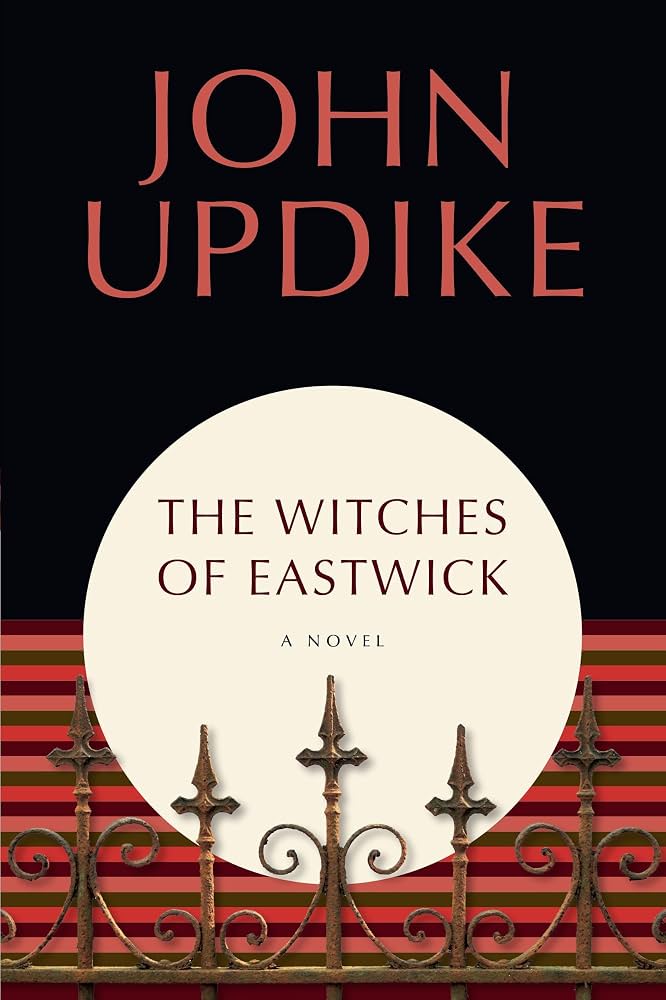
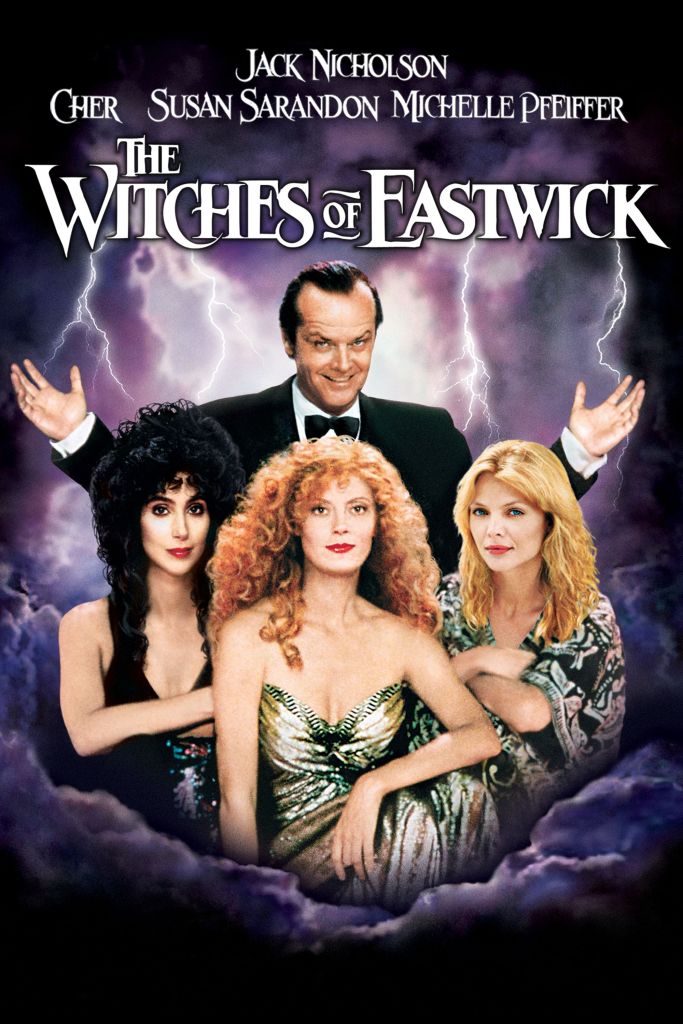
I first saw The Witches of Eastwick when it came out in theaters in 1987, and I absolutely loved it; something about its delightful mix of dark comedy, occult fantasy, sexy glamor, and Jack Nicholson’s unhinged scenery-chewing struck all the right notes for me, and I ended up watching the thing dozens of times subsequently over the years.
At some point, out of curiosity, I decided to give the book it was based on a read. John Updike’s novel was published in 1984, and I probably first read it sometime in the early 1990s. And while I liked the novel okay, I was actually pretty gobsmacked (and disappointed, frankly) at how different the book was to the film. Though I wouldn’t go quite so far as to call the film an adaptation in name only, the contrast is very stark, especially in the second half, so we’re going to have a LOT to talk about. Get a BUNCH of snacks, in other words; this might take a while.
Though both book and movie have the same broad outlines—three witchy women in a small New England village become entangled with a mysterious, possibly diabolical stranger who arrives in town, and supernatural shenanigans ensue—everything else wildly diverges, including the era in which the story is set, the entire moral intent of the characters, and a drastically different ending including at least one major character who does not appear in the movie at all. In general, the movie is more amusing and fun, with some blackly comedic flourishes and over-the-top special effects toward the end; while the novel is nastier, stranger, more rambling, and much more morally complicated.
The movie was directed by George Miller (yes, the director of all the Mad Max movies, as well as the animated penguin film Happy Feet), who famously did not read the novel before making the film, commenting that if he had read it, he probably wouldn’t have even seen a viable movie in it. John Updike himself would go on record later, saying that the film essentially distorted or ignored the central plot he had written. That’s hard to argue with, to be fair, but honestly, I think overall I enjoyed the movie much more than the novel; the film is an entertaining, fantastical romp, while the book is sort of off-putting, bitchy, and not nearly as whimsical. It’s hard to compare them directly, since their methods of attack vary so much, but dammit, I’m going to try my best.
As usual with these posts, I will try to follow along with the story more or less chronologically and point out differences as I go. This should go without saying (though again as usual, I’m going to say it anyway), but major spoilers for both movie and novel are ahead. Oh, and because the book and the film are so dissimilar, this breakdown might kinda veer all over the place, but just bear with me; I’ll try to keep things as coherent as possible.
The film is set in the then-present day of the mid to late 1980s, and the titular witches live in a picturesque small town in Rhode Island. They consist of sarcastic sculptress and mother of one Alexandra Medford (Cher); prim and childless music teacher Jane Spofford (Susan Sarandon); and newspaper reporter and mother of six Sukie Ridgemont (Michelle Pfeiffer). We learn very early on that all three women have fairly recently become single: Alex’s beloved husband Oz died; Jane’s divorced her because she was infertile; and Sukie’s deserted her because she had too many kids. The three women meet up every Thursday for martinis and bonding sessions, and it’s fairly clear that all three of them are lonely and desperate for male companionship.
The book, on the other hand, takes place toward the end of the Vietnam era, in the late 1960s or very early 1970s. This is actually a bigger change than it might initially appear, because John Updike’s Eastwick is awash in the cultural upheavals of the late sixties: feminism, sexual liberation, divorce, environmentalism, political radicalism, generational conflict, changing attitudes toward religion, and all the rest of it. The witches’ newfound freedom is connected very specifically to this moment in American history. The movie retains essentially none of this context, other than the small town of Eastwick being sort of uptight and religious and pretty judgmental about people with different attitudes, turning the film’s story more into a contemporary fantasy about lonely women discovering their sexuality and personal power, rather than the broader societal and political bent found in the novel.
The women’s names are also different in the book, being Alexandra Spofford (changed to Medford in the movie; Spofford was Jane’s last name in the film), Jane Smart (see previous parenthetical), and Sukie Rougemont (changed to Ridgemont in the film). Even their physical appearances get shuffled around: Book Alexandra is a plump, matronly, somewhat hag-like gray-blonde woman; Jane is small and dark-haired; and Sukie is a redhead, pretty but boyish and somewhat simian in appearance. In the movie, Cher’s Alexandra is tall and dark-haired, Susan Sarandon’s Jane is a small redhead, and Michelle Pfeiffer’s Sukie is blonde and decidedly non-boyish. And fun fact about the casting: Susan Sarandon was originally slated to play Alexandra, but was given the role of Jane instead after Cher came on board and insisted on playing Alexandra herself. Susan Sarandon was apparently not told of this character switch until she arrived for the first day of shooting, which seems pretty shitty, but hey, that’s Hollywood for you.
Oh, and this isn’t a huge change, but it’s Daryl Van Horne in the film and Darryl Van Horne in the book.
In the movie, after a very short, efficient setup establishing the three women, there’s a scene where they’re all at some event (I think it’s an elementary school graduation?) being held outside the town hall. Felicia Alden (played by Veronica Cartwright in a wonderfully batshit performance) is the wife of the newspaper editor and the local religious scold, and she sings “America the Beautiful” at whatever this event is. Afterwards, high muckety-muck Walter Neff (Keith Jochim), who is maybe the mayor of Eastwick and/or the school principal, comes out and gives an endless, droning speech about values and patriotism and similar bollocks.
Alex, Jane, and Sukie look bored out of their skulls, variously looking up at the sky, and wouldn’t you know it, a sudden, violent storm blows in, drenching the crowd and sending everyone running for cover, plus mercifully bringing an end to Walter’s incessant nattering.
Later on that evening, the storm still raging, Jane and Sukie arrive at Alex’s house for their weekly boozin’ and bitchin’ get-together, and they all realize that the moment the weather went sideways earlier that afternoon, they’d all been thinking exactly the same thing: to wit, that they wished something would happen so that Walter would put a sock in it and they could all go home. Jane in particular tells them that she thought Walter was “all wet.” Sukie immediately believes this is significant, but the other two women don’t think it’s a big deal; it’s probably just a coincidence, right? In the movie, this is the first hint that the women are becoming aware that when they are together, they can make things happen.
The book is completely and utterly different in this regard, because the women already know perfectly well that they are witches from the very beginning. They already have powers, and they don’t hesitate to use them. Alexandra can see auras and summon thunderstorms, Jane is telepathic and can fly, and Sukie can transform things. Together, they can generate a kind of psychic “cone of power,” sense things about the people around them, manipulate objects, and perform deliberate magical acts.
They have also apparently done some pretty fucked up things before the events of the novel even get rolling. For example, unlike in the film, all the women have actually killed their husbands: Alexandra slowly shrank her former spouse, eventually transforming him into multicolored dust which she keeps in a jar in the kitchen; Jane has reduced hers to a dried herb hanging in her cellar; and Sukie has turned her ex into a plastic placemat on her dining room table.
Which is admittedly a pretty fucking spectacular way of announcing that these ladies are not merely going to discover that they can wiggle their noses and make the dishes wash themselves; they’re witches, and definitely not nice ones. I get why this was changed for the film, honestly, since in the book the women are really pretty horrible people, and I don’t imagine audiences would have been too keen to see such well-known and well-liked actresses playing such unsympathetic characters. Still kind of jarring, though, not gonna lie.
Anyway, in the movie, the women are still at their Thursday night shindig, and they begin listing attributes of their “ideal man,” who is preferably not from Eastwick, possibly foreign or exotic somehow, a nice man who is intelligent and a good conversationalist, handsome but not too handsome, has a dick that’s not too small but not too big, and various other things. Immediately following this scene, we see someone in a fancy Rolls arriving in town on the same rainy night and pulling up in front of a massive mansion. The implication is that the women have either conjured this man into existence, or their burgeoning witchy energy has lured him to Eastwick from elsewhere.
Shortly afterward, the whole town is abuzz with the news that a man has bought the historic Lenox mansion, but oddly, no one seems to be able to initially remember his name, a nice little eerie supernatural detail that is also featured in the book (though to a much lesser degree). In the movie, Sukie (who works at the newspaper office) is talking to Alex on the phone and telling her about a mysterious man with no family buying the house.
In the book, literally on the first page, Jane is telling Alex about the man who bought the house. She got the news from Sukie, so there is no implication beforehand that the women summoned him to Eastwick, because the scene of them describing their perfect man is not in the novel in any form; the book just immediately starts with the women discussing him moving there.
Jane says she heard that the man needs all the room in the enormous house because of his piano collection, and also because he’s an inventor and needs space for a lab for his experiments (which he later explains are mostly chemical in nature, such as protective floor coatings and shit like that, along with a sideline in solar energy). While the pianos are mentioned in the movie, the laboratory is not, and indeed, the whole “Renaissance man/mad scientist/quasi-Iron-Man” angle of the character in the book is not touched on in the movie at all.
Also in the novel, the house is beautiful and stately, but we see later that Daryl puts a lot of boxy and shabby modern furniture and crazy pop art in it (like a giant vinyl hamburger and a sculpture of a naked woman made out of chicken wire and garbage, for example). In the movie it just looks like a classy-ass mansion, with elegant woodwork, marble floors, chandeliers and shit. Oh, and in the book, because Jane tells Alex that the man has no wife or family and is from New York, Alex first assumes he’s gay.
In the film, there’s also a scene around here with Sukie’s editor, Clyde Alden (Richard Jenkins), and his intensely moralistic wife Felicia, who is immediately disturbed by the newcomer and increasingly convinced that something evil has entered Eastwick. Felicia is a ridiculously abrasive and judgmental character, but the irony is that she is essentially correct about the mystery man.
As far as more character backstory goes, while the three main women in the movie complain of not getting any dick, the women in the book are practically drowning in penis. Alex is fucking a married Italian plumber named Joe Marino, the latest in a string of affairs she’s cultivated since her husband’s death (including one with Sukie’s former husband Monty). Jane is involved with Raymond Neff, a married high-school music teacher (who Alex has also banged a few times here and there). Sukie has connections with several men, including Unitarian minister Ed Parsley (who Jane might have also slept with) and, later and more importantly, her married editor Clyde Gabriel (named Clyde Alden in the movie).
In the film, the women don’t have sex with anyone other than (eventually) Daryl Van Horne (and, it’s implied, with each other in group sex situations). Also, Walter Neff (who I assume is the same character as Raymond Neff in the book) is not sleeping with any of the women in the film, but grabs Jane’s ass on one occasion while she’s at work (much to her shock and annoyance), and both Alex and Sukie complain that he has sexually harassed them as well.
In the movie, Alex has one teenage daughter who sometimes babysits Sukie’s six kids (who are all girls in the movie but mixed genders in the novel). In the book, Alex has four children. She also has a black Labrador named Coal who is her familiar. In fact, early on in the novel, Alex takes Coal down to the beach for a walk one day, while checking out the Lenox mansion from afar to see if the mysterious new tenant has moved in yet. She resents that there are a bunch of young people on the beach so she can’t let the dog off-leash. She therefore conjures up a thunderstorm to drive everyone else away. This happens very early on in the story, so like I said, in the book it’s very clear from the jump that these women are witches who have no qualms about using their powers to get what they want.
Speaking of dogs, incidentally, we find out later that Daryl also has a dog in the book: a collie named Needlenose. Plus he has a long-haired cat named Thumbkin, who he alleges houses the soul of an eighteenth-century barrister and can shape-shift, because why not? I’ll note that we never see the cat acting like anything other than a cat, however.
The initial meeting between Alex and Daryl Van Horne is quite different in both mediums too. In the movie, Alex goes into one of the local antique shops that sells her sculptures. These, by the way, are little clay female figures sort of like fertility totems; they are white and nearly identical in the movie, but in the book she paints clothes on them and they’re all different. The older woman who owns the shop says that the mysterious man came into the store and bought all of Alex’s figurines. The woman says the man was “riveting” and made her think naughty thoughts, but she’s startled to find that she can’t remember his name, even though she wrote it down. Soon after this, Alex rides her bike out toward the Lenox mansion and encounters Daryl Van Horne on the property; he invites her back to the house for lunch.
In the book, Daryl comes to a chamber music concert in town and meets Alex there; the conversation they have is similar in both mediums, in that he tells her how “potent” her sculptures are, that he sent a bunch of them to a friend in New York who owns a gallery, and that she really needs to let go and work much bigger. I’ll get back to Alex and Daryl in a minute.
So in the movie, there is also a scene at a chamber music concert (in which Jane is playing), and Daryl falls asleep in the back row, snoring so loudly that everyone turns around to stare at him, but this happens before he’s formally met anyone. He does, however, send flowers to Jane backstage, and as she, Alex, and Sukie are talking, Sukie suddenly remembers the man’s name is Daryl Van Horne. The second she remembers it, everyone else in the room remembers it too, and Sukie’s pearl necklace suddenly breaks and sends pearls rolling all over the floor. Felicia trips on them and tumbles down the stairs, breaking her leg.
A sort of similar thing happens in the book, but Alex deliberately breaks the necklace with magic, and what’s more, the necklace is worn not by Sukie, but by an old woman and very minor character named Franny Lovecraft (who does not appear in the film, as far as I’m aware). Alex breaks her necklace because Franny is being dreadfully boring and irritating at the concert and Alex is sick of talking to her. She also undoes the woman’s shoes while she’s crouched down picking up the pearls, just to be an asshole. The pearls don’t cause Felicia to fall, but Franny does, and everyone thinks she’s broken her hip (though we find out later it’s not broken). Alex tries to leave the room during the commotion but encounters Ed Parsley, who puts the moves on her (even though he’s married and also still involved with Sukie). In her annoyance, Alex magically breaks his expensive watch band, and while he stumbles to catch it, she slips around him and goes outside, where she runs into Daryl briefly. This scene in the book does not carry any of the significance of the tripping-on-the-pearls sequence in the film.
Back in the movie, Felicia is laid up in the hospital for a bit with her busted leg, and starts to act increasingly bonkers, ranting about evil and what not. The doctors explain to her husband Clyde that sometimes a bad fracture can cause an inflammatory response that can affect the brain and therefore behavior, and to be patient with Felicia as she heals. Felicia does seem to be aware that something is wrong with her, but she also turns on a dime and gets all bug-eyed, claiming there is something evil inside of her that is infecting the entire town.
In both the book and the film, Alex and Daryl are the first ones to meet one another, and in both mediums, Alex is initially pretty repulsed by him. In the novel, she thinks he’s a vulgar snob, looks unwashed, has grossly hairy hands, complains a lot, and talks entirely too much about himself; she even thinks she might hate him. In the novel, the two meet at the chamber music concert at which Jane has performed, and they talk for a bit (well, Daryl mostly talks at her) before Jane comes up and Daryl begins laying on the “charm” for her. He tells Jane how much he admires her musical talent, her “beautiful callus,” and insists her intonation isn’t “prissy” like her conductor says. He also tells her that her bowing hand is her downfall. A very similar conversation to this occurs in the movie, but it happens later, when Jane and Daryl are alone at Jane’s house, and not at the concert where they first meet. In the novel, minister Ed Parsley also comes up and engages in conversation, and Daryl eventually invites Jane to his mansion to play some music together. Shortly afterward, Jane’s latest fling Raymond Neff turns up and spirits her away, and then Sukie comes up to meet Daryl. It’s interesting that in the movie, the women all meet Daryl separately, but in the book they all meet him at the same event, quite early on. There isn’t as big of a mysterious buildup to Daryl’s character, like there is in the film.
I’ll also note here that Book Sukie and Movie Sukie are significantly different, personality-wise, much more so than the other two. In the film, Michelle Pfeiffer’s take on her is as a gentle, maternal, romantic, compassionate woman who seems to feel things much more deeply than the other two women and has a very strong moral center. She is the first one to become alarmed when their powers start to cause harm to other people. In the book, though, she’s inquisitive, assertive, and sort of aggressively cheeky. Because she works for the Eastwick Word, she’s a conduit for gossip, and she has a kind of restless social energy; she’s easily the most outgoing of the witches. She’s also not maternal at all in the book, calling her kids “little shits,” “repulsive,” and saying they get in the way.
Anyway, back to Daryl and Alex in the film. As I mentioned, Alex meets Daryl on his property and he invites her to a fancy lunch out on the lawn of his mansion. They have a conversation (again, it’s more of a monologue on Daryl’s part) about women and how much better they are than men for various reasons. Alex seems bemused by Daryl’s ranting, and when he asks if she wants to see his house, she agrees, so he gives her the tour.
When they arrive at Daryl’s bedroom, he basically stretches out on the bed in his silk robe and does a very overt and hilarious “seduction,” saying that Alex is such a straightforward woman that he feels it would be an insult to her to try and be slick about the fact that he wants to fuck her. This leads to easily the funniest bit of dialogue in the movie, and Cher delivers it with perfect intonation and timing:
“I think… no, I am positive… that you are the most unattractive man I have ever met in my entire life. You know, in the short time we’ve been together, you have demonstrated EVERY loathsome characteristic of the male personality and even discovered a few new ones. You are physically repulsive, intellectually retarded, you’re morally reprehensible, vulgar, insensitive, selfish, stupid, you have no taste, a lousy sense of humor, and you smell. You’re not even interesting enough to make me sick.”
After this awesome proclamation, Alex turns to leave, but Daryl switches to another approach, lowering his voice to a more honeyed but reasonable tone and basically playing on Alex’s deep-seated insecurities that she has never lived up to her potential and is capable of (and deserves) so much more out of life. His spiel works like magic, and she enthusiastically jumps into bed with him, despite her initial disgust.
Either the same day or the very next day, Daryl turns up unannounced on Jane’s doorstep, violin in tow. Jane is very restrained and nervous, her hands visibly shaking as she drinks tea with him at her little dining table. Daryl asks her to get out her cello and play a difficult piece she’s been working on, as he plays piano and violin accompaniment. Daryl eggs her on and encourages her to free herself as she plays, and as the music reaches a crescendo, she plays with increasingly wild abandon, her hair coming loose from its tight bun and flying around, the strings of the cello beginning to smoke, and Daryl’s piano playing becoming ever more chaotic. Eventually, a clearly very horny Jane lets the cello thump to the floor and leaps lustily on Daryl, macking on him shamelessly.
I’ll note that in the novel, Jane (not Alex) is actually the first one to go to the mansion (I think; see next paragraph for clarification), and we only find out about it after the fact, as she’s telling Alex about it over the phone. In contrast to the movie, Jane absolutely does not sexually liberate herself through her cello playing and jump on Daryl’s meat whistle; in fact, she tells Alex that although Daryl is an incredible piano player, she initially thinks of him as “asexual.” Besides, she points out, even if she wanted to hump him, there’s all kinds of construction going on at the mansion and there are workmen everywhere (one of whom is Joe Marino, Alex’s latest flame).
Oh, and incidentally, during this phone conversation, Alex complains that her period has been going for five days and is really painful, and idly wonders if Joe’s wife Gina used witchcraft to give her cancer (she seems to have a profound fear of cancer; she thinks of it often, and this fear will become a bit significant later in the story). Jane also says she’s going to visit Daryl again on Thursday and blows off the women’s regular Thursday night get-together, which pisses Alex off a great deal.
Sukie also visits the Lenox mansion in the book before Alex does, although it’s not specified whether she goes there before Jane. Sukie is actually sent there on assignment to write an article about Daryl and the changes he’s making to the property, and Alex reads the article in the paper and calls her to talk about it. Again, Sukie and Daryl don’t have sex yet, but he does get her drunk and he talks a lot. Sukie says that she told him all about herself and Alex and Jane, says he’s really interested in them, and that he seems to love Alex the most. Alex subsequently gets jealous that she is the last one to go to the mansion, even though she supposedly loathes Daryl.
Shortly after this conversation between Sukie and Alex in the novel, Sukie does a little spell to encourage Alex and Daryl to fuck. It’s at this point when Alex drives out to the beach near the Lenox mansion and encounters Daryl, who invites her back to the house (which of course happens much earlier in the film). By the time she gets there, she is already starting to fall for him, but she leaves before they do anything because she left her dog Coal in her car on the causeway and the tide is coming in (don’t worry, the dog is fine). Daryl begs her to stay and see his bedroom, but she insists she has to get to her dog and get home to tend to her kids. In the book, Daryl is much more scattershot and sloppy and sort of desperately blabbermouthed, not nearly as suave or overtly “infernal” as Jack Nicholson portrays him in the film.
Anyway, the movie next jumps to the morning after Jane and Daryl’s musical and sexual encounter. Alex and Sukie are cycling toward the Lenox mansion, as Daryl has invited them to play tennis. Alex waxes rhapsodic about her sexual dalliance with Daryl, commenting on how his penis bends the wrong way, and she says that she can’t wait for Jane to meet him because Jane is going to love him. Neither Alex nor Sukie realize that Jane has already met (and done the horizontal rhumba with) the intriguing stranger.
When they arrive at the house, they’re both surprised to see Jane lounging on a chair under a canopy on the lawn. She’s sexily sipping a martini and looks MUCH different than usual: her red hair is all frizzy and untamed, and she’s wearing a form-fitting polka-dot tennis outfit and oversized shades. In the novel, Jane is already plenty sexually active and doesn’t undergo a radical physical transformation like she does in the film.
Jane is just as obviously taken aback by the presence of her two friends, and she asks them what they’re doing there (unaware that Daryl has also already slept with Alex). Alex cheekily says they were invited over for tennis, and when Daryl emerges from the house, Jane says she thought it was just going to be her and Daryl playing. She approaches Daryl with a theatrical, “Darling!” but he blows right past both her and Alex and makes a beeline for Sukie, the only one he hasn’t seduced yet. Jane and Alex both look as though they could spit nails as Daryl puts his arm around Sukie and walks off toward the tennis court, asking her questions about herself and leaving the other two women behind.
During the tennis game, Alex and Jane in particular are not subtle about their jealousy, spiking the ball hard at each other and at Sukie, then pretending it was accidental. They begin squabbling and arguing, but then the tennis ball begins behaving in magical ways, floating motionless in the air, flying upwards into the clouds and not coming down, things like that. Another sudden storm blows up that ends the game, and it appears that the realization of their shared power has dissolved any feelings of jealousy they had toward one another. They all go happily into Daryl’s mansion to spend the rest of the afternoon swimming in the indoor pool and sipping cocktails.
It’s at this point in the film that Daryl hones in on Sukie, and because of her character (at least the movie version of her), he seems much gentler and much less sure of himself with her, telling her he has no idea how he’s going to seduce her, as she seems so open and guileless. She is charmed by the fact that he doesn’t care if he gets her pregnant (since she’s so fertile and all; remember, six kids), and he is charmed by her calm self-possession. He calls her peculiar and she genuinely thanks him, and the two kiss and vanish beneath the surface of the pool.
There’s a tennis game in the book too, but the jealousy element isn’t really there between the women because none of them have had sex with Daryl yet and their relationship dynamic isn’t quite the same. The supernatural aspects of the game are more pronounced and deliberate than in the movie too, with the tennis ball being turned into a bat and a frog by Sukie while Jane is trying to serve it. Sukie also makes the lines on the court move around so Jane gets a fault, and Alex stirs up a dust devil so Daryl misses a swing. Jane and Alexandra are playing against Daryl and Sukie in the book; in the movie it’s Jane and Daryl versus Alex and Sukie. There’s also no sudden thunderstorm in the novel like there is in the movie.
I’ll note as well that the tennis game and subsequent dinner and drinks in the book takes place on Halloween night. Over Daryl’s protestations, Sukie leaves to check on her and Jane’s kids (Jane has kids in the book too even though movie Jane is childless). She further says she might not be back because she said she would do a Halloween-night color piece for the paper, interviewing trick-or-treaters. Jane, Alex, and Daryl have a naked soak in Daryl’s big teak hot tub and smoke some weed. Jane gets jealous of the attention being paid to Alex and starts to get a bit pissy, thinking being nasty will put more attention on her. This is also the point in the book where Daryl says something about how he’d love to be a woman because their bodies can make babies and make milk to feed the babies, which is a line he says to Sukie during her “seduction” in the movie (though in the novel, Sukie is not present when he says it).
In the hot tub, Jane starts touching Alex, but gets interrupted when Sukie returns; then Sukie gets her kit off and climbs in the tub too, and the three women start sort of making out. Eventually, they all “play” with Daryl on some velour mattresses (implying blowjobs and handjobs), with the women being pleased at how cold his semen is. Again, it’s sort of interesting that Daryl seduces the women one by one in the movie, making each of them initially think they are his only interest, but in the book the witches all have their first sexual experience with Daryl as a group.
Also, right around here in the novel, the minister Ed Parsley (Sukie’s current paramour and a character that doesn’t really figure significantly in the film) runs off with a teenage hippie girl named Dawn Polanski who’s also something of a revolutionary (see, there’s some more of that political context that wasn’t really in the movie). Alex then wonders if they should befriend Brenda, Ed’s wife, but Jane can’t stand her smug ass and shuts that idea down. Alex then asks if Sukie will set her sights on Daryl now that Ed is gone, but Jane says it’s more likely Sukie will go after her boss, Clyde. Alex idly suggests that Clyde’s insufferable wife Felicia should be “put out of her misery,” and Jane is totally on board, but then Alex thinks better of it.
Still in the novel, there’s a short scene around here where Felicia is ranting to Clyde about Ed, about Sukie, and about Daryl tearing up the wetlands on his property to build his tennis court. She’s being a real cunt (I mean, she is in the movie too; Veronica Cartwright really nailed the character), and while she’s talking, little feathers start coming out of her mouth. Felicia tearfully tells Clyde that she’s been coughing up weird things like pieces of straw lately and has terrible breath and can’t figure out what’s going on. Clyde tells her to go to the doctor, but she’s afraid they’ll think she’s crazy. This isn’t explained in the book quite yet (though duh, it’s witchcraft), but a scene very similar to it happens later in the film. Remember also that Felicia never broke her leg in the book like she does in the movie, so all of the stuff having to do with her broken leg doesn’t occur in the novel.
Oh, and it’s also here where we learn that Clyde and Felicia have two grown children named Jenny and Chris who both live out of town (Jenny in Chicago and Chris in New York). These two (Jenny in particular) will be major characters in the novel, but are not in the movie at all.
Slightly later in the book, Sukie tells Daryl at lunch that Ed Parsley and Dawn have joined the Movement and are learning to make bombs. It’s also here we discover that the witches have been amusing themselves by throwing pins, sweepings, and feathers into a cookie jar in order to magically harass Felicia. Sukie further tells Daryl that she and Clyde have either started an affair or she’s planning to start one; Daryl encourages it, and a bit later there’s a long sex scene between Sukie and Clyde at her house that ends with Sukie getting herself off thinking about Felicia after Clyde has fallen asleep.
Back in the film, there’s what seems to be a montage over an unspecified time period, showing the women enjoying their luxurious “arrangement” with Daryl at his mansion. They dance in fabulous outfits, let Sukie’s kids play in a cavernous atrium filled with pink balloons, and push one another around on dining carts. At one stage, one of these carts ridden by Jane goes barreling into the swimming pool room and Jane is catapulted into the air, where she grabs onto a huge chandelier. The other two women begin to laugh, as does Jane, and they discover that their laughter causes them to levitate, which delights all three of them. Then Daryl’s servant Fidel (Carel Struycken) enters and startles them, and they all crash into the water.
In the next scene in the film, the women, all with wet hair and robes, are lounging on rugs and giant pillows in front of the fireplace, and Daryl is filming them with one of those bulky 1980s video cameras. They’re talking about their greatest fears: Jane’s is the brevity of life and how quickly everything disintegrates; Alex’s is snakes, or more specifically, being covered with snakes and them making her disappear; and while Sukie says she is not afraid of death, she doesn’t understand why life has to be filled with so much pain. All of the things the women say on the tape will be important later.
I will note that in the book, the women meet up with Daryl together sometimes, but also meet up with him individually quite often as well, with seemingly not much jealousy between them. I will also note that all the stuff with the videotape and the witches’ fears is not in the novel at all.
Meanwhile, back in the movie, crazy Felicia has gotten out of the hospital and is sitting in church, becoming increasingly agitated, whispering the word “whores” under her breath a bunch of times before shouting it loudly in front of the congregation. She starts raving about all the sin seeping into Eastwick in general and happening at the Lenox mansion in particular, including “vice, perversions, and shamelessness…cavorting with that devil!” She also notes, “Drugs, murder, rape, incest, Spanish flies, dildos, anal intercourse!” Sounds like a party! Clyde drags her crutch-toting butt out of there tout suite, apologizing profusely.
In the next scene, Jane is teaching her music class at the school, and the kids are terrible and tuneless, sounding like a sack of squalling babies playing kazoos inside a tumble dryer. Jane, obviously over it, encourages the kids to throw away the sheet music and just go with the flow, essentially playing the piece while using the Force. She’s still got her wild hair and patented “brazen hussy” duds (not that there’s anything wrong with that), and she kicks off her shoes and conducts the kids, using some of the same words and phrases that Daryl used when she busted out on the cello. The kids start playing amazingly, and an overjoyed Jane starts spinning around and dancing all over the room. Walter Neff comes down the hall and peeks in her classroom, seeing Jane like a whirling dervish in the middle of all the (now standing) kids who are playing like prodigies, and he nopes the fuck out and flees down the hall.
Next, Jane pops into a grocery store after work to pick up a few things, clad in a short dress, red heels with lacy ankle socks, wild hair, and slutty shades. At first she’s oblivious, tossing stuff into her basket, eating pickles out of the jar without a care in the world; but we notice the other Eastwick ladies giving her the stinkeye, looking scandalized, and muttering things under their breath. When she gets to the checkout, one of the women calls her a slut, whispering but deliberately loud enough for her to hear. When she calls the woman out, the other women all look at Jane sneeringly, as if to say, “Yeah, we all think you’re a slut too and you don’t belong here.” Jane realizes everyone in town has now turned on her and scuttles out of the store, mortified.
There’s next a scene where Sukie is at work at the newspaper office talking to Clyde, her boss. He’s lamenting how insane Felicia has gotten and how hard of a time he’s having dealing with it, and Sukie is genuinely sympathetic. Clyde pleads with Sukie to tell him that all the rumors about what’s going on at the Lenox mansion aren’t true, but Sukie doesn’t deny them. She understands that he has to fire her, not only because of her soiled reputation around town, but because Clyde wants to show Felicia that he’s doing something to stand up to the “evil” in Eastwick (since Felicia has made some pretty emasculating comments to him in this regard).
That night, the women have dinner at Daryl’s mansion. Sukie suggests they stop seeing each other until the heat dies down, and while Alex reluctantly agrees, Jane and Daryl are defiant. Jane, though, does mention that Felicia has spoken to the mothers of all her music students and many have cancelled their lessons; also, kids who go to school with Sukie’s kids tease them that Sukie is a lesbian. Further, Daryl is being sued for millions because some changes he’s making to the property are interfering with an egret nesting site, a lawsuit he admits is “inconvenient.”
While Daryl is wheedling the women to forget the puritanical townsfolk and continue their arrangement, he encourages them to eat some fresh cherries out of a huge silver bowl on the table. The women start eating them and spitting the pits back into the bowl (which…gross). Meanwhile, back at Felicia and Clyde’s house, Felicia is ranting once again at Clyde about the mansion being a den of iniquity and so forth, and Clyde is desperately trying to read his paper and ignore her as best he can. But soon enough, she begins coughing up cherry pits, and as the scene goes on, it becomes more and more gag-inducing as Felicia repeatedly vomits up massive quantities of cherry pits and sludge, spraying dark red slurry all over the furniture, lampshades, and carpet. As she spews, the scene cuts back and forth between her and the women at Daryl’s mansion, eating cherries and spitting the pits into the bowl, even though it’s clear they have no idea that what they’re doing is having this effect on Felicia.
Finally, Felicia is covered in cherry-flavored bile and screeching like a banshee, and Clyde snaps, snatching up the fireplace poker and beating Felicia to death with it (offscreen, though; this movie has horror elements for sure, but it’s not a gorefest by any means).
None of the previous paragraphs occur in the novel really; though Clyde also beats Felicia to death with a fireplace poker in the book, it actually happens much earlier, and there isn’t anything about cherry pits. In the novel, Felicia starts ranting again and making horrible comments about Clyde, saying she knows he wants to fuck Sukie but doesn’t have the guts (little does she know he already is); and as she talks she spits up straight pins, part of an eraser, parrot feathers, dead wasps, pieces of eggshell, and thumbtacks, but just keeps on talking anyway until Clyde finally loses it and kills her. He then hangs himself. In the movie, it’s actually never mentioned what happened to Clyde afterward, whether he committed suicide or was arrested for murder.
It’s also interesting to note that in the film, the “witches” are completely clueless as to what they’re doing in regard to the cherry pit trick; it’s made clear that Daryl is behind it and the women are essentially blameless. In the novel, it’s strongly implied that the witches intended to harm Felicia with magic on purpose, and although Sukie seems mildly upset at Clyde’s death and is somewhat remorseful that their actions caused Felicia’s murder, the women generally talk about it like it’s no big deal. Jane, in fact, is particularly callous, saying that Felicia absolutely deserved to be beaten, but that Clyde perhaps took it a touch too far. It seems a good time to mention here that Book Jane is a stone cold megabitch supreme, unlike her movie counterpart, who is slightly bitchy but overall a good person.
There’s also no scene in the book prior to Felicia’s death where the women talk about not going to Daryl’s house anymore because of the rumors about them; if anyone other than Felicia was talking bad about them behind their backs in the book, they don’t appear to give a fuck. They seem to have targeted Felicia simply because she annoyed them. So we can see here that the film puts way more of the villainy on Daryl’s shoulders, while the book has the women much more in control and suitably wicked themselves without Daryl’s help.
So at this point in the breakdown, it doesn’t really make sense to continue doing a back and forth, one-to-one comparison between both mediums, because from now on, the movie and the book are totally different. So I think what I’ll do is finish recapping the film to the end, then back up to the crossroads of Felicia’s death and recap the third act of the novel. And boy, gird your loins, because if you’ve never read the book, you’re going to think I’m making shit up, but I assure you I absolutely am not.
Back in the movie, after Felicia is killed, the three women are at a park across from the Gabriel house, watching as the police take Felicia’s body away. Sukie, immediately realizing their involvement, is horrified by what they’ve done, but Alex and Jane don’t think they had anything to do with it, because how could they? They have a blistering argument about it, and their fury causes the ground to crack beneath them, frightening them and confirming that their wishes and moods actually do manifest in real life and that Daryl has been a catalyst for all of it.
The witches decide to stop associating with Daryl after Felicia’s death, though it’s apparent they sort of miss him and the fun times they all had. An increasingly morose and lonely Daryl, upset that the women are not visiting him anymore, tries to convince them to come back and have things be like they were. He calls Alex first, and she reluctantly speaks to him, but she tells him she can’t talk to him or see him anymore, then hangs up on him. After this, he flips out, screaming and tearing a furrow in the wood tabletop with his long fingernails.
Next he goes to Sukie’s house, bringing her a basket of fruit and pretending that he thought it was her birthday. She looks like hell, wan and with a big cold sore, and she’s kind to him, but tells him she can’t let him in and she can’t accept his gift. Daryl throws the basket on the porch, stomps on it, and huffs off.
Next he goes to Jane’s house, but she either isn’t home or won’t open the door to him. I’d like to note that after the “breakup,” the weather in Eastwick is always stormy, mirroring the emotions of the women (and of Daryl). It isn’t explicitly mentioned, but it’s a nice touch.
We discover in the following scene that Jane wasn’t home because she was at the doctor finding out that she’s pregnant, and she’s actually delighted at this news. She was the one who was the most affected by Daryl’s ministrations, after all, and the one who was the most hesitant to cut ties with him.
Without telling Alex or Sukie, she goes alone out to Daryl’s mansion to surprise him; she’s keen to rekindle their relationship and tell him about the pregnancy. But after Fidel admits her and she starts walking down the hall, she notices that Daryl is sitting in the TV room with his back to her, looking like twenty miles of bad road. He’s watching the videotape of her saying what she was afraid of, over and over again. If you’ll remember, she said something about looking in the mirror and “seeing things disintegrating faster and faster,” and to her horror, she notes that her hands now look like those of a very elderly woman. A quick glance at her reflection confirms that her face looks just as decrepit. She flees from the mansion, though the aging effect doesn’t last once she leaves the premises.
Meanwhile, as you might have guessed, Alex wakes up in her bed and is completely covered in snakes, since that’s what she said she was scared of most on the tape. She freaks out and bolts from her house, running into Jane, who has driven to her house to check on her. Both of them are rattled, but fine.
Sukie, however, isn’t so lucky. Because she said that she was most afraid of pain, Daryl really does a number on her, cutting into a pomegranate and then cruelly crushing it until the seeds and juice drip down his arm before cramming the pulp into his mouth. At her home, Sukie is suddenly stricken with unbelievable agony in her abdomen and starts to hemorrhage; the phone rings (presumably it’s Jane or Alex), but Sukie is thrown violently back against against the wall and can’t answer.
In the next scene, Jane and Alex are visiting Sukie in the hospital. The doctors can’t figure out what’s wrong with her, but all the women know that Daryl has cursed them. Sukie also tells them that she’s pregnant, and Alex admits that she is too, so all three of them are now carrying Daryl’s hellspawn. This, by the way, does not happen in the book at all; none of the three main women get pregnant by Daryl, though someone else does. More about that later.
Because they can’t stand seeing Sukie in pain and teetering on the brink of death, they realize that the only thing they can do is play nice with Daryl until he removes the curse. Alex drives out to the mansion and attempts to reason with Daryl, but he’s petulant, self-absorbed, and shitty, basically pretending that he can’t do anything about Sukie’s problem and whining about how all three of them abandoned him for no reason. Alex rightly calls him out on his bullshit, but he has a full-on mantrum, throwing things and kicking and screaming and generally just Jack Nicholson-ing out like no one’s business.
Alex is eventually able to sweet-talk him and convince him that all three of them will return to him and everything will go back to the way it was. Back at the hospital, Sukie’s pain abruptly stops, and while she’s naturally relieved, she and Jane look at one another significantly, knowing what this means.
The three of them dress up all fancy and go back to the mansion in the Rolls, driven by Fidel. They lay it on thick, smooching on Daryl and talking about how everything is going to be so much better now. They even drape themselves across his bed seductively, clad in skimpy lingerie.
Daryl, apparently as dumb as he is evil, goes to town the next morning to buy some ice cream for the women, since they tell him they’re having pregnancy cravings. The moment he leaves, the trio snaps into action, digging through Daryl’s occult books, looking for a spell that will get rid of him. They melt some candles, and sculptress Alex begins to make a wax effigy of him while they all basically try to reverse the inadvertent witchery that drew Daryl to Eastwick by remembering the words they said when they were wishing for their ideal man.
Daryl is in town and everything seems normal at first, but as the women’s spell progresses, he begins to be adversely affected. While in the ice cream shop, for instance, the women poke the leg of the wax figure, causing Daryl to double over in pain. As they manipulate the wax figure in various ways, whatever they do to it is reflected physically in Daryl as he moves through town. When they start blowing feathers from a pillow at the wax figure, Daryl is blown down the street by a strong gust of wind.
Daryl immediately understands what’s happening, and grows increasingly animalistic and rage-filled as the spell pummels him into submission. In another hilarious scene, Daryl bursts into the town church in the middle of a service, ranting about what horrible bitches women are and how they’re a punishment from God. He also starts vomiting cherry pits and slime all over the pews as the women pull the same cherry pit stunt that resulted in Felicia’s death.
Leaving Fidel in town, Daryl drives back home like a bat out of hell, while the women race to clean up the evidence of what they did. They just manage to get into “acting casual” mode when Daryl storms into the house, looking like a furious werewolf after a boxed wine bender. He isn’t fooled by their innocent act and lunges at them, causing the three women to scatter in all directions. Daryl chases them around, and at one point Jane falls from a high balcony, but remembers to laugh (which causes her to levitate) right before she hits the floor.
The women make it to the kitchen, Daryl hot on their heels, and they manage to get hold of the wax effigy (which they’d hidden in a cookie jar). Tossing it to one another causes Daryl to fly all around and smash into the walls, and while he’s down they lock him out of the kitchen. But then Sukie tosses the doll at Jane and she drops it; it breaks into three chunks. We’re left to imagine what this does to Daryl on the other side of the door, but we haven’t seen the last of him yet.
The women see a bunch of flashing white lights under the door and hear growling, and then the window breaks behind them and a gigantic, deformed Daryl-monster appears outside, snarling in at them. The kitchen catches on fire in the melee, and before Monster Daryl can reach in and snatch them, the women throw the three pieces of the wax figure into the flames. The Daryl creature shrinks down to a weird, mewling baby-thing with Jack Nicholson’s face before winking out of existence entirely. None of this final magical battle royale occurs in the novel, which I’ll discuss in a bit.
The film then jumps ahead to eighteen months later. All the women are living a peaceful life in the mansion with their toddlers, all fathered by Daryl. Fidel has stayed on too, and seems to be a good babysitter. One day, the children are in their baby walkers and hear someone calling them from the TV room, where there’s a big grid of screens mounted on the wall. Once they arrive at the threshold, the screens, which all had different programs on, gradually change over to Daryl, talking baby talk to them and telling him he’s their dad. After a minute or two, the women all show up; Daryl sees them and tries to play nice, but they unceremoniously turn all the TVs off with the remote. The end.
Now let’s rewind to the point where Felicia died in the book and see what we can see as far as the rest of the novel goes, because we’re going off on an entirely different track. So only Sukie goes to Clyde and Felicia’s funeral, and she tells Alex on the phone about the couple’s adult children, Jenny and Chris, who have come to Eastwick to pay their last respects. As I mentioned, Jenny and Chris are very important characters in the book, but don’t appear in the film at all.
Soon after the funeral, Sukie runs into Jenny Gabriel in the street and takes her for a cup of coffee. Jenny and Chris are staying in Eastwick for a few months until they can sort through their parents’ things and get their house sold. Sukie tells Jenny that she was having an affair with her dad and apologizes, but Jenny doesn’t seem all that upset about it. Sukie also says that Jenny needs to meet Daryl because he’s been a big help and inspiration to them.
In the very next scene, Sukie has brought Jenny and Chris to Daryl’s house for tennis; Jane and Alex are also there. The women all play tennis together while Daryl gives Chris a tour of the house. The game has a few supernatural flourishes, such as the ball turning into heavy putty, a bird or insect, and an egg; Sukie’s racket turning into a snake; and Sukie freezing Alex in place. Alex and Jane seem extra bitchy because Sukie brought Jenny, who is young and lovely and not part of their usual configuration. Jenny isn’t fazed by the supernatural shenanigans at all, as she confesses that Brenda Parsley already told her that the women had magical powers.
Everyone goes inside for tea, but Sukie persuades Daryl to come out and play one more game of tennis with her. Afterward, Daryl asks her (nicely) to kiss him on his ass cheeks and his asshole, which Sukie happily does. As anyone familiar with occult lore knows, it was a common perception that witches kissed the Devil’s ass to show their loyalty. I should note here that in the movie, it’s made pretty obvious that Daryl is the literal Devil, but in the book it’s a lot more ambiguous.
Anyway, Daryl goes back in, and though the women expect him to come get in the hot tub with them as usual, he surprises them by hanging out with Chris in the library, reading comic books. The women all go have a naked soak together, talking and bonding, and after they all get out, they look for false teats on Jenny’s body and it seems to be implied that they get her off.
In the next scene, Jane is talking to Alex on the phone and saying she isn’t sure she likes Jenny, that she’s too “demure,” comparing her to Alice in Wonderland. She also informs Alex that Ed Parsley and Dawn Polanski (remember them?) apparently blew themselves up accidentally with a homemade bomb. Sukie calls later and says she was at Ed’s funeral, and she’s not sad at all, it seems, mostly just making sly jokes at everyone’s expense. She also says she got fired from the newspaper; she gets fired in the movie too, as I mentioned, but it’s because of the rumors about the women and Daryl, whereas in the book it’s more a case of her sorta quitting because she doesn’t like the new young editor that took over after Clyde’s death. She curses the guy, actually, and a bit later that winter he slips on the ice and breaks his leg. Sukie eventually gets a job as a realtor.
It’s also during this conversation in the novel that we learn Daryl has hired Jenny as his lab assistant (since she’s a chemistry whiz and was in medical school). Sukie says she was over at the house the day before and Alex gets jealous that Sukie and Jenny were there but no one told her. Sukie reassures Alex again that Daryl loves her best, but Alex has her doubts.
Throughout the winter, the women continue visiting Daryl, and now Jenny and Chris are there too, as well as the servant Fidel and his girlfriend Rebecca. It seems to be not always sexual, as sometimes they all play touch football on the lawn, or charades, but they do have orgies as well. The witches also seem to enjoy letting Jenny give them oil massages. Daryl rarely joins them anymore, though, preferring to play chess with Chris in the library.
That spring, Sukie sells the Gabriel house to a retired couple from out of town. Daryl also takes some of Alex’s larger sculptures to his gallery friend in New York, but the gallery doesn’t want them, and they get damaged on the way back when Daryl and Chris pick up a hitchhiker. Chris and Jenny have decided to stay in Eastwick, and Jenny is even going to use some of her inheritance money to help fund Daryl’s latest project.
It’s at this stage when the witches begin to turn on Jenny, and their ire ramps up considerably when they learn that Daryl has asked Chris and Jenny to move in with him. Jane in particular is incensed, feeling that Daryl has betrayed them, and tries to convince Alex to do some malevolent magic on Jenny. Alex is reluctant, but open to the idea, as she had harbored fantasies of basically being Daryl’s “queen.” In fact, after Alex finishes talking to Jane, Alex magically kills a squirrel she sees out the window because of her anger.
The following day, Alex is surprised when Daryl calls her and tells her to come to his house on Easter Sunday; it’s a depressing day for him, he says, and he wants everyone there so he can “try some stuff out on them.” Alex resists at first, resenting his thing with Jenny and Chris, but of course she goes.
Turns out that Daryl wants to play them some piano pieces he’s composed, as well as some versions of well-known songs. After he plays them, he explains that another friend of his in New York has told him that he can record the songs and sell an album to make some money. Daryl is in tight financial straits, it seems, and is in danger of being foreclosed upon because he hasn’t been paying his bills.
Jenny eventually joins the party, opening her robe and asking Alex to feel some lumps and warts she has on her body, worried they might be cancerous. Daryl then announces that he and Jenny got married at a justice of the peace the day before. The witches are naturally livid; Alex even throws champagne in Daryl’s face. Daryl seems shocked by their reaction, telling them he thought they’d be pleased, since they were the “cupids” who brought him and Jenny together. Jenny tells him she knew they would react this way, though she admits she didn’t think they’d be so “ill-mannered.”
The witches seem to get over their upset pretty quickly (or at least pretend to), and everyone has cake and champagne, and they dance drunkenly around in a circle chanting in Latin. Sukie suggests they do their usual soak in the tub, with orgy to follow, but Jenny shuts that down by saying the tub has been drained in preparation for cleaning and repair.
In the next scene, the witches meet at Jane’s house to decide what they’re going to do about Jenny. Jane suggests that they hex her, specifically by giving her cancer since she’s already so afraid of it. Alex and Sukie are a bit uncertain at first, but Jane insists she needs for all three of them to be in on it to make sure the curse is effective. She then reveals that she secretly kept the marzipan head of the Jenny figure from the top of the wedding cake to use for the spell, and also that she flew to the mansion in the middle of the night, climbed in a window, and swiped a bunch of stuff from Jenny’s bathroom, including Kleenexes with blotted lipstick and some shaved leg hairs from the shower.
Alex uses some melted candles to make a figure of Jenny (much like the women made a figure of Daryl later in the film), and they pierce it with tacks. All three of them then put their fingers on a larger needle and stick it through the wax figure’s heart. After that, they all spit on it and wrap it up in aluminum foil to seal in the evil. Alex takes it back to her house and stows it on a shelf, then later flings it into a bog on her property after she has second thoughts about the curse.
Soon after, Sukie tells Jane that Daryl and Jenny go everywhere together, and have even joined the choir at the Unitarian church, as though they’re trying to be respectable and fit in with the other townsfolk. Daryl even has people over to the mansion so he can explain his experiments to them and hopefully get investors.
Sukie then says that she ran into Jenny and that Jenny was actually really nice to her, saying that all the women should come back to the house soon when she and Daryl weren’t so busy. Obviously Jane has vowed never to go back to the mansion, and asks Sukie if Jenny looks like she’s getting sick yet. Sukie replies in the affirmative, saying she looks paler than usual and that when they went for coffee, Jenny barely ate the blueberry muffin she got. Sukie also says that she herself has started an affair with the younger editor at the newspaper, the guy she initially hated whose leg she broke with a curse.
Meanwhile, Alex has sex with Joe one last time and then breaks up with him because he had started telling her he was going to leave his pregnant wife Gina and marry Alex instead, and Alex isn’t into that action. Soon afterward, Jenny calls Alex, wondering why the women are all avoiding her and wishing things could go back to how they were. She also confesses that she thinks something is terribly wrong with her, that she’s tired all the time and constantly hungry but unable to eat. It’s actually sort of sad because Jenny clearly trusts Alex and wants to see her, to have some human connection, but even though Alex pretends to be nice to her, she tells her she can’t be involved with her or Daryl anymore. It’s actually implied that Jenny believes Alex can cure whatever her malady is with witchcraft, not realizing that it was Alex and the others who made Jenny sick in the first place.
Sukie, Jane, and Alex resume their Thursday get-togethers, this time at Sukie’s house. Jane is overjoyed that Jenny is looking so ill and pleased that all her hair has fallen out. She also says that her latest boyfriend knows the doctor who’s treating Jenny and that the girl is absolutely riddled with cancer and probably won’t live longer than two months.
Sukie then tells the others that she saw Dawn Polanski, who everyone thought got blown up in the accidental bomb incident with Ed Parsley. Sukie also says she broke things off with the editor, who got fired from the paper anyway, and tells them she’s thinking about applying for the editor job herself.
Alex suddenly blurts out that they need to reverse the hex on Jenny, but Jane says hell no, and Sukie tries to make her feel better by saying that maybe it wasn’t even their magic that gave Jenny cancer; maybe she would have gotten it anyway. Alex tells them she fears she might have cancer too.
In the next scene, Brenda Parsley is giving a sermon about the evil in Eastwick, and it’s evident she’s talking about Alex, Jane, and Sukie, though she doesn’t mention them by name. As she speaks, a bumblebee and then a butterfly come out of her mouth and the congregation starts to freak out. Jenny is there and finds the whole thing hysterically funny, wondering which of the three women is responsible for the mischief.
There’s next a scene where Jane gets up in the middle of the night to play her cello, which she does quite often, and it so happens that she has such an intense session that she forgets or neglects to put the cello back in its case, and her dog later chews it all up.
Subsequently, Sukie goes over to Alex’s house to help her find the wax figure that Alex tossed in the bog. Alex is hoping that if they find it, they can undo the hex. They do locate it, but the wax has completely disintegrated and there’s no turning it back into a figure.
In the next scene, Brenda Parsley, who has taken over as ersatz minister after her husband Ed’s death, is allowing Daryl to give the sermon at the Unitarian church. This is an interesting contrast to the film, where both Daryl and the women were perceived as evil by the churchgoing set; in the book, after his marriage to Jenny, Daryl seems to be trying to ingratiate himself with the religious townspeople. It’s not clear how successful this is, however, as the title of the sermon he gives is, “This Is a Terrible Creation,” and it’s completely deranged, focusing a great deal on intestinal roundworms and other parasites.
It’s soon revealed that Daryl is beside himself because Jenny is back in the hospital with uncontrolled bleeding and it’s presumed that she’s not going to make it. It’s also mentioned that Sukie is in attendance at the church, but in disguise; her column at the paper has been reinstated and she came to cover Daryl’s speech.
There’s a scene of Daryl giving a demented “sermon” of sorts in the movie too, as I mentioned earlier, but the context is entirely different, as in the film he just bursts in and starts ranting (he wasn’t invited to speak like in the book), and the thrust of his words is more misogynistic, as he’s pissed off at the witches for (in his mind) fucking him over. In the book, he’s more ranting against God or nature in general.
Oh, and this is only touched upon in the novel here and there, but it’s implied that several of the women in Eastwick are witches, and in fact there’s another “faction” of them stirring up toward the end of the book that includes Dawn Polanski, a woman named Rose (who bought the Gabriel house with her husband), and a German woman named Greta, as well as possibly Brenda.
So Jenny dies that September at four in the morning; her brother Chris is with her but asleep, and Daryl had gone home briefly so wasn’t with her when she passed. Sukie seems pretty nonchalant about it, but Alex still feels bad. Alex went to the doctor for her own cancer fears, but nothing was found. Sukie tells Alex that she heard from Jane that Jenny was pregnant when she died. Jenny, in fact, was the only person to be impregnated by Daryl, unlike in the film.
Alex then admits to Sukie that she gathered all the pins they’d stuck into Jenny’s wax figure and poked them into her own body in the hopes of giving herself cancer out of guilt, but it didn’t work. Sukie sympathetically tells her she’s “getting weird.”
Immediately after, Jane calls Alex and tells her that Daryl suddenly up and left town, and took Chris with him. She says Alex was right all along and that Daryl was “one of those,” meaning gay. Jane opines that Daryl only married Jenny to get his hands on her money, when it was Chris he wanted all along.
Sukie calls Alex later, and she suggests that Daryl was the one who planted the idea of killing Jenny into their heads so he wouldn’t have to do it. Alex isn’t sure she buys that, and says that Daryl was sort of a tragic figure because he wanted to create things but couldn’t; he could only help release creation in others, especially in women. Sukie also says that Jenny knew (and possibly witnessed) what Daryl and Chris were up to sexually, and because of it probably wasn’t sad to die. It sounds a bit like cope, though; Sukie seems slightly in denial about their responsibility.
Alex then asks how Jane is because she hasn’t seen her in a while, and Sukie tells her that she looks very pale and not great, and also that she saw the other “faction” of witches in town, but that they just smiled at her, demonstrating that there’s no beef between all of them anymore. It’s around this stage where it’s become undeniable that the witches have all grown apart and that their friendship has run its course.
Alex then works a bit on one of her unfinished larger sculptures, sprinkling her dead husband’s dust on it in order to conjure herself up a new husband, presumably. She eventually enrolls in art school and ends up marrying one of her instructors and moving to New Mexico.
We later learn that both Sukie and Jane did the same thing, summoning up another husband with magic, and both ultimately leave Eastwick to live with their new spouses elsewhere. The Lenox mansion is subsequently turned into condominiums. Chris vanishes back into obscurity in New York. The novel also points out that Daryl Van Horne was likely a pseudonym, though there are several patents under that name. And that’s pretty much it. The movie ends with a big magic battle and the (partial, temporary) defeat of the villain, and the book just kind of peters out.
So yeah, obviously there are massive disparities between the book and the movie that almost make them completely different stories altogether. In the movie, the women don’t know they’re witches at first and are generally decent people, but become seduced by Daryl (who is very obviously the Devil) and unwittingly end up doing evil by causing Felicia’s death. They immediately realize this, however, and band together for strength, using their newfound powers to send the Devil away. There is also the added implication that although they are all raising demon children, they will try to override the Devil’s influence in their kids.
On the other hand, in the novel, the women are already witches and really kinda suck as human beings. They obviously don’t need Daryl’s help at all to liberate them or serve as a catalyst for their powers, since they were already doing all the witchy stuff before he even got there. Indeed, in the book it isn’t entirely explained if Daryl is even supernatural in any way. He makes a couple of offhand, pretty vague comments suggesting devilry, and there is the ass-kissing scene and his “depression” around Easter Sunday, but everything he does in the book could also be written off as the actions of a wealthy, eccentric weirdo and con man who is, in general, not much more terrible than the average person, let alone the Devil himself.
The book is also significantly more anticlimactic and very morally gray: I mean, the witches are obviously the villains, especially in regards to Jenny, but they aren’t really punished at all for their actions the way Daryl is “punished” at the end of the movie. Everything just kind of carries on, like real life I suppose. Whereas the film is in an entertaining (and pretty standard for Hollywood) three-act structure that finishes with a bang and just the barest hint that the evil still lurks around and must be watched out for, the book comes across more as a ramshackle slice of life, where we drop in, check in with this crazy situation that happened in Eastwick over the course of about a year, then drift back out again, just as the characters continue drifting through their own lives. So anyone used to the theme and tone of the movie will probably be sort of confused or underwhelmed by the novel, I would imagine.
If I had to boil the thematic difference down to its simplest form, the movie is essentially an empowerment fantasy, while the novel is a much pricklier satire about what empowerment actually means once you strip away the inspirational bumper-sticker version of it. In the film, Alex, Jane, and Sukie discover that they have power, initially allow a predatory man to direct and exploit that power, then finally recognize what he’s doing and turn it against him. Their friendship ultimately becomes their greatest asset, and Daryl can pretty comfortably be understood as the embodiment of all the selfish, manipulative, entitled male bullshit they’ve been putting up with their entire lives. Once they stop competing for his attention and stand together, they can literally cast the bastard out. It’s not exactly subtle, but it is enormously satisfying.
John Updike’s novel is doing something considerably messier and more cynical. Its women are already liberated, already sexually adventurous, already powerful, and already perfectly capable of being selfish, cruel, petty, jealous assholes entirely on their own. Daryl doesn’t corrupt them so much as wander into an environment where all of those qualities are already flourishing and give them another object around which to organize their desires and resentments. So while the movie suggests that female liberation and solidarity can be a means of escaping male control, the book seems much more interested in pointing out that liberation doesn’t automatically make anyone wiser, happier, or morally better; freedom merely gives people more room to be whatever they already are. That’s a considerably less comforting message, obviously, and probably one reason the movie is so much more fun to revisit, and has held up remarkably well, especially in contrast to the novel.
That said, the book is pretty engaging, and I liked it much more this second read-through. The prose is quite beautiful at times, and it has its own disturbing power, giving us a peek into the world of people for whom malevolence is as mundane as doing housework or running errands; people who don’t even need the Devil’s influence to be complete shitheads. But after seeing the movie, it lacks that spark or pizazz, and while there is humor in it, it’s of a much drier, sardonic, satirical flavor. How you feel about that is entirely up to you.
Well, that will do it for another of my long-winded comparisons. I hope you enjoyed reading it as much as I enjoyed writing it, and until we meet again, keep it creepy, my friends.

