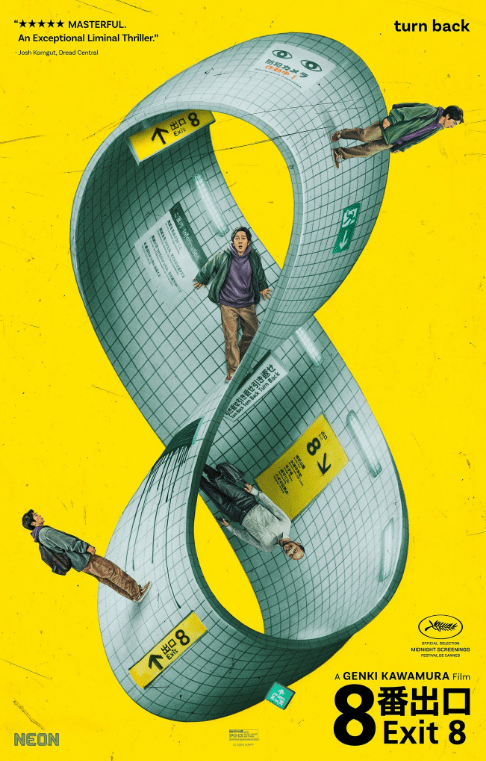
Liminal horror really seems to be having a moment, especially with the roaring success of Backrooms (which I still haven’t seen as of this writing; don’t fret, I’ll get around to it), and I started to notice that several discussions of other liminal titles inevitably ended up mentioning the Japanese psychological horror film Exit 8, directed by Genki Kawamura. Screened in 2025 at Cannes and released in Japan later that year, it didn’t arrive in North America until April of 2026, and is now available to stream on Shudder (at least in the US).
It’s based on a 2023 indie video game that’s essentially a spot-the-difference walking simulator, and if you think that doesn’t sound like it would make a very compelling horror movie, well, you’d be quite wrong, at least in my opinion, because I found Exit 8 to be an eerie, nightmarish experience that got me way more emotionally invested than I was expecting. It’s not a thrill a minute, and the looping nature of the premise may strike some viewers as repetitive, but I got really into this film and thought a lot about it after I watched it, especially the meaning of the ending (which I’m not going to spoil, since the movie’s so new).
Singer/songwriter/radio host Kazunari Ninomiya plays our unnamed main character, who in the credits is referred to simply as “The Lost Man.” At the beginning of the film, he’s on a crowded subway and witnesses a man angrily chastising a young woman who can’t stop her baby from crying. The Lost Man seems disturbed that no one steps in to defend the woman or tell the yelling dude to go fuck himself, but notably The Lost Man doesn’t say anything either, just slipping his earbuds back in and ignoring the confrontation.
After he exits the train, he gets a phone call from his ex-girlfriend; it’s established that they’ve only recently broken up. She informs him that she’s at the hospital and that she’s pregnant; she wants him to help her decide what to do. The Lost Man seems heavily burdened by this news, and just as unsure of how to proceed as she is, but before he can continue the conversation, his phone loses its connection and he begins to realize that he’s now in a part of the subway station that’s completely deserted.
At first, this doesn’t seem to faze him, but then shit starts to get REAL weird. He walks through one empty corridor and is passed by an older man who’s looking straight ahead and walking in a slightly unnatural fashion. The Lost Man turns a corner and then another, but then recognizes that he’s in the exact same corridor he was just in, and what’s more, the exact same man walks past him in the exact same way. We’ll learn more about this guy, known only as The Walking Man (played by Yamato Kochi), later on in the movie.
After a couple of go-arounds, and noticing that a yellow sign on the wall sometimes has a zero and sometimes has a one, The Lost Man notices another, smaller sign that helpfully explains the “rules.” Basically, these few corridors are an endless loop, and to escape the loop, you have to look for “anomalies” during each pass. If you spot something different in one of the corridors, you must immediately turn around and go back the way you came, but if there are no anomalies, you keep walking forward. If you’re successful, the numbers count up every time you pass the yellow sign; when you get up to exit 8, you can presumably leave the loop. But if you fail to spot an anomaly, then the next time you pass the sign it will kick you back down to zero and you have to start all over again.
Once The Lost Man figures out what’s going on, he starts paying much closer attention to his surroundings. The anomalies could be something as subtle as a doorknob being in the middle of the door instead of to the side, or the eyes of a person in a poster looking in a different direction; they could also be as undeniable as all the white tiles in the corridor turning yellow, or blood starting to drip slowly from the ceiling.
After messing up a couple of times, The Lost Man is understandably getting pretty disheartened, wondering what in the hell he did to deserve this and fearing that he might never get out. At one point, he successfully makes it up to exit 5, but then he gets another call from his ex-girlfriend, where he confesses to her that because he didn’t stand up for the woman with the baby on the train earlier, he isn’t sure he’s ready for fatherhood. Because it sometimes isn’t obvious what’s an anomaly and what isn’t, though, he ends up back at the beginning again when it’s revealed that the phone call wasn’t real.
As I mentioned, we actually start to follow The Walking Man for a bit too, finding out what his story is and what he has to do with the loop, and we also eventually meet The Boy (Naru Asanuma), a little kid who’s initially mute and frightened but ends up helping The Lost Man a great deal as his identity gradually becomes clear.
Keep in mind that pretty much the entire movie is set in essentially two hallways, and much of the runtime consists of The Lost Man navigating them and cataloguing the objects in them, looking for differences. For some audiences, this might get tedious, but I thought it was intriguing, as I felt as though I was playing the game right along with him, searching the environment with an eagle eye and yelling at the screen when I spotted an anomaly that the protagonist missed. The corridors also change up often enough (sometimes in startling ways) that it never got boring for me, although of course your mileage may vary.
While I wouldn’t call Exit 8 a scary film per se, it’s for sure unsettling, especially some of the scenes with The Walking Man and the more horror-focused sequences toward the end. I noticed some commenters who didn’t like the film criticizing the character of The Lost Man for messing up the game so many times (for example, taking far too long to turn back after spotting what was obviously an anomaly), but this didn’t bother me at all, since the whole point of his character was his indecisiveness and his failure to act, traits which got him stuck in the loop in the first place. And the ending, while seemingly hopeful, left enough ambiguity to suggest a couple of different possibilities, which left me with some food for thought.
If you like Backrooms and liminal horror movies in general, especially ones based around existential doom spirals like this, then give Exit 8 a look; it’s a simple premise, but I thought it was really effective and hypnotic, especially for being based on a video game that has no story to speak of.
Until next time, keep it creepy, my friends.

