Next up on the Night Gallery docket is season 2, episode 16, another one that consisted of three stories. This time around, all of them were at least decent, even the more comedically-inclined tale in the middle, though I admit they were all a bit slow-moving.
The first story, and the best of the bunch in my opinion, is “Lindemann’s Catch,” written by Rod Serling and directed by Jeff Corey. Set in what we’re led to presume is a seaport in New England somewhere, the tale opens one night in a dockside tavern, where all the old salts are boozing it up and taking a breather in between onerous excursions in their fishing boats. A local man and bar regular named Abner Suggs (Harry Townes) offers to tell fortunes for all and sundry, using his array of soothsaying items, but everyone seems to be pretty much ignoring him.
Enter the titular Captain Lindemann, played by Stuart Whitman, who coincidentally also turned up in a 1964 movie called Shock Treatment that I recently reviewed. The grizzled old coot is clearly not a people person, and waxes on about how miserable the life of a fisherman is, and how he knows that it will eventually be the death of him. His monologue is great, by the way, and really sells his character as a world-weary sourpuss who loathes his own existence.
Abner attempts a friendly conversation with the old sailor, talking about his predictions, and it’s obvious that this is a regular occurrence, because within minutes, Lindemann has decided he’s had enough of the fortuneteller’s shit for one evening and slaps the ever-loving piss out of him. A cowed, bloody-lipped Abner laments that Lindemann has no love in him for anything or anybody.
Shortly afterward, some of the other sailors give a shout from outside, and everyone rushes out to the dock to see what the commotion is. They’re all staring in wonder into Lindemann’s boat, but at first, the audience can’t see what they’re all looking at. Lindemann takes a gander in there too and starts screaming his beardy little head off.
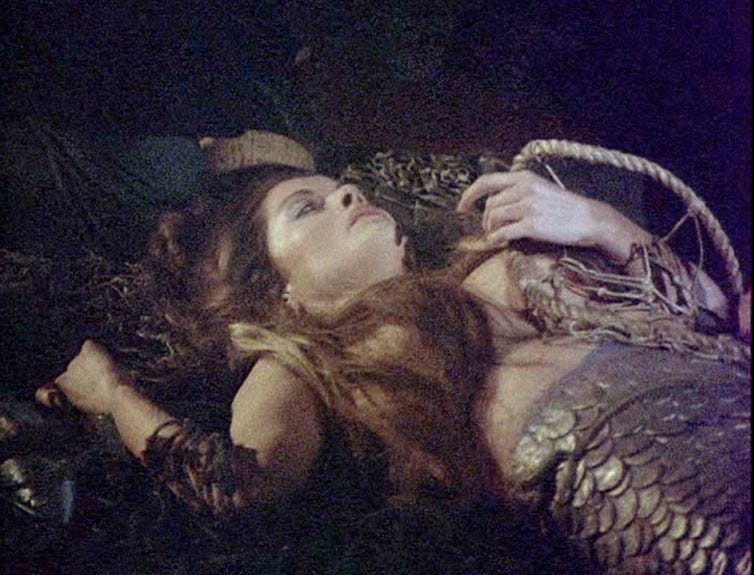
So it turns out that apparently unbeknownst to him, Lindemann has caught an honest-to-goodness mermaid in his fishing net. The beautiful creature is in noticeable distress, unable to speak and simply reaching out to the men as if pleading for help. Almost immediately, the sailors start planning on selling her to a traveling carnival for a tidy profit (classy), but an enraged Lindemann is appalled, basically calling her an affront to all that’s good and holy and vowing that he’s going to kill her. Bit of an overreaction, I reckon, but he is portrayed as a hateful old curmudgeon, so probably not surprising.
The other guys are able to talk Lindemann out of his murderous impulses for the time being, though they still seem to be scheming about how they’re gonna spirit the mermaid away to sell her before she inevitably dies.
We then skip ahead a couple of days, and it’s revealed that not only is the mermaid still in the hold of Lindemann’s boat, but Lindemann himself hasn’t been seen since the night he caught her. Now, you might be thinking that Lindemann had a change of heart and discovered he was all about the fish-lovin’ and I guess you’d at least partially be right, though this isn’t stated explicitly. Lindemann at last emerges from his boat and into the tavern, begging the town doctor (Jack Aranson) to administer some medicine to the mermaid because she’s dying.
The doctor reasonably argues that the mermaid belongs in the sea and that maybe Lindemann should, y’know, put her back, but Lindemann seems to have fallen in love with the creature and refuses to let her go, claiming that he and she have been communicating without words (which probably means exactly what you think it does).
Abner hears about the poor captain’s predicament, and wouldn’t you know it, but amid his vast collection of tarot cards, crystals, potions, and tinctures, he just happens to have a concoction that should (theoretically) turn the mermaid into a human woman. Why Abner would possess a magic elixir for this very specific and, I would imagine, unusually rare problem is never explained, but a desperate Lindemann doesn’t question it; he just gives the blue tonic to the creature (offscreen) and hopes for a miracle.
And at first, it would appear that he’s gotten one. He climbs down into the hold the next morning and is delighted to see a pair of shapely and very human gams sticking out from under the blanket where previously there was naught but a scaly fish tail. So elated he doesn’t even bother to pull the blanket away, he rushes back up on deck to tell the other sailors what’s happened.
Well, because this is a horror story and because Lindemann very pointedly did NOT peek under the blanket, you can probably guess where this is going. The former mermaid staggers up from the hold on her unsteady human legs, but it’s quickly revealed that the potion has transformed her into something of a butterface, because her upper half (well, mostly just her head) is now a fish. She makes a couple fishy faces at the men, staring at them with her bulbous fishy eyes, before jumping back into the sea, no doubt to be rejected as a mutant by her mermaid brethren. A heartbroken Lindemann leaps in after her, and presumably drowns, as the men are seen later that night throwing a black wreath onto the surface of the water.
While “Lindemann’s Catch” was pretty ponderously paced, it had spooky atmosphere for days, and Stuart Whitman’s performance as Captain Lindemann was outstanding. Once he gave the mermaid the change-up juice, it was very obvious how the story was going to end, but I didn’t mind that a bit, and the fish face effect, while clearly low budget, was actually fairly effective. A solid installment for sure.
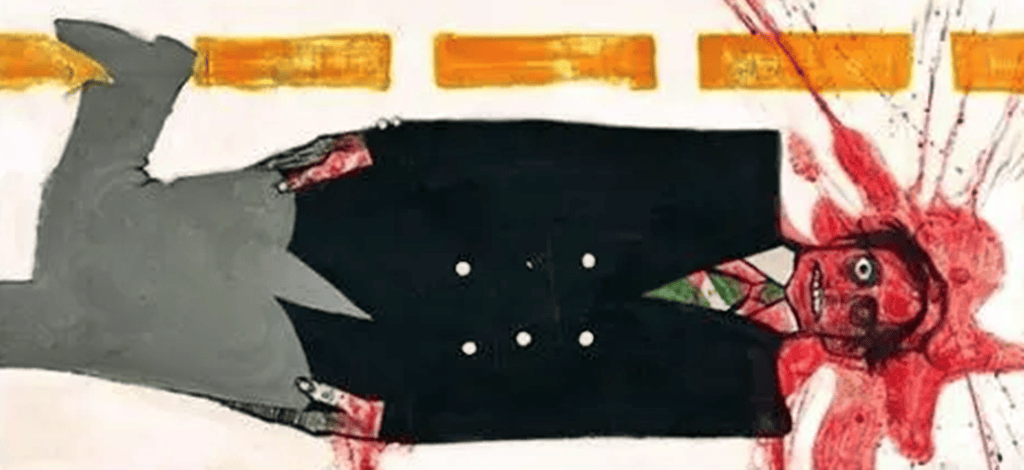
The next story, “The Late Mr. Peddington,” was more on the funny side, and consisted almost entirely of two people in an office talking. Despite this, it was still pretty entertaining. It was likewise directed by Jeff Corey, and was based on a short story called “The Flat Male” by Frank Sisk. I’ll also note that the painting that introduced this segment was easily one of the most hilariously gruesome ever featured on the show. Check this thing out:
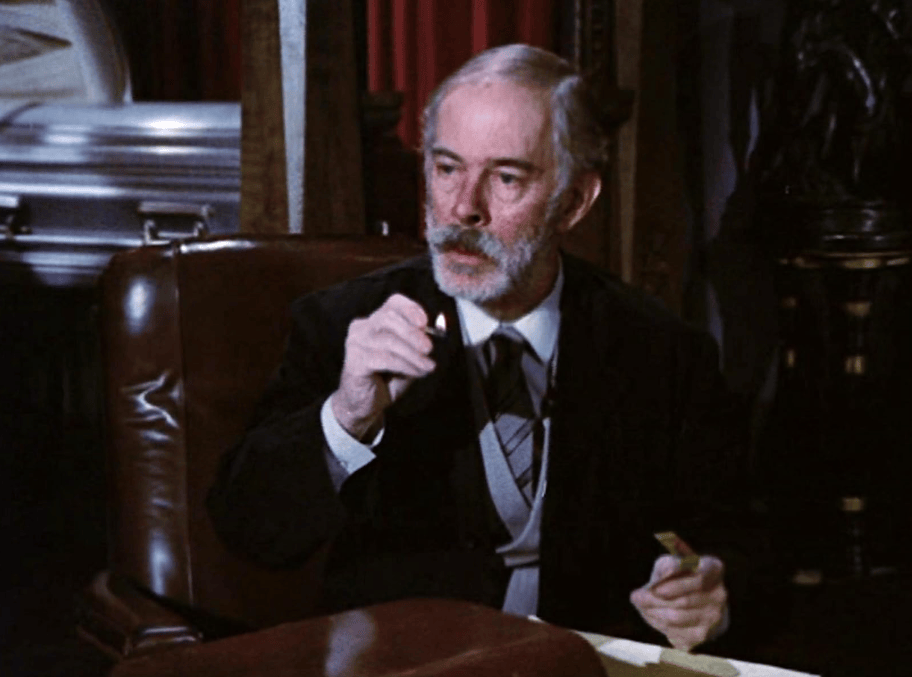
So Thaddeus Conway (Harry Morgan) runs a mortuary, and one fine day he gets a visit from a potential client named Cora Peddington (Kim Hunter). She starts asking him about funerary options, with a view to keeping things as budget-friendly as possible.
She goes on and on for a bit before she even thinks to name the recipient of said funerary services, which turns out to be her husband Adam. Conway notices that the widow Peddington doesn’t seem too broken up about her spouse’s death, and she explains that he was always so consumed with business and making money that they never really had much of a relationship; didn’t even have a honeymoon, she says, to which the slightly elderly Conway counters that he never even had a marriage. This isn’t the Misery Olympics, Conway, and not everything is about you. Jeez.
Anyway, when Conway asks what happened to the deceased, Cora tells him in an amused tone that the balcony on their apartment had to be removed because it was crumbling, to be replaced at a later time. Because her husband was gone from home on business so much, she says, she just plumb forgot to tell Adam that the new balcony hadn’t been installed yet, so when he swanned out to get some air, he plummeted several stories to splatter spectacularly on the concrete below. Dirty shame, really.
After making some sympathetic noises, Conway starts asking about what types of options Cora wants for her husband’s funeral. She basically tells him she wants it as cheap as possible: no service, and no coffin; in fact, can’t he just be stuffed in a basket or something? Conway seems amenable to her penny-pinching, but states that surely she must have some insurance money coming to her at the very least, as Mr. Peddington had been quite a wealthy man.
Yeah, about that, says Cora. Sure, Adam was loaded and his estate is worth a fuckton, but he was also a real tightwad. There was a stipulation in his will that Cora was only to receive $2,000 to live on for two years, as that was the amount he had lived on when he had first started his business, many years ago (when the cost of living was of course much less). Cora is not allowed to get charity and is not permitted to work to supplement this meager amount; if she does, her husband’s entire estate goes to some charitable organization instead of to her.
Now, there is a double indemnity clause, she explains, so if Adam were to, say, die in an accident, Cora would receive $4,000 to live on for two years, which still ain’t shit, even in the early 1970s (it’s actually equivalent to about $33,000 in 2026 money, which yeah, ain’t shit), but it’s better than the alternative. Cora now hopes that Conway understands her dire need to economize.
He does, and states he’ll do what he can to accommodate her, but she still leaves without finalizing the deal. Conway is then seen talking to his assistant (played by a young Randy Quaid!), saying he’s not worried about Cora taking her business elsewhere; for one thing, Conway’s mortuary can undercut anyone else in town, and for another thing, Conway is pretty sure he’s figured out that Cora hasn’t actually killed her husband yet but is simply testing the waters before she goes through with engineering the “accident.” This is confirmed by a hilarious, abrupt smash cut to a floppy man-size dummy falling down the side of a building with an overdubbed shriek.
This one was also a good time, even though it was pretty much all dialogue and never left its single location. Again, it was pretty obvious from the jump that Cora had killed or was planning on killing her husband, so the “twist” wasn’t really shocking, but the acting and amusing interactions between the characters made this one worthwhile.
The final tale, “A Feast of Blood,” was directed by Jeannot Szwarc and was based on a short story called “The Fur Brooch” by Dulcie Gray. It’s also a decent installment, if a tad murky in its lore, and the monster is slightly ridiculous, but at least original.
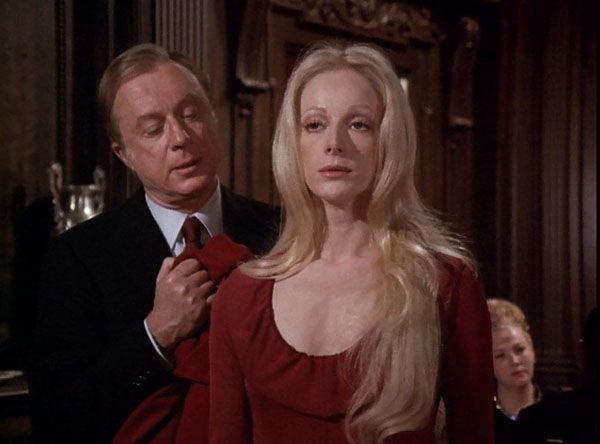
Sondra Locke plays Sheila, an imperiously beautiful young woman who lives with her busybody mother (Hermione Baddeley, who I recognized from Mary Poppins). She has a young (and unseen in the episode) suitor named John who she hopes will someday propose, but her mother is constantly encouraging her to date another, much older and wealthier fellow, a transparently creepy dude named Henry (Norman Lloyd). Henry is constantly bringing gifts and taking Sheila out to nice places, but Sheila isn’t into him and isn’t afraid to make that fact glaringly apparent.
Early in the story, Henry arrives to take Sheila out to dinner, and he brings her a gift of a weird-ass brooch that looks like a tiny, furry, red-eyed shrew with a gold pin and chain running through it. Sheila thinks it’s ugly and strange, but her mom encourages her to put it on her coat and go out to dinner with the creepy old man like a good girl. Now, because of how the brooch looks and because there’s a scene where Henry smiles leeringly at Sheila in the doorway and it looks like he has fangs, I thought Henry was going to turn out to be a vampire; the story is called “A Feast of Blood,” after all. But it turns out that’s not really what’s going on; it’s actually a bit weirder.
The pair go out to a fancy restaurant, and Henry basically tells her that John is probably never going to propose and she should throw in her lot with Uncle Creeper instead. Sheila dismisses him, saying she loves John whether he proposes or not, and that she isn’t going to change her mind about giving Henry a chance. Henry then makes the startling claim that he’s good at “everything,” a statement which Sheila mercilessly mocks, and he also reveals he has some kind of undisclosed “secret” that made him good at everything. He then tells Sheila about the brooch, and how it’s based on a very rare kind of mouse that’s similar to a bat (there’s that vampire thing again). He further says that the brooch has a special clasp that keeps it from falling off ever. When Sheila observes that he’s talking about the brooch as though it’s alive, he does a sinister Grinch smile and says, “Am I? How silly of me.” Hmm, wonder what all that’s about.
After ages of listening to this insufferable freak drone on and on, Sheila says she’d like to go home, please, and by the way, don’t call her for another date because it ain’t happening. Henry seems to be gracious and starts to drive her home, but he’s still trying to convince her to be with him and she is digging her heels in refusing him. Finally he stops the car and grabs her, forcefully trying to kiss her, and at this point she rightfully jumps out and tells him to fuck off, that she’ll be walking home even though she’s on a dark, lonely road out in the middle of nowhere. He basically tells her she made her choice, and peels off.
As she’s walking, we start to notice that her little mouse brooch seems to be moving of its own accord, slowly crawling up toward her face. When she realizes this, she wigs out and breaks into a run (though oddly doesn’t think to just shrug out of the coat that the brooch is attached to), but then we cut to a sudden shot of her with the brooch grown to roughly beach ball size, with its round red eyes like convex dinner plates. She screams as the giant brooch mouse partially eats her or drains her blood (I guess), and her mangled, bloody corpse is discovered a short time later by two drunks on bicycles. Probably not the way she imagined her life would end, slaughtered by a fuzzy, tacky, ambulatory accessory, but here we are.
In the coda, we see Henry sleazing up to another beautiful woman at a bar, and so the cycle starts anew. I’m not entirely sure where exactly he gets the mouse brooches from, what exactly they are or do, or why he thinks killing resistant women with them will result in him eventually finding a beautiful wife (if indeed that’s what his endgame is). But hey, in his defense, maybe he really is playing 5D chess here and I’m just too dumb to see it.
This one was fine, a touch silly in places and sort of out there, but still enjoyable. Henry was such an overt weirdo that I’m surprised he got any woman, hot or no, to give him the time of day, but maybe the magic behind the mouse brooches also made him appealing to the opposite sex (at least at first). I think I liked it about equally (or maybe slightly less) to the second story, even though they were completely different in tone.
Well, that wraps up episode 16; there are only six episodes left in season two, and I will get around to them all eventually before powering on to season three. Until then, keep it creepy, my friends.

