Sometimes you get in the mood for some good old-fashioned 1970s horror weirdness, and as you’ve probably surmised, I recently got into one of those exact moods. Earlier in the evening I had done a rewatch of the underrated 1978 haunted house flick The Evil (which we reviewed ages ago), and after it was over, I was scrolling through Tubi to see if there was something else along the same lines that I hadn’t seen before. And that’s when I landed on the 1973 Canadian film The Pyx.
I had heard the title before, and for a brief moment I thought I had already seen it, but after I fired it up, I realized I hadn’t, and that I must have confused it with the 1972 British film The Asphyx (which I did see and discussed at length here).
The Pyx is based on the 1959 novel of the same name by John Buell; efforts to do a movie adaptation of the book began back in the 1960s, with all kinds of big names attached, like director Curtis Harrington (Night Tide, Whoever Slew Auntie Roo?, Ruby) and actors James Mason, Ursula Andress, Catherine Deneuve, and Orson Welles.
By the time the movie got made, however, directing duties had transferred to film and TV producer/director Harvey Hart, and the roles of the main protagonists fell to two other big names, Karen Black and Christopher Plummer.
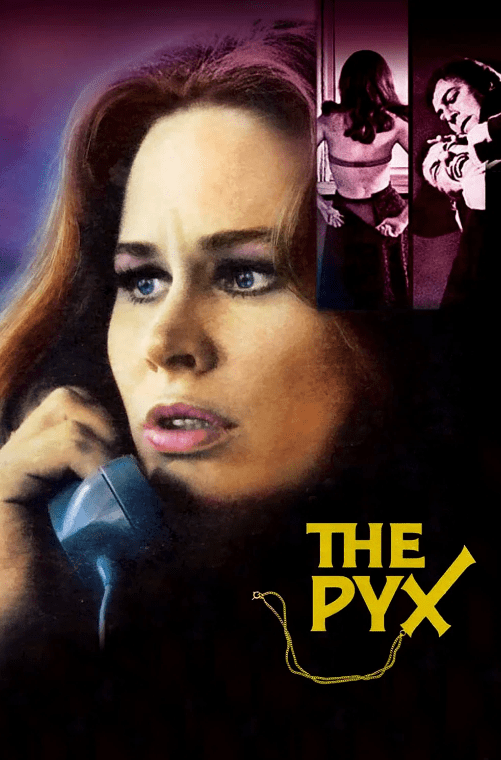
Just as an aside, I had no idea what a pyx was until I watched the movie, but turns out it’s the snazzy little round container that Catholic priests store the Eucharist wafers in. And before you ask, yes, a pyx is fairly instrumental to the story. As another aside, this movie is also known as La Lunule (the French name for a pyx, from what I could gather) or as The Hooker Cult Murders, which is not only a far more lurid title than the tone of this film deserves, but also gives away a significant aspect of the plot.
Shot entirely in Montreal and mostly in English but with a smattering of French here and there, The Pyx also features several original songs that were written and performed by Karen Black herself. The songs are actually pretty great, very sparse and creepy, sounding sort of like proto-gothic neo-folk. Opinions may differ, but I thought the songs really added to the languidly eerie pace of the film (which not gonna bullshit you, is relatively slow and jumps back and forth in time in a way that can sometimes be confusing, so just know that before going in).
At the very beginning of the movie, Karen Black’s character is already dead, having plummeted from the balcony of a penthouse apartment about nine or ten stories up. Detective Sergeant Jim Henderson (Christopher Plummer) is one of the first on the scene, and he notes that the woman is clad in a sheer white dress and wearing a large gold cross on a chain around her neck. There’s also a little pillbox situation clasped in her hand; it’s a pyx, but Jim doesn’t know what that is (despite being a former Catholic himself), so he just keeps it for evidence.
The shifty building superintendent (Jacques Godin) tells the police that no one lives in the apartment that the woman fell from; it’s owned by a company, he says, and people only stay there occasionally. Jim insists that someone must have noticed the woman in the building at some point, given the striking way in which she was dressed, but the super just clams up and says he doesn’t know anything.
Through some standard detective work, Jim and his partner, Detective Sergeant Pierre Paquette (Donald Pilon), discover that the dead woman is Elizabeth Lucy, who made her living as a sex worker and had a pretty pronounced heroin addiction. They also find out that she sometimes stayed in a large apartment occupied by her madam, Meg Latimer (Yvette Brind’amour), and a few other prostitutes.
Bad cop Pierre essentially threatens Meg with prison if she doesn’t talk, but this is clearly not her first rodeo and she isn’t intimidated, claiming all she knows is that Elizabeth went to meet a client unknown to her, and simply never returned. Meanwhile, good cop Jim gets a bit more scuttlebutt out of one of the other sex workers, who not only says that she’s sure Elizabeth was wearing a fancy black cocktail dress, not a see-through white shift, when she left, but that the cross necklace and pillbox thingie are not hers.
We then abruptly go into a flashback. The movie does this a lot, hopping around in the timeline and showing some scenes out of order, so you as a viewer kind of have to stay on your toes to suss out in what sequence these events occurred.
Anyway, Elizabeth is shown at a Catholic hospital type deal, and we eventually learn that she’s there to visit someone named Sandra (Louise Rinfret), against the wishes of the nuns. She finally talks them into allowing it, and though at first I thought that Sandra was her daughter, because she’s quite young, it turns out that this is another sex worker and heroin addict who is still a teenager and who Elizabeth is trying to help with her detox. Everything seems fine at first, but it’s obvious that Elizabeth is still an addict herself and can’t offer much consolation to the girl, despite the fondness she has for her. It’s also implied that Elizabeth is trying desperately to get her life back together, perhaps through reconnecting with her lapsed Catholicism, but this goal doesn’t appear to be working out.
Elizabeth goes back to Meg’s place, but Meg tells her that she needs to scram, because Meg has someone important coming over and she doesn’t want them to see Elizabeth shooting up. Elizabeth protests, but finally concedes that she’ll go do her business at her own apartment in a building across the street, which she is adamant that Meg not tell any of her clients about. Elizabeth shares her apartment with her best friend and confidante, a gay man named Jimmy (Terry Haig). By the way, it only just occurred to me that Christopher Plummer’s main character is named Jim and this side character here is named Jimmy. I wonder if that happened in the book too? It didn’t confuse me when I was watching the movie because Jimmy was only in a couple scenes, but that seems like it would have been pretty easy to avoid by just naming Jimmy Dave or something instead. Anyway.
The movie then jumps ahead again to (I think) the day after Elizabeth was found dead. Jim goes back to Meg’s to question the madam further, and walks into a bloodbath. Not only has Meg’s adorable black cat been killed and stuck to the door with a kitchen knife (ARRRRGGGHHHHHH), but both Meg and another sex worker have been brutally butchered.
Jim suspects that Elizabeth’s death was far more complicated than the simple suicide he’d initially believed it was, and that maybe some larger forces are at play. This suspicion is all but confirmed by Jimmy, who tells Jim that he’d had dinner with Elizabeth a few hours before her fatal fall, and she’d made cagey references to a rich new client with a yacht called the Mont Royal. Jimmy can’t quite remember the guy’s name, but Jim, who’d got the name from other sources, asks if the guy was called Keerson (Jean-Louis Roux). Jimmy confirms that this was indeed the case. He also reveals that when he and Elizabeth went for a ride a day or two before her death, they’d been followed by someone driving a black Cadillac, and that Elizabeth hadn’t been particularly surprised by this.
Because of the movie’s non-linear structure, we’ve already encountered Keerson and the man in the Cadillac, a slick ex-con named Herbie Lafram (Lee Broker). Madam Meg, you see, was contacted by Keerson through his lackey Lafram; Keerson was interested in procuring Elizabeth’s services, and money was no object. According to the Wikipedia plot synopsis, Keerson also owned the building in which Meg’s brothel was situated, but I don’t remember if this was stated outright in the film or just implied.
Despite Elizabeth apparently having never met Keerson before, she is extremely reluctant to accept the offer, no matter how much cash is put on the table. I’m not certain if Elizabeth had heard of Keerson through the grapevine and suspected what he was up to, or she was just trying to extricate herself from sex work altogether, but it takes quite a bit of convincing (and low-key intimidation from both Meg and Lafram) to get her to agree to the terms.
Lafram actually takes her out to Keerson’s moored yacht, and Keerson is just as unsettling as you might imagine. He tells Elizabeth to take her clothes off, but then he just sits on the sofa across from her and asks her questions about where she was born, who her parents were, and if she believes in God. Elizabeth sits there naked and answers them, evidently more humiliated by the situation than she would have been if the dude just wanted to have sex with her. He then sends her away.
At some point somewhere in here, Jim and Jimmy go to Elizabeth and Jimmy’s apartment, where someone ambushes them and shoots Jimmy dead before fleeing the scene. There’s also a later shootout between the police and Lafram out at the yacht, in which both Lafram and Jim’s partner Pierre are killed.
As you’ve probably figured out by now, Keerson is a Satanist (technically I think he’s also a defrocked priest) who is planning to use Elizabeth as the centerpiece (and likely sacrifice) of a Black Mass he’s conducting with his other occultist buddies. Meg (and the building superintendent) seem to have been in on the conspiracy from the beginning, and when the night of the Black Mass arrives, Meg even drugs Elizabeth’s drink with something or other to make her more compliant before dressing her in the sheer white shift and sending her off to the devil worshippers, whose nefarious little gathering is taking place in the penthouse apartment.
During the ritual, Elizabeth is placed on the altar and given the gold upside-down cross she was found with. The resplendently-attired Keerson then shows her the pyx and the single Eucharist inside, telling her that they now have to desecrate the host. By the way, the Wikipedia plot summary states that the host is already desecrated when he shows it to her, but this is wrong; I was under the impression that Keerson was going to desecrate the host by inserting it into Elizabeth’s vagina, since the cultists are shown parting her legs just before Keerson shows her the pyx. This may seem like an insignificant point, but it really isn’t, because the fact that the ritual didn’t go the way Keerson planned informs the whole meaning of the end of the movie.
Before the host can be desecrated, Elizabeth leaps off the altar and snatches the pyx, putting the wafer into her mouth, symbolically taking communion and reaffirming her faith. There’s then a struggle between her and Keerson that ends up out on the balcony, though it’s not entirely clear if Keerson pushes Elizabeth off the balcony to her death, or whether Elizabeth allows herself to fall before the ritual can be completed, thus thwarting whatever Keerson hoped to accomplish with the sacrifice. The second scenario actually makes more sense given the theme of the movie, but it did look more to me like Keerson had at least “helped” Elizabeth fall, so I’m not quite sure what to think.
Anyway, in the denouement, Jim finds Keerson lying on the altar at the penthouse apartment, alive but seemingly weakened (or at least that’s how I interpreted it). He says something about the power he obtained from going to the dark side, as it were, and he even seems to demonstrate psychic powers when he tells Jim that he knows that Jim was happy and relieved when his wife died (a statement that obviously hits a nerve). A disgusted Jim empties his pistol into the weird little Satanist, after which Keerson says that Jim “set him free” before keeling over dead.
The Pyx is a strange movie for sure; it’s very understated and slow-moving, with a narrative structure that can be frustrating if you aren’t paying attention. It’s classified as a horror movie, and it does have horror elements, but it’s more akin to a murder mystery; think of it like a very subdued mash-up of Klute and Rosemary’s Baby. The acting performances are great across the board, especially Karen Black, and the score gives it a desolate, spooky vibe that I really dug. It’s definitely not for everyone, but if you’re into subtle, bleak horror with a strong religious motif, few extraneous frills, and a cold, grimy, slightly off-kilter atmosphere, you might find a lot to like here.
Until next time, keep it creepy, my friends.

