Way back in the neon-colored mists of 1986, I was nothing but a fourteen-year-old weirdo navigating her unsteady way through eighth and ninth grades. Amid all the hairspray and hormonal meltdowns, though, a few choice horror movies managed to rise above the angsty fray, and I’ll talk about them momentarily. But first, as usual, aside from the favored five, I also have a small handful of honorable mentions, and here they are:
Ken Russell’s Gothic is inspired by the true events surrounding the famed “haunted summer” of 1816, whereby a gaggle of legendary figures (writers Mary Shelley, Percy Shelley, and Lord Byron; Byron’s physician John Polidori; and Mary Shelley’s stepsister Claire Clairmont) were confined by torrential storms inside Villa Diodati on the shores of Lake Geneva in Switzerland. Much drinking, drug-taking, philosophizing, and ghost story reading ensued, with Byron eventually proposing that each attendee write their own original ghost story. Most famously, Mary Shelley produced the first draft of the iconic Frankenstein, while John Polidori came up with a tale called The Vampyre, which was a massive influence on Bram Stoker’s later Dracula (published in 1897). Ken Russell’s cinematic version of this meeting of the minds is relatively restrained compared to the director’s usual fare, but is still pretty overheated and wild, featuring some trippy imagery (nipple eyes, anyone?) and entertaining turns from the stacked cast (which includes Julian Sands as Percy Shelley, Natasha Richardson as Mary Shelley, and Gabriel Byrne as Lord Byron). If you’re into Ken Russell’s emblematic freakouts and have a love for gothic literature, this one is a must-see.
House was the third film directed by Steve Miner (after Friday the 13th parts 2 and 3), and though it tends more toward comedy than horror (not as much as the sequel does, to be fair), it has some fantastically weird creature effects and is loads of fun overall. The story revolves around writer Roger Cobb (played by the Greatest American Hero himself, William Katt), whose son Jimmy vanishes under mysterious circumstances from his aunt’s house. Determined to discover what happened to the kid, Roger moves in and encounters all sorts of crazy phenomena, such as monsters in the closets, mounted swordfish that move around on their own, and bathroom mirrors to other dimensions. There’s also a great subplot featuring Roger’s old Vietnam buddy Big Ben (memorably played by Richard Moll), who seems to have returned from the grave to take revenge. While House is definitely more funny than scary, it does have some unsettling moments and an off-kilter vibe that has always been really endearing to me.
Speaking of horror comedies, I have to give props to Tobe Hooper for following up one of the best and most disturbing horror movies ever made (the 1974 Texas Chainsaw Massacre, of course) with something that went in almost the completely opposite direction. It would have been easy, in other words, to double down on the skin-crawling and visceral ambience of the original and simply continue the saga in that vein, but going wacky with it brought a whole other dimension to the madness. Whether you love it or hate it, Texas Chainsaw Massacre 2 was a ballsy-ass move, and I will always respect that. Pitting delightfully sassy DJ Stretch Brock (Caroline Williams) and doggedly unhinged former Texas Ranger Lefty Enright (Dennis Hopper) against the cannibalistic Sawyer clan in their underground lair (which they somehow have now), the film is far more zany, over the top, and ridiculously gory than the OG, and although this undercuts the horror to such a degree that it’s practically non-existent, I find I can’t be too mad at it because the whole movie is just such a blast from beginning to end. The addition of Bill Moseley as Chop Top probably has a lot to do with that, as he steals pretty much every scene he’s in, and rightfully became a horror legend in years to come.
Now, without further ado, on to the main event.
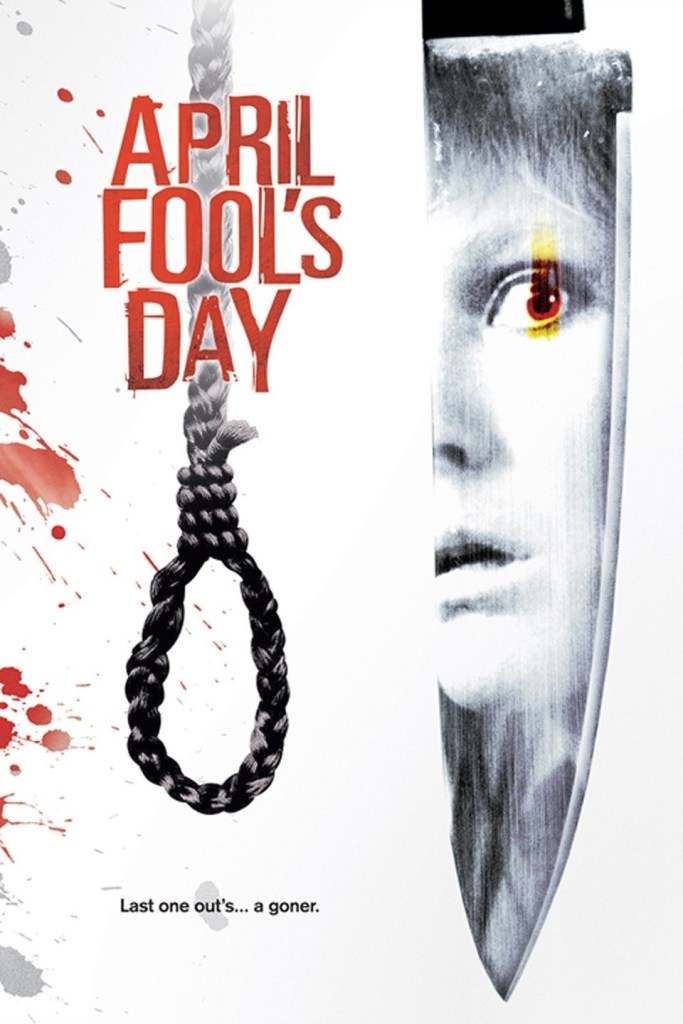
April Fool’s Day
I did a long breakdown of this movie here, so I’ll try not to repeat myself too much, but I definitely feel like this proto-meta slasher still doesn’t really get its due. It’s not excessively bloody, and modern audiences might be able to guess the twist before it happens, but I’ve always had such affection for the characters and dialogue in this one, and something about it stands out from some of the more generic examples of the subgenre, even given the fact that this is a slasher in which (spoiler alert) none of the victims really die.
We’re following a group of privileged, upper-middle-class college kids who have all been invited by their friend Muffy (Deborah Foreman of Valley Girl) to spend the April Fool’s Day weekend at her family’s remote island mansion. The gang consists of Nikki (Deborah Goodrich from Just One of the Guys), Rob (Ken Olandt from Summer School), Chaz (Clayton Rohner, also of Just One of the Guys as well as I, Madman), Kit (Amy Steel of Friday the 13th Part 2 fame), Arch (Thomas F. Wilson, otherwise known as Biff from the Back to the Future movies), Harvey (Jay Baker), and Muffy’s brother Skip (Griffin O’Neal), as well as a wallflower-type chick named Nan (Leah Pinsent), whose presence at the shindig is the source of much confused speculation.
We get to know these people through some funny, sparkling dialogue and interactions, but before long, some mighty weird shit begins to occur. Before they even get to the island, a deckhand named Buck (Michael Nomad) is horribly injured in an accident, putting the whole group in an unsettled mood. Once they get to the house, things seem fun at first, but start to get dark pretty quickly.
For one thing, they all fall victim to various pranks, some harmless and amusing but some straight up unsettling, suggesting that whoever engineered them knows their deepest secrets. And the morning after their arrival, their esteemed host Muffy seems to have changed personalities entirely, going from a bubbly, flirty sorority girl to a dowdy, awkward plain Jane who shuffles around in nurse shoes and can barely string a sentence together or look anyone in the eye.
Even more alarming, people start going missing and later turning up considerably less alive than they were when they got there.
When only Kit and Rob remain, they’re able to deduce that Muffy is in reality not Muffy at all, but her crazy twin sister Buffy, who has presumably escaped from an asylum somewhere and decided to go on a college kid killin’ spree.
But not so fast. Remember how I said that this was a slasher movie in which nobody actually died? Turns out that this whole multiple murder scenario was cooked up by Muffy, who actually doesn’t have a crazy twin sister at all, and who was testing an idea for a “murder mystery weekend” she planned to open on the family estate. As each victim was “killed,” they would be let in on the secret, until final girl Kit was the last one standing and got the whole explanation in front of her magically “resurrected” friends.
Although April Fool’s Day isn’t super gory and has a twist that might piss some people off, I absolutely love the vibe of this one, and that’s largely down to its excellent ensemble cast and entertaining script. I’ve always thought it was woefully underrated, and even a bit ahead of its time as well, though as always, your mileage may vary.
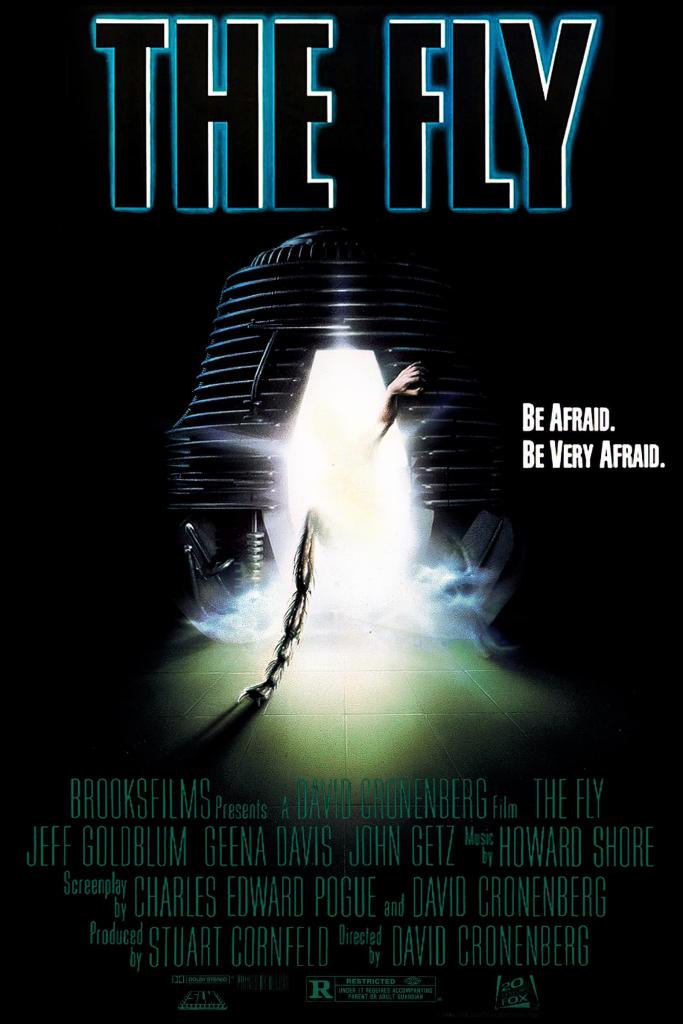
The Fly
I swear, only the legendary David Cronenberg could take an entertaining but cheesy 1958 low-budget sci-fi movie (which was actually based on a short story by George Langelaan) and turn it into not just one of the gooiest and most disgusting body horror films of the 80s, but also one of the most emotionally affecting. It was, further, Cronenberg’s most financially successful and most accessible film, garnering almost universally positive reviews and winning an honest-to-goodness Academy Award for Best Makeup.
Jeff Goldblum, in one of his career-best performances, plays a brilliant scientist named Seth Brundle, who, like the scientist in the original, is working on building a teleporter. Science journalist Ronnie Quaife (Geena Davis) becomes intrigued by his work and asks to write a feature on him, but in the course of this endeavor, the pair fall in love.
Seth is an appealingly weird dude from the outset, socially awkward but charming, the kind of eccentric genius who dresses exactly the same every day because he doesn’t want to waste brainpower deciding what to wear. His teleportation experiments are initially limited to inanimate objects because, as he eventually realizes, the computer doesn’t understand flesh. When he tries to transport a baboon, for example, the poor animal emerges as a screaming, inside-out meat pile, which is probably a pretty good indication that the technology still has a few bugs to work out (pun absolutely intended).
Eventually, though, Seth figures out that the computer needs to be taught how to interpret living tissue rather than merely reconstruct it, and after another experiment successfully teleports a second baboon with seemingly no harm to the animal, he’s understandably thrilled. He’s solved one of the most impossible problems imaginable and is standing on the verge of completely transforming human civilization.
Unfortunately, Seth is also insecure as hell. When Ronnie leaves one evening to confront her sleazy ex-boyfriend and editor Stathis Borans (John Getz), Seth gets drunk, becomes convinced she’s gone back to Stathis romantically, and decides that right now would be an excellent time to teleport himself. What he doesn’t realize is that a small housefly has entered the telepod with him. The computer, presented with two separate organisms where it was expecting only one, does the most computer-like thing possible and decides to solve the problem by combining them at the genetic level.
Seth emerges looking perfectly normal. For a while, he actually seems better than normal. He suddenly possesses ridiculous amounts of energy, strength, agility, and sexual stamina. He’s constantly hungry, rarely sleeps, and can perform gymnastics that would make an Olympic athlete tell him to settle the fuck down. Seth naturally concludes that teleportation has somehow purified him, removing all the unnecessary weakness and imperfection from his body. This period is one of my favorite parts of the movie because Goldblum gradually shifts Seth from quirky and lovable to manic and genuinely frightening without flipping some obvious switch. The transformation initially looks like an upgrade, but his personality is changing right along with his body. He becomes arrogant, aggressive, hypersexual, and increasingly contemptuous of ordinary human beings, whom he dismissively refers to as nothing more than “insect politicians.” Ronnie, understandably, begins to suspect that something has gone very, very sideways.
And then Seth starts literally falling apart. His fingernails loosen and come off. His skin develops hideous lesions. His teeth begin falling out. Weird coarse hairs sprout from his back. His face changes shape. Eventually, after digging through the teleportation records, Seth discovers exactly what happened: the computer didn’t simply transport him alongside the fly. It fused the two creatures together molecule by molecule.
What follows is essentially a prolonged death scene stretched across the second half of the movie, and this is where The Fly becomes something much sadder and more disquieting than a conventional monster film. Seth doesn’t simply turn into a giant bug overnight. He’s forced to watch his own body betray him incrementally, piece by piece, knowing that there’s nothing he can do to stop it.
There’s something uniquely horrifying about the way Cronenberg approaches this deterioration. The gross-out effects are spectacular, obviously, but they’re rarely there just for shock value. Seth carefully storing his fallen teeth and fingernails in the medicine cabinet—his little collection of “Brundle Museum of Natural History” artifacts—is funny in a morbid way, but it’s also incredibly sad. He’s cataloguing the pieces of himself as they disappear.
And the film somehow keeps finding new ways to make the transformation worse. Seth eventually realizes that his digestive system has changed so drastically that he can no longer eat solid food normally. Instead, he has to vomit corrosive enzymes onto his meal, dissolve it externally, and suck up the resulting sludge. Lovely.
Later, he demonstrates this process on Stathis in one of the movie’s nastiest sequences, dissolving the poor bastard’s hand and foot after Stathis tries to stop him from forcing Ronnie into the teleporter. By that point Seth’s transformation has accelerated dramatically, and whatever human restraint he once possessed is rapidly disappearing.
Yet what’s so remarkable about Goldblum’s performance is that Seth never completely stops being Seth. Even beneath Chris Walas’s increasingly elaborate makeup effects, there’s still enough of the sweet, strange scientist we met at the beginning for us to mourn what he’s becoming. At one point, Seth even gives Ronnie a warning about the thing he’s turning into, explaining that insect psychology isn’t built around concepts like compassion, compromise, or diplomacy. He understands that his humanity is slipping away and is frightened by it, even as another part of him becomes increasingly fascinated by his own evolution. That’s the real tragedy of The Fly: Seth is both victim and scientist right up until the end. He’s horrified by what is happening to him, but he also can’t stop studying it.
Things become even more complicated when Ronnie discovers that she’s pregnant and has no idea whether the child was conceived before or after Seth’s genetic fusion. This leads to one of the film’s most memorably disgusting sequences, in which Ronnie dreams that she gives birth to a gigantic squirming maggot. Again: lovely.
Terrified that the fetus might somehow be carrying Seth’s mutations, Ronnie decides she wants an abortion, but Seth finds out and abducts her before the procedure can take place. By this stage, his thinking has become completely warped. Rather than simply wanting Ronnie back, he devises a horrifying plan to use the telepods to fuse himself, Ronnie, and their unborn child together into a single supposedly perfect organism. This is where Seth’s tragedy finally tips fully into monster territory.
Many critics and film scholars at the time noted that Seth’s deterioration could be read as a metaphor for AIDS, which was understandably looming heavily over the culture in 1986. Cronenberg went on record as saying that he saw the transformation more broadly, as analogous to aging, cancer, or really any process in which the body begins changing in terrible ways beyond a person’s control. AIDS certainly fits comfortably within that interpretation, but the horror is ultimately more universal than any single disease.
Because of the love story at the heart of the film, The Fly packs quite an emotional wallop too, and Geena Davis’s performance really sells the heartbreak. Ronnie isn’t merely watching some creature become dangerous; she’s watching the man she loves disappear in front of her while flashes of him continue to surface inside the monster.
The finale is absolutely grotesque, with the last remnants of Seth’s human body sloughing away to reveal the fully transformed “Brundlefly” underneath. During the struggle, he becomes accidentally fused with part of the telepod itself, resulting in one final hideous incarnation that’s equal parts human, insect, and machinery.
And then comes the moment that absolutely wrecks me. The creature crawls toward Ronnie, grabs the barrel of her shotgun, and deliberately raises it to its own head. There’s still enough Seth left inside to understand what he’s become. Ronnie pulls the trigger.
It’s a devastating ending precisely because Cronenberg never lets the spectacle overwhelm the tragedy. We’ve spent the whole film watching these two people fall in love, and no amount of slime, acid vomit, torn-off jaws, protruding insect limbs, or exploding flesh can obscure the fact that this is ultimately a story about losing someone while they’re still standing right in front of you.
This many years later, The Fly is still a brilliant film, with outstanding acting performances that give the story real stakes and power, and incredible special effects that still look amazing today. Plenty of body horror movies can make you squirm, and plenty of tragic romances can make you cry, but very few can make you do both within about thirty seconds of each other. The Fly does. And that, more than all the glorious goo, is why I think it’s endured.
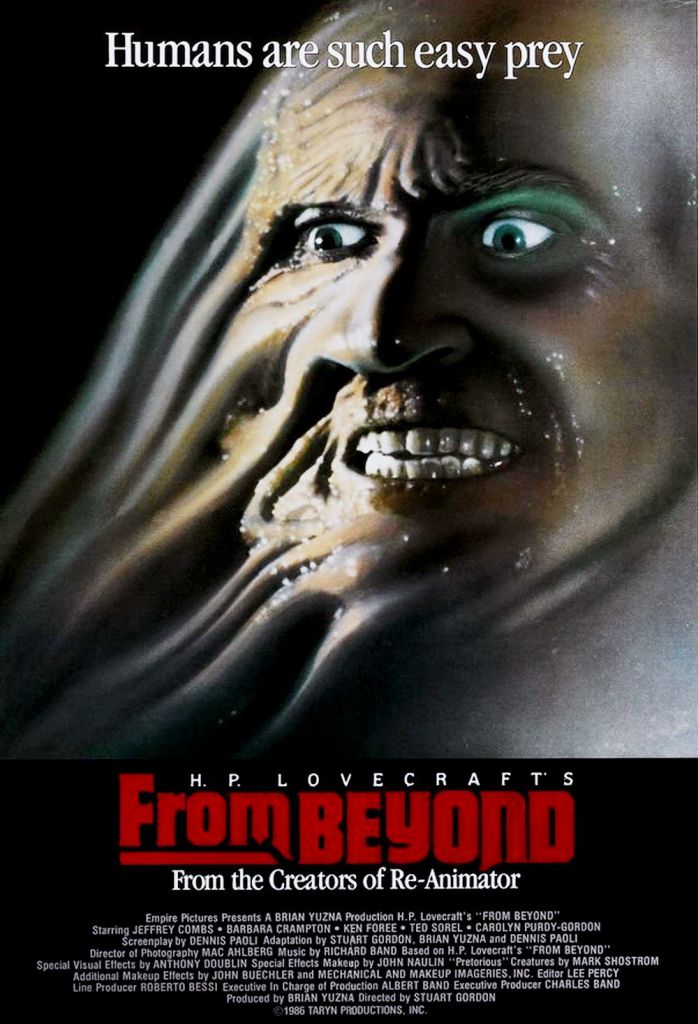
From Beyond
After the smashing success of 1985’s Re-Animator, director Stuart Gordon decided to stick with a winning formula, following up with another loose H.P. Lovecraft adaptation prominently featuring national treasures Jeffrey Combs and Barbara Crampton (albeit playing different roles). And while Re-Animator was packed to the gills with over-the-top gore and evisceration, From Beyond goes slightly more surreal and cosmic with it, showcasing some incredible body horror mutations designed and executed by no less than four different effects teams.
The story centers on the fabulously named Crawford Tillinghast (Jeffrey Combs), an extremely nervous scientist who has been assisting the decidedly less nervous (and considerably more perverted) Dr. Edward Pretorius (Ted Sorel) with a machine called the Resonator. The device stimulates the pineal gland, supposedly a dormant sensory organ, and thereby allows anyone within its range to perceive an entire dimension of reality that’s normally invisible to human beings. Unfortunately, there’s a fairly significant downside: once you can see the things inhabiting this other dimension, they can also see you.
We discover all this after an experiment goes spectacularly tits-up, leaving Pretorius decapitated and Crawford gibbering to the police about creatures floating around in the air and eating people’s heads “like a gingerbread man,” in one of the film’s most iconic lines. Crawford is naturally hauled off to a mental institution, where he’s eventually examined by psychiatrist Dr. Katherine McMichaels (Barbara Crampton). Rather than dismissing his story outright, Katherine notices that his pineal gland has actually become enlarged, which lends at least a little scientific credence to his otherwise batshit account of what happened. Against Crawford’s extremely emphatic objections, she decides they should return to Pretorius’s house and fire up the Resonator again to see what’s what. They’re accompanied by detective Bubba Brownlee (Ken Foree), who is understandably skeptical about the whole thing but agrees to play babysitter while the two scientists poke the interdimensional bear, so to speak.
Once the Resonator gets humming, the room fills with squiggly, eel-like creatures swimming through the air, and the supposedly dead Pretorius reappears in a considerably altered form. Evidently death has agreed with him, because he’s now able to manipulate his body into all kinds of increasingly disgusting configurations and has become even more obsessed with sensation, sex, and the possibilities of the mysterious realm “beyond.” Crawford wants absolutely nothing to do with any of this, but Katherine becomes fascinated by it to a dangerously obsessive degree, particularly since stimulation of the pineal gland seems to awaken all sorts of previously suppressed appetites. This culminates in the stunning Barbara Crampton sashaying around in bondage gear, which not gonna lie, is worth the price of admission all by itself (hubba hubba, in other words).
The film quickly descends into a delirious parade of mutations, slimy appendages, exposed brains, flying flesh-eating monstrosities, and bodies stretching and reassembling themselves in ways that bodies were very much not intended to do. Pretorius becomes less and less recognizably human every time he appears, while Crawford undergoes a pretty gnarly transformation of his own, eventually developing a protruding pineal gland that pops out of his forehead like the world’s most upsetting antenna (or penis). The poor bastard also develops a craving for human brains, which he satisfies by sucking gray matter out through his victims’ eye sockets.
Like Re-Animator, From Beyond has a gleefully adolescent interest in combining sex and viscera, though the mixture feels somewhat darker here. The Resonator doesn’t merely expose another dimension; it seems to strip away inhibition and turn desire into something ravenous and grotesque. Katherine’s transformation from buttoned-up psychiatrist into leather-clad sensation seeker is certainly not what anyone would call subtle, but Crampton commits to the escalating insanity so completely that she makes it work. And Jeffrey Combs is equally fantastic, playing Crawford as a completely different flavor of mad scientist than Herbert West. West usually seems delighted by whatever horrible thing his experiments produce, whereas Crawford spends most of From Beyond looking like a man who has peered behind the curtain of reality and desperately wishes he could un-peer.
Ken Foree is great too, and Bubba’s relative normalcy gives the movie some much-needed grounding. In a house full of people getting increasingly excited about enlarged pineal glands and alternate dimensions, he’s essentially the only person with enough sense to suggest that perhaps everyone should stop turning on the goddamn machine. Naturally, being the sensible guy in an eighties horror movie does not work out particularly well for him.
From Beyond might not have quite the same cultural footprint as Re-Animator, but I’ve always loved it nearly as much. It’s got the same Gordon/Yuzna combination of intelligence, sleaze, black humor, and absolutely revolting practical effects, but it’s also stranger and more dreamlike, drenched in lurid pink and purple light and operating according to the logic of some horny cosmic nightmare. Add in Combs, Crampton, Foree, and Sorel chewing what’s left of the scenery, and enough latex monstrosities to keep several effects shops working overtime, and you’ve got one of the weirdest and most lovable horror freakouts of 1986.
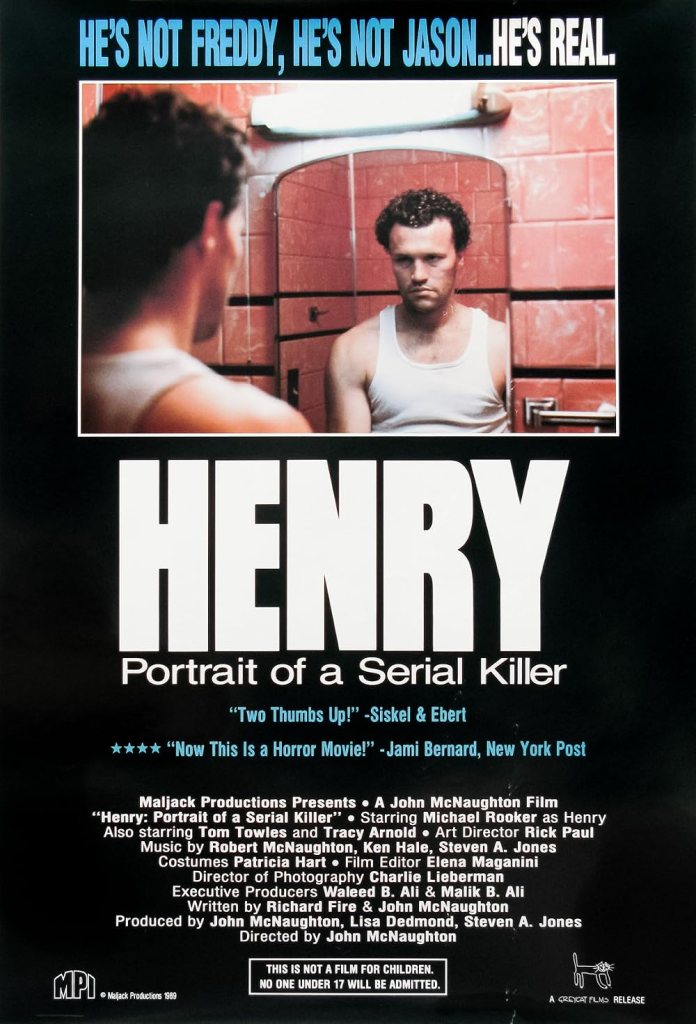
Henry: Portrait of a Serial Killer
Easily one of the most horrifyingly realistic serial killer films ever made, the John McNaughton-directed Henry not only took some inspiration from the real-life crimes of scumbag murderers (and compulsive liars) Henry Lee Lucas and Ottis Toole, but also boasts one of the most astonishing and chilling acting performances in all of horror, in the form of the magnificent Michael Rooker as the titular Henry.
Rooker plays Henry as a soft-spoken, emotionally blank drifter who has recently moved in with his old prison buddy Otis (Tom Towles) in a shitty little Chicago apartment. By day, Henry works sporadically as an exterminator; by night (or afternoon, or whenever the mood strikes, really), he murders people. There doesn’t seem to be much rhyme or reason behind his victim selection, either. Sometimes he follows a woman home from a shopping mall, sometimes he picks up a hitchhiker, sometimes he simply sees an opportunity and takes it. Murder isn’t presented as some grand compulsion or elaborate ritual for Henry; it’s just something he does, with roughly the same level of emotional engagement that another person might bring to stopping for cigarettes on the way home.
Into this exceedingly grim domestic arrangement comes Otis’s sister Becky (Tracy Arnold), who’s fled an abusive husband back in Texas and needs somewhere to stay. Becky is sweet, vulnerable, and tragically accustomed to being treated like shit, and she takes an almost immediate liking to Henry, apparently mistaking his quiet reserve for gentleness. In fairness, Henry actually is comparatively gentle with her, particularly when placed next to the profoundly sleazy Otis, whose behavior toward his own sister gets creepier and more sexually aggressive as the film goes along.
But let’s not get carried away and start thinking Henry has secretly got a heart of gold buried somewhere under all that sociopathy. McNaughton is far too smart for that shit.
One of the things that makes Henry so unnerving is how deliberately it avoids the usual cinematic mythology surrounding serial killers. Henry isn’t Hannibal Lecter, delivering witty monologues and moving in upper-crust artistic circles and constructing elaborate tableaus with his victims. And he isn’t some masked boogeyman lurking in the shadows like in a slasher movie. He’s just some guy. He drives around. He eats dinner. He sits on the couch. He makes small talk. And occasionally he brutally murders somebody before going about the rest of his day. The movie’s grubby, low-budget look only adds to the effect, giving everything an almost documentary-like ugliness that makes you feel less like you’re watching a horror movie than accidentally witnessing something you were never supposed to see.
Things get even worse once Henry decides to bring Otis along on one of his outings. After the pair murder two men together, Henry essentially starts teaching Otis how to be a serial killer, explaining that the trick is to constantly change your methods so the police can’t establish a pattern. Shoot somebody this time, stab somebody next time, strangle somebody after that. Different victims, different weapons, different locations. Keep moving. Otis, being an enthusiastic piece of human garbage, takes to the hobby with alarming gusto.
This leads to the movie’s most infamous sequence, and one that still packs an absolutely sickening punch today: the home invasion. Henry and Otis break into a suburban house and murder an entire family while recording the attack on a stolen video camera. Horrifying enough on its own, sure, but McNaughton makes the scene infinitely worse by showing us Henry and Otis afterward, sitting casually on their couch and watching the footage on television. Otis even rewinds it because he wants to see it again. Jesus Christ.
There’s no dramatic music telling us how appalled we’re supposed to be, no heroic intervention, and no last-minute escape for the victims. The scene simply unfolds with the same awful matter-of-factness that characterizes the rest of the film, forcing the audience into the deeply uncomfortable position of watching two killers watch themselves commit murder. It’s an incredibly effective bit of cinematic voyeurism, particularly given that home video technology was still relatively novel at the time.
Meanwhile, Becky’s growing affection for Henry creates an interesting tension because, despite everything we’ve already seen him do, the movie almost (but not quite) gets us wondering whether there’s some tiny fragment of humanity left in the guy. She confides in him about the abuse she’s suffered, and Henry opens up about his own horrific childhood and the murder of his mother, though even his account of that changes depending on when he tells it. Becky eventually tells Henry that she loves him, and for a fleeting moment it seems possible that perhaps this weird little connection between two profoundly damaged people might actually mean something.
Then Otis attempts to rape Becky, Henry catches him in the act, and the resulting fight ends with Otis very, very dead. Henry subsequently chops up his body in the bathtub, because even the closest thing this movie has to an act of heroism inevitably winds up involving dismemberment.
Henry and Becky dispose of Otis’s remains and leave Chicago together, apparently planning to head west and eventually send for Becky’s daughter. Becky confesses her love again, and Henry awkwardly tells her that he guesses he loves her too. If this were almost any other movie, this would be the beginning of some fucked-up redemption arc, with Henry abandoning his murderous ways and attempting to build a life with someone who somehow managed to reach him. However, this is not almost any other movie.
The following morning, Henry checks out of their motel alone. He drives for a while, eventually pulls over alongside the highway, takes Becky’s bloodstained suitcase out of the car, leaves it sitting in a ditch, and drives away. And that’s it.
That ending is one of the bleakest gut punches in horror because it obliterates whatever faint hope we’d allowed ourselves to entertain about Henry. Becky wasn’t special. Whatever affection he might genuinely have felt for her wasn’t enough to override what he fundamentally was. There’s no climactic showdown, no police finally closing in, no punishment, and not even any real explanation. Henry simply dumps the evidence and continues down the road, presumably toward another town and another collection of people unfortunate enough to cross his path.
And that’s ultimately what makes Henry: Portrait of a Serial Killer so goddamn disturbing. Plenty of horror movies are gorier, more sadistic, or more explicit, but very few feel this plausible. McNaughton strips away almost everything remotely entertaining about the cinematic serial killer and leaves us with an emotionally vacant man whose violence is random, ugly, and horrifyingly mundane. Michael Rooker is phenomenal in the role, never overselling Henry’s menace because he doesn’t have to; the coldness is right there in his eyes, even when he’s being polite or seemingly affectionate. Tom Towles is equally terrific as the repellent Otis, and Tracy Arnold brings a heartbreaking vulnerability to Becky that makes the ending land even harder.
Interestingly, although Henry was filmed in 1986, it spent several years languishing in release limbo, partly because of its battles with the ratings system, and didn’t receive its wider theatrical release until 1990. In a way, though, that almost seems appropriate. The movie feels like something that shouldn’t have gotten out in the first place: a grimy little artifact somebody found in a box and probably should have left there. It’s an extraordinary film, but “enjoyable” isn’t remotely the word I’d use for it. Henry is the kind of horror movie you admire, feel slightly contaminated by, and then carry around in the back of your head for years afterward.
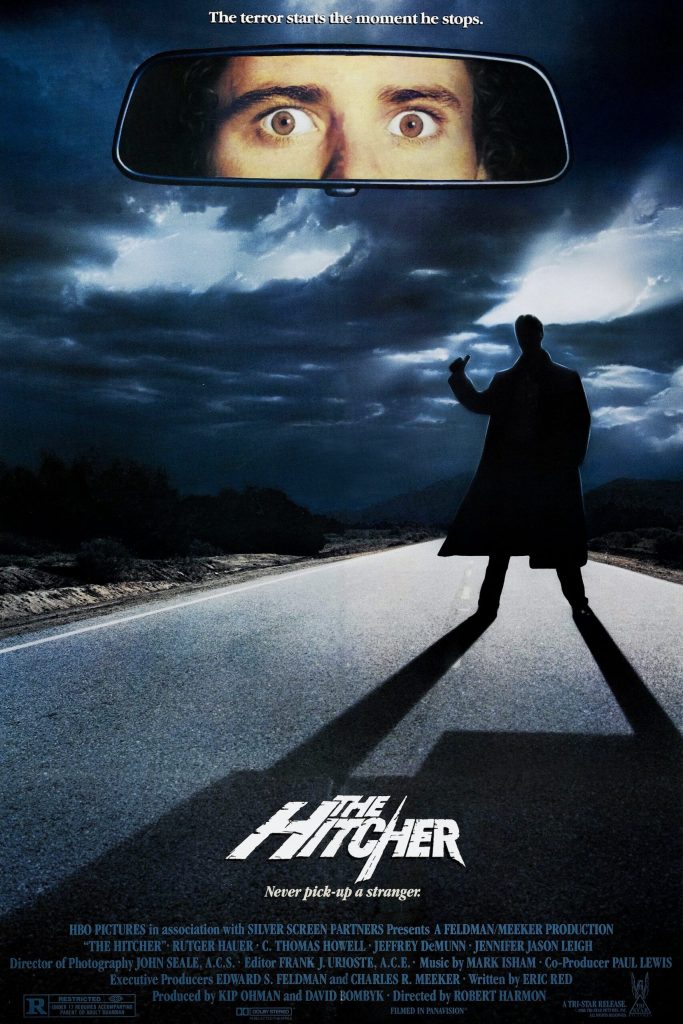
The Hitcher
Although this one had enough of a following to merit a remake in 2007 (that I admit I haven’t seen), I feel like I don’t hear that many people talk about the 1986 original, which for my money is one of the best, most suspenseful highway thrillers ever made, despite its rather lukewarm reception at the time of its release. A lot of its effectiveness is down to the terrifying presence of Rutger Hauer as Ryder, a relentless psychopath who begins menacing an innocent young man who gives him a ride, seemingly for no reason other than pure evil.
Jim Halsey is played by C. Thomas Howell, who was only nineteen or so when the movie was made, and his comparative youth is important to the whole dynamic. He’s not some hardened action hero or grizzled cop; he’s basically just a kid delivering a car from Chicago to San Diego, trying desperately to stay awake during a lonely nighttime drive through West Texas. When he spots a bedraggled hitchhiker standing in the rain, he makes the fatal mistake of deciding to be a decent human being and picks him up.
The hitchhiker, John Ryder, is initially quiet and weird, but things escalate after they pass a broken-down car on the side of the road. Ryder casually informs Jim that he murdered the driver and plans on doing the same thing to him, pulling out a knife and making various deeply unhelpful observations about what happens to human body parts when you fuck them up. Jim understandably begins shitting bricks, but when he notices that Ryder hasn’t fastened his seat belt and the passenger door isn’t completely closed, he manages to shove the psycho out of the moving car. And that should be the end of that. Obviously, it isn’t.
One of the things I love most about The Hitcher is how quickly it transforms from a fairly straightforward “picked up the wrong stranger” thriller into something closer to an existential nightmare. Ryder starts appearing everywhere. Jim sees him riding in the back of a family station wagon and frantically tries to warn them, only to discover them slaughtered shortly afterward. Ryder steals Jim’s car, gives it back, steals other vehicles, blows shit up, murders cops, and generally materializes at exactly the right moment to make Jim’s life considerably worse. His apparent ability to be everywhere at once is never explained, and that’s precisely why it works. Ryder barely even feels like an actual human being after a while. He’s more like some malevolent force that has arbitrarily selected Jim for a prolonged psychological torture session.
The exact reason for this fixation is left tantalizingly vague. Early on, when Jim desperately asks Ryder what he wants from him, Ryder simply tells him, “I want you to stop me.” It’s probably the closest thing the film ever offers to a motive, and even that raises more questions than it answers. Does Ryder genuinely want Jim to kill him? Does he recognize something in Jim and decide to test him? Is the entire ordeal some grotesque attempt to turn this innocent kid into someone capable of violence? Or is Ryder simply fucking with him because that’s what Ryder does?
Whatever the case, Jim quickly finds himself not only being hunted by Ryder, but being framed for Ryder’s increasingly impressive body count. This is another thing the movie does incredibly well: every time Jim seems to reach safety, the ground immediately drops out from under him again. He gets to the police, only for them to assume that he’s the murderer. He’s locked in a cell, falls asleep, and wakes to discover that Ryder has somehow gotten into the station, murdered everybody, and left Jim sitting there amid the carnage looking extremely guilty.
Jim escapes, because what the hell else is he supposed to do, and eventually crosses paths with Nash (Jennifer Jason Leigh), a waitress at a roadside diner who initially has no particular reason to believe his insane story. Thankfully, she gradually realizes that Jim is telling the truth, and the two of them end up on the run together while the police continue chasing Jim and Ryder continues playing his seemingly endless game.
Jennifer Jason Leigh is great in what could easily have been a thankless role. Nash isn’t around merely to scream or become a romantic reward for Jim; she’s one of the only people who believes him and treats him like a human being once the entire world seems to have decided he’s some kind of homicidal lunatic. Her presence briefly introduces the possibility that Jim might actually have found an ally and that the movie might be shifting into something slightly less relentlessly bleak.
Yeah. About that.
The sequence involving Nash and the two tractor-trailers is probably the thing most people remember from The Hitcher, and for very good reason. Ryder kidnaps her and ties her between the two trucks, with one wrist and ankle attached to one vehicle and the others attached to the second. Jim is brought to the scene while the police surround Ryder, who’s sitting behind the wheel of one of the trucks with his foot controlling whether or not the vehicles pull apart.
It’s an absolutely diabolical setup because Jim is given what appears to be an opportunity to kill Ryder and save Nash, but he can’t bring himself to pull the trigger. Ryder knows he won’t. And then, without the movie needing to wallow in gore or even explicitly show what’s happening, Ryder simply accelerates.
Holy fucking shit.
Even all these years later, that scene is brutal as hell, largely because director Robert Harmon knows that what we’re imagining is far worse than anything he could have put onscreen. Jennifer Jason Leigh’s terrified expression, Jim’s helplessness, the sound design, and Hauer’s eerily calm demeanor do all the heavy lifting. It’s one of those horror movie deaths where the actual violence is mostly withheld, yet the implication is so awful that it feels far more graphic than plenty of things that show you every last dangling intestine.
It’s also the point where whatever innocence Jim still had left gets pretty comprehensively obliterated. By this stage, Ryder has accomplished something much more disturbing than merely terrorizing him: he’s essentially remade Jim in his own image. The frightened kid who initially couldn’t bring himself to kill another human being is gradually replaced by someone hardened, furious, and increasingly capable of meeting Ryder on his own terms. When Ryder is finally apprehended, even the police seem to understand that something bizarre and deeply personal has developed between the two men.
Jeffrey DeMunn turns up as Captain Esteridge, one of the first authority figures to actually believe Jim’s story, but even his intervention can’t bring things to a conventional conclusion. Ryder escapes custody, naturally, because apparently ordinary earthly restraints are merely suggestions to this guy, and once again starts killing everyone in his vicinity. By that point Jim seems almost resigned to the fact that nobody else is going to end this. So he does.
After a final highway confrontation, Jim deliberately runs Ryder down and then finishes him off with a shotgun. Ryder, even mortally wounded, still seems almost amused by the whole thing, as though this was exactly the outcome he’d been engineering from the moment he climbed into Jim’s car. And maybe it was.
That’s one of the reasons the ending works so well for me. Killing Ryder doesn’t really feel like a victory. Jim survives, technically, but the cheerful kid we met at the beginning is long gone. The film even bookends itself with the striking of a match, visually linking Jim to the man who has spent the entire movie tormenting him. Ryder may finally be dead, but whatever he wanted to awaken in Jim appears to have been successfully awakened.
Rutger Hauer is fucking amazing throughout, and I honestly think John Ryder belongs in the conversation with the great horror villains of the eighties. Hauer hardly raises his voice, doesn’t have much dialogue, and isn’t given some elaborate tragic backstory explaining why he’s such an asshole. He simply radiates menace. That huge smile of his can shift from oddly charming to absolutely terrifying with almost no visible change in expression, and his icy blue stare gives Ryder an unsettling quality that’s simultaneously human and otherworldly.
C. Thomas Howell deserves a lot of credit too, because the movie only works if we buy Jim’s steadily increasing exhaustion and terror. He spends most of the running time being beaten up, chased, falsely accused, shot at, psychologically tortured, and deprived of sleep, and by the end he genuinely looks like somebody who’s been dragged through hell behind a speeding semi.
The cinematography is another huge part of why The Hitcher has stuck with me. The wide-open desert landscapes should theoretically feel liberating, but instead they make Jim seem horribly exposed. There are miles and miles of empty highway in every direction, yet Ryder somehow keeps turning up. The road itself becomes this endless liminal space where the usual rules don’t seem to apply, dotted with lonely diners, gas stations, motels, police outposts, and random stretches of nothing where absolutely nobody is coming to help you.
The Hitcher received a pretty hostile response from some critics in 1986 (Roger Ebert famously despised the thing, for some unfathomable reason), but time has been much kinder to it. And I think that’s deserved, because underneath all the explosions, car crashes, and serial-killer theatrics is a genuinely eerie little nightmare about a random encounter that destroys one person’s entire sense of safety. Ryder has no meaningful motive, no discernible history, and seemingly no goal beyond forcing Jim to participate in whatever fucked-up game he’s devised. That’s what makes him so frightening. There’s nothing to understand. Sometimes you’re just driving down a dark road, you see somebody standing in the rain, and you make one bad decision that fucks up your life forever. That’s the very definition of effective horror.
Well, 1986 is in the can, but we’ve still got a long (LONG) way to go, so keep watching this space. Until next time, keep it creepy, my friends.

