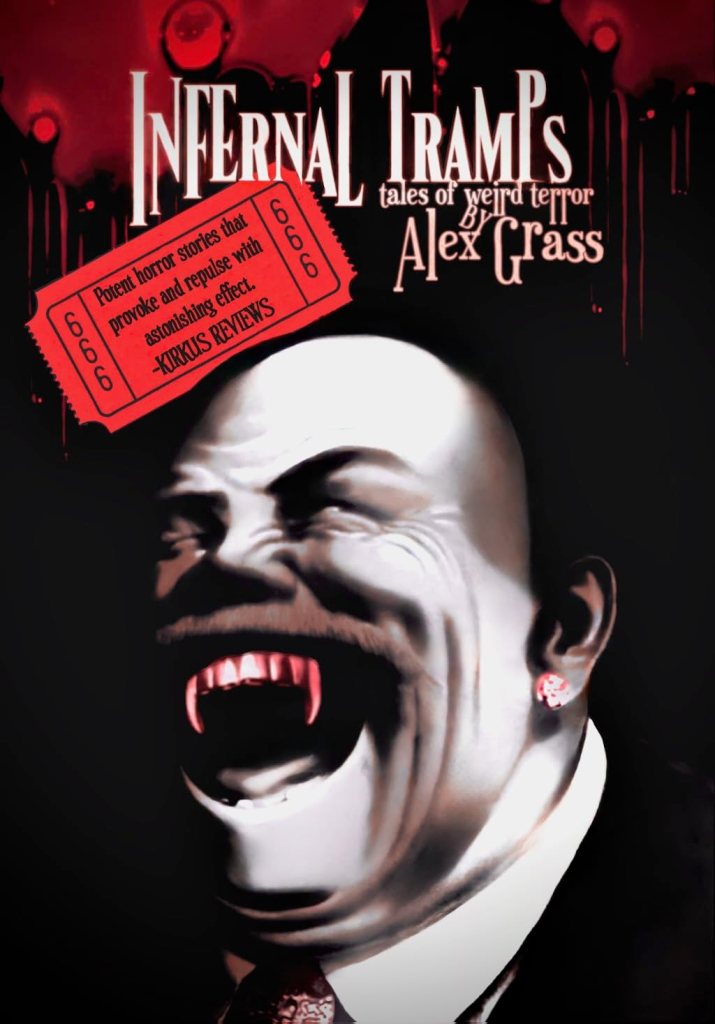
Pennsylvania-based author Alex Grass recently contacted me and generously offered to send me an honest-to-goodness print version of his latest work for review, a short story anthology of weird fiction titled Infernal Tramps. This appears to be Alex’s fifth book, and was published very recently, in mid-July of 2026.
Comprised of tales of varying lengths (including some flash fiction and short vignettes), Infernal Tramps is categorized as weird terror, mixing body horror, creature features, sci-fi-tinged dread, and a strong undercurrent of esoteric, almost alchemical unease. Less like standard horror stories and more like slow-burn, sometimes apocalyptic nightmares, the book isn’t for everyone (as nothing is), but it should appeal specifically to fans of Thomas Ligotti, early Clive Barker, Brian Evenson, or Eric LaRocca, so if you’re on that wavelength, then you will probably love this.
I will say from the jump that Alex Grass has a real gift for visceral, tactile prose that makes the grotesque feel intimate and inescapable. You can practically smell the rot, feel the slime, and hear the wet sounds of transformation. The overarching feel of all the tales prioritize atmosphere, moral decay, and that queasy feeling that the world is fundamentally wrong in some way, often leaving things vague or open to interpretation.
The stories often center characters who are already on the margins, like desperate drifters or lonely misanthropes, and then drops them into situations where the monstrous isn’t just external; it’s growing inside them or already wearing their face. The ambiguity and almost eschatological vibe of most of these stories also reminded me of another short story collection I reviewed a while back, 2022’s Spontaneous Human Combustion by Richard Thomas, now that I’m thinking about it.
The opening piece, “The Tezcat Apparatus,” is very short but throws you into this bizarre world right away, and actually ended up being one of my favorite stories in the bunch. We have a folksy old blind salesman (or is he?) showing up at a presumably rural man’s home with the titular device, a pest control thingamabob which will supposedly stop all the local critters from munching on the vegetables in the garden. The salesman, whose appearance subtly changes over the course of the story, offers to install the apparatus for free as part of a “test program.” The device seems to do what’s advertised, but the first weekly maintenance visit reveals something far more sinister is going on, the details of which are hinted at but largely left to the reader’s imagination. The whole feel of this one really appealed to me, and got me invested in the book right away.
“Pujkamaunka Splash” is another highlight, being a nostalgic, creeping story about a kid in 1993 obsessed with a supposedly legendary video game that no one else seems to remember. The kid is taken by his grandfather to stand in line to buy this game when it’s released, but the story very quickly curdles into something much darker involving a wishing well, pit bulls, possible murder and dismemberment, and a sense that memory itself might be the unreliable narrator. It had an appealing lost-media creepypasta energy but was executed with far more literary bite and emotional weight.
The title story, “Infernal Tramps,” was also a standout, a longer work revolving around reclusive, whiskey-soaked bum living near abandoned railroad tracks who witnesses a phantom caboose materialize out of the mist. From it emerges a towering, hunchbacked mother creature who drops off a grotesque infant with an oversized mannequin-like head and a collagen exoskeleton. The lonely and strangely compassionate drifter, for whatever reason, feels compelled to essentially adopt the “baby” and tries to raise it. It soon transpires that there are more of these infants out there, who soon grow into carrion-eating adults, speak German to one another, and may have likewise been dropped off the phantom train to be raised by others on the margins of society.
I also need to mention “Meeting Ivor Voëlman,” a meta horror story with strong In the Mouth of Madness vibes. The narrator (later revealed to be named Dennis Hurston) is a horror enthusiast. His friend Zola brings him a rare, limited-edition hardback of the 1970s horror magazine Whispers (a Fritz Leiber double issue). Hidden inside is a phone number. When the narrator calls it, a man’s voice quotes a bleak, nihilistic line: “It is good to be a cynic—it is better to be a contented cat—and it is best not to exist at all.”
Shortly after, an envelope appears at his door containing an invitation from the reclusive, legendary horror author Ivor Voëlman, along with first-class plane tickets to Palm Beach. Despite Zola’s initial hesitation, they fly to Florida the next day. Strange shit starts on the plane immediately, including the flight attendants being different every time one passes and Zola drooling a black, ink-like substance in her sleep; once they land, the eccentric driver who picks them up rants incoherently about flesh, blood, “strings in the guts,” and field-dressing deer. Shortly after arriving at an opulent resort, Zola is taken away to parts unknown while Dennis is ushered into a meeting with Ivor Voëlman himself, who soon reveals a horror about Dennis that he was in no way expecting.
My favorite story in the book, though, had to be “Odd Egg,” another relatively short one that hit just the right balance of weird, funny, kind of gross, and batshit insane. It’s told from the first-person POV of a seemingly normal woman named Maryellen who answers her door one day to find a strange man with an elongated, egg-shaped head named Roger waiting on her porch.
Roger claims to represent the Keystone Co-operative Growers Association (KCGA) and presents her with a carton of “farm-fresh, cruelty-free” eggs as a community service. His sales pitch quickly turns cult-like and unhinged: he speaks of a god living inside the eggs, the coming “Time of the Egg,” how the eggs will feed the sick and poor, the “Many Heads,” and a future in which the world’s flags will be “blooded” and everything dead will be reborn. After his pitch, he sprints into the woods.
Maryellen is creeped out (as you would be) and initially decides not to eat the eggs, probably a wide decision. The next morning, however, they are the only food in her fridge. When she tries to cook them, eleven of the eggs are mysteriously empty despite feeling full. The twelfth hatches a small, egg-shaped human head with six spindly legs (three on each side). The tiny creature sizzles in the pan, makes baby-like cries, and dies after she flips it onto the counter.
Shaken, she drinks and smokes on the porch. When she returns to the kitchen, the creature has vanished, only to be replaced by a much larger grapefruit-sized egg. As you can imagine, the situation does not improve from there. I legit loved this one; it was so bizarre and like many of the stories, hinted at much larger things without spelling everything out, but still remained somewhat grounded.
As I mentioned, this type of weird fiction is an acquired taste for sure, but if you dig the authors I mentioned above, and maybe even a few other ones like Nathan Ballingrud (whose book Wounds I reviewed here), Michael Cisco, or Agustina Bazterrica (whose Tender is the Flesh I reviewed here), then I suspect this would be in your wheelhouse; it’s somewhat cryptic and inscrutable, but also quite revoltingly tangible and grisly at the same time, if that makes any sense. Many thanks to Alex Grass for sending me the print book; it’s a great collection of peculiar tales that are likely going to stick with me for a long while.
Until next time, keep it creepy, my friends.

