When we last left Night Gallery, we were discussing episode 13 of season 2, so let’s move on to episode 14, which consists of three stories, none of which are particularly memorable (though the middle one is the best and is actually pretty good).
The Different Ones
The first tale, written by Rod Serling and directed by John Meredyth Lucas (who did loads of films and TV, including eleven episodes of the original Star Trek) is essentially a less successful take on the classic 1959 Twilight Zone episode “Eye of the Beholder.”
Set at some point in the future where it seems that everyone must conform to some arbitrarily “normal” appearance and there are no resources for folks unlucky enough to look different, a father named Paul Koch (Dana Andrews) is lamenting the sad life of his seventeen-year-old son Victor (Jon Korkes), whose face is initially hidden under a black hood but is presumably a real uggo. Neighborhood kids come by the house specifically to yell at Victor about what a freak he is, and Paul has to run them off pretty much every day.
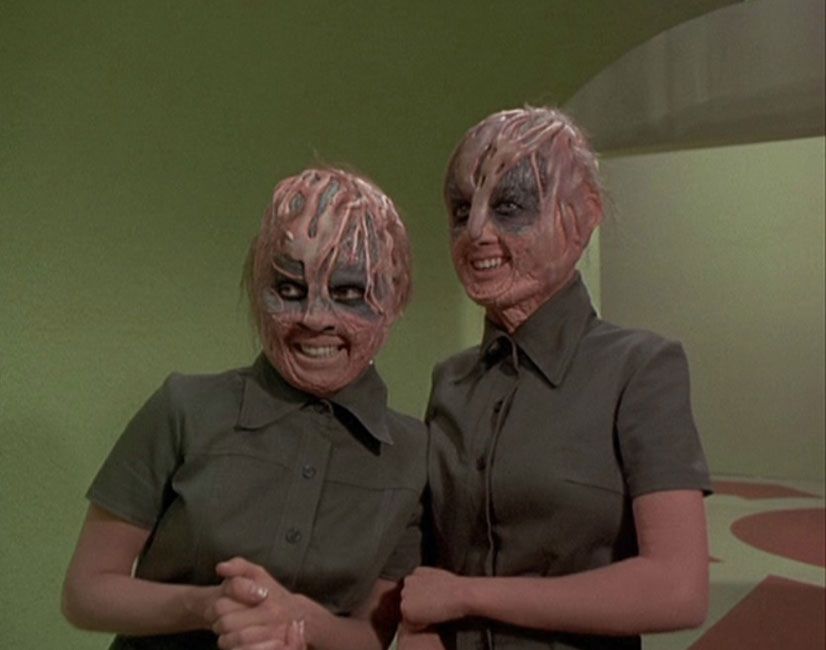
Not surprisingly, Victor is depressed about the whole situation, knowing that he’ll never be able to hold down a job or get married or do any of the things that regular people do. On the down low, Paul contacts some official over his fancy Jetsons video phone, and she informs him that there are no institutions or agencies to help with Victor’s little ugliness problem. Overhearing the conversation, Victor comes into the room and whips off his hood to show the official what he’s dealing with, and with his blackened eye sockets and waxy protuberances dripping down his head, he looks like nothing so much as a lost member of Slipknot that was ordered off of Wish.
Paul later goes to visit another official (Monica Lewis) to ask her what the options are for his son, but she basically tells him that Victor can either live at home and have his dad support him for his entire life, or he can be “put to sleep” as a mercy. Paul naturally balks at euthanizing his son, who other than his deformity is very intelligent and creative, but it’s never quite explained why Paul can’t just let Victor live with him as he has been up to now. Maybe it’s just because Victor is so unhappy and Paul feels bad, but there really doesn’t seem to be any pressing reason why Victor can’t just stay with his dad indefinitely, even though he is on the cusp of adulthood.
Anyway, a dejected Paul leaves the office, but as he’s on his way out, the official gets a phone call. She tells Paul to wait up, because a new possibility has just presented itself. Earth is doing an exchange with another planet called Boreon, you see; Boreon has a low population and needs people, especially males. The planet also has no laws governing the appearance of people who are sent there, so if Victor is willing, he can be shipped off to another planet to see if he can perhaps live a relatively normal life.
Victor seems ambivalent about leaving Earth and his father behind, but he does state that anywhere would be better than here. There then follows a very long, clearly padded-out sequence of NASA stock footage of rockets launching and so forth, smacking the audience in the face for several minutes with the fact that Victor is most definitely going to another planet, in case that wasn’t obvious from the dialogue.
So when Victor arrives at the Star Trek-looking corridor that comprises Boreon, he is greeted in passing by a conventionally handsome man (Dennis Rucker) who is leaving Boreon to go to Earth (he’s the one who’s being exchanged with Victor). Victor asks why he’s going, and the man says he just can’t fit in on Boreon; “Just look at me,” he says. “I know what I look like.”
After the man leaves, a woman shows up to welcome Victor, and surprise surprise, she has the exact same facial deformity as Victor does, as do a gaggle of giggling females behind her, who whisper among themselves how good-looking Victor is. A happy Victor accompanies the women down the corridor, pleased to fit in at last.
As I mentioned, this is almost exactly the same plot as “Eye of the Beholder,” in which an extremely attractive woman keeps getting surgeries to look “normal” but keeps “failing” until you eventually find out that she lives in a future where everyone looks like humanoid pigs. This episode thus held no suspense whatsoever; once it was revealed that Victor was going to another planet, it was a foregone conclusion as to what was going to happen.
The acting in this one was decent, but the melted-candle-looking makeup on Victor and the Boreonians (?) was a little silly, and of course, the story wasn’t spooky or creepy at all, being more akin to a morality tale about judging people solely based on their looks. So-so, but not great, and very predictable.
Tell David…
This story, easily the best of the three, was directed by Jeff Corey from a teleplay by Gerald Sanford, which was adapted from a short story by Penelope Wallace.
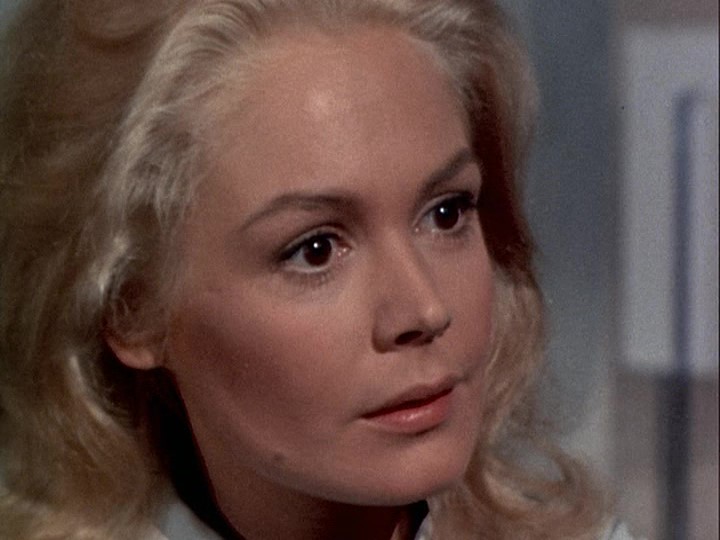
Sandra Dee plays a woman named Ann, who is driving home from somewhere in a bad thunderstorm and gets hopelessly lost. She spots a house and stops to ask for directions; the door is answered by a pleasant and helpful woman called Pat Blessington (Jenny Sullivan), who invites her inside to use the phone.
There are a couple of weird things going on in this house, however. For one thing, the phone is some futuristic, pillar-looking thing with a little screen on top, which Ann can hardly make heads or tails of. She eventually figures out how to call home to tell her husband she’ll be late, but the line is busy and she can’t get through.
The house also has some high-tech closed-circuit security system and snazzy one-way glass on the windows. When Ann asks Pat for a cigarette, she says she doesn’t smoke but should have a pack around somewhere because her husband David (Jared Martin) always keeps things like that around for guests. The cigarettes are a brand that Ann has never heard of, and they have no tar and no nicotine. Ann smokes one and loves it, but Pat seems a little confused because she didn’t know there were any cigarette brands other than that one.
Soon enough, David comes downstairs; Pat told Ann that David was really into gadgets and inventing things, hence all the cool shit in their house. To help Ann find her way home, he produces what is essentially a GPS, but housed in something the size of a briefcase, on which he shows her the best route to take.
Ann is grateful for the couple’s help, and when they ask her to come by and visit them again in a few days, she says she’d be happy to, as they seem like lovely people. She then drives off toward home.
Strangely, though, when she pulls into the driveway, everything is dry; there’s no sign of the raging thunderstorm she drove through, in other words. Shrugging and figuring it was probably just a cloudburst or something, she heads inside.
There’s then a very weird sequence where she walks into the living room, and there’s a figure in a cape and Halloween mask behind her who jumps out and grabs her. She’s startled but immediately realizes that this is her husband Tony (also Jared Martin), wearing a bizarre costume for reasons which are never explained. He screeches about her being late and why didn’t she call, and was she with someone else, and all this other shit, and Ann asks him, “Is that what I sound like?” So I guess this is a fight they have a lot when Tony doesn’t let her know where he is; he’s very defensive and insists that Ann is too jealous, and he’s trying to get back at her by apparently using her own words against her. Dressing up in a withered old crone costume to make that point seems a tad deranged, though.
Ann tells him that she stopped at a house for directions and that she did call home, but the line was busy. Tony dismisses this, saying no one was using the phone all evening. Ann says that maybe their nanny Yvonne (Françoise Ruggieri) was on the phone, and there then follows a significant glance between Yvonne and Tony that all but advertises in bright neon letters the fact that they’re boinking behind Ann’s back. In other words, Ann has every right to be suspicious because Tony is in fact cheating on her, but he’s gaslighting her into thinking that she’s just imagining it all because of her jealousy. Cool, cool.
Anyway, a few days later, Ann goes back to visit the Blessingtons as she said she would. There’s another young woman there who it appears is getting David to fix some gadget for her, and before she leaves, she full-on kisses David on the mouth, right in front of his wife, who does not react at all other than with placid indifference. I will admit that at this point in the story (even though this episode was aired in 1971), I thought Pat and David were going to turn out to be swingers and ask Ann to join them as a third, because that’s totally the vibe I got, but that isn’t what happens (though not gonna lie, that would have been really hot).
No, what actually happens is that after the young woman leaves, Ann asks Pat how she doesn’t get jealous seeing her husband kissing another woman in front of her. Both David and Pat simply shrug like it ain’t no big thing, and David says that jealousy is a very destructive emotion and one must not let it control one’s life. So we should just let our husbands make out with other chicks in front of us and not say boo about it, is I guess the message there. Dudes gotta dude, dontcha know.
David then tells Ann a story about why he doesn’t get jealous. When he was four, he says, he tried to slice a piece of cake at his birthday party but cut his thumb with a knife, an injury he still has a scar from. He then says that on that same day, his dad wasn’t at the party for possibly suspect reasons. His mom got jealous, and his mom ended up killing his dad and then herself. Young David was then sent to live with distant relatives whose last name was Blessington. David tells her that jealousy killed his mother, but that he forgave her and that he still has a cherished picture of her that she left for him. She’s very beautiful, David says, while looking meaningfully at Ann.
At this point, astute viewers will very likely have deduced that David is actually Ann’s son, but twenty years in the future. Not only are there all the futuristic gizmos in the Blessingtons’ house as a clue, but Ann mentioned earlier that she had a four-year-old son whose name was also David. And in case you didn’t notice, David and Ann’s husband Tony are played by the same actor, to make sure there’s a family resemblance (though interestingly, Ann never comments on this; yes, the hair is different, but it’s clearly the same person).
So once that realization hits, you can see how the rest of the episode will probably play out. Ann is having a little birthday party for her son for which Tony is MIA (evidently visiting his “cousin” Jane), and little David indeed cuts his thumb while trying to slice the cake. Now convinced that she has met David twenty years in the future, she attempts to tell Tony about the whole thing when he gets home, but of course, he doesn’t believe her and thinks she’s losing her marbles. She’s confined to bed, anxious and ranting, but then she remembers the cigarettes she got from Pat the first day she showed up at Future David’s house. The pack has the year 1989 printed on it (THE FUTURE!), and an excited Ann goes to take the pack downstairs to show Tony she’s telling the truth.
Of course, when she gets down there, she sees Tony canoodling with Yvonne, and in a fit of rage, she shoots him dead. She gets arrested and put in jail, and when her lawyer comes to talk about her defense, she serenely says there won’t be a trial, implying that she’s going to off herself, thus succumbing to the fate that her future son warned her about. She’s comforted by the fact that future David told her that he had forgiven her, still kept her picture, and had a good life and a wife who loved him and let him mack on other women without complaint.
Oh, and by the way, little David is sent to live with Jane Blessington, who it turns out was Tony’s cousin after all. Tony was totally still banging the nanny, though.
This was actually a pretty great little story; not scary at all, but intriguing enough, with solid acting performances (particularly from Sandra Dee, who’s terrific here) and a pleasingly twisty plot. There were a couple of strange things in regards to Tony’s baffling stunt with the Halloween costume and the underlying message that you shouldn’t be jealous or suspicious of your husband even though he is one hundred percent cheating on you, but this was an entertaining tale all around, and the highlight of the episode.
Lagoda’s Heads
The third story was sort of dumb and also kinda racist, and as such I felt it was by far the weakest of the bunch, even though the teleplay was written by none other than Robert Bloch and based on a story by August Derleth. Jeannot Szwarc once again had directing duties.
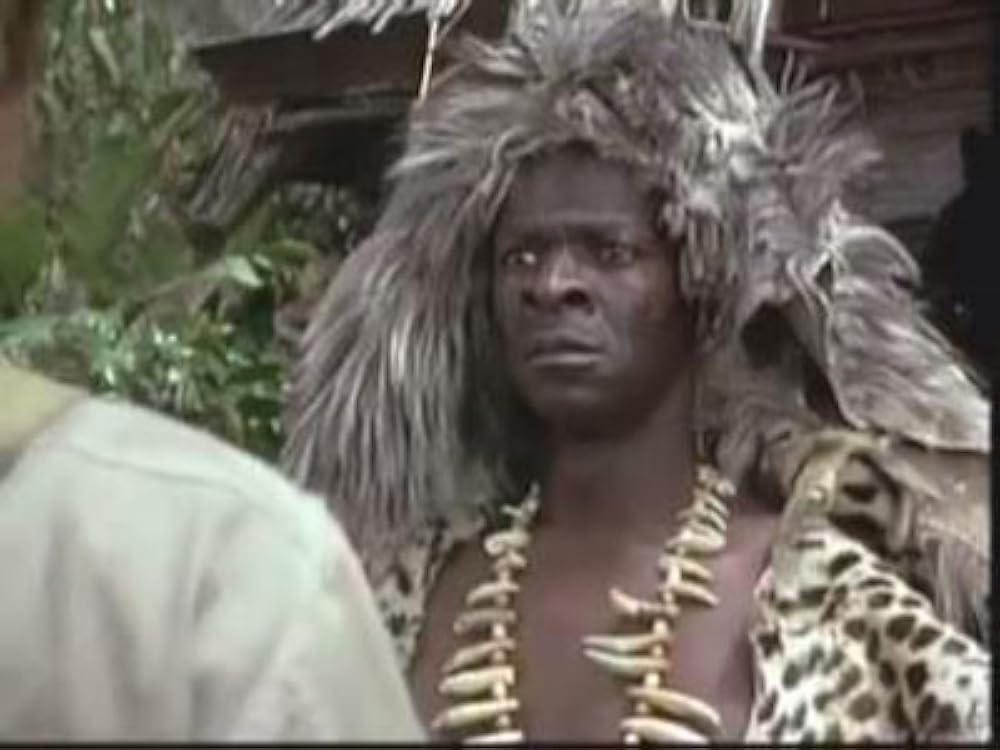
Major Crosby (Patrick Macnee) and a dude named Henley (Tim Matheson) show up in some unnamed African village while stock monkey and tropical bird noises litter the audio track (thank fuck there were no added “ooga-booga” tribal chants in there, but it honestly wouldn’t have surprised me if there had been). Henley is looking for his anthropologist brother, who might have come this way, and after some rigmarole with a wildly gesturing old woman who’s played by Zara Cully from The Jeffersons, they’re allowed into a hut to consult the village elder, the titular Lagoda (Brock Peters).
Lagoda claims that no white men have come around here and that he has no idea where Henley’s brother might have got off to. Henley doesn’t believe him and starts to mouth off, but is interrupted by the entrance of the beautiful Kyro (Denise Nicholas of Blacula fame), who says she’s from another village and tells Henley that his brother is dead.
Lagoda tells her to shut her trap or he’s going to put a curse on her, and then invites the men to come into the next room so he can ask his heads what happened to the errant white man.
The elder starts shimmying around, presumably getting psychic information from the series of (actually really decent-looking) shrunken heads that are tied to a horizontal pole. The heads sway back and forth by themselves as though blown by a mysterious wind, and at the end of it, Lagoda decrees that Henley’s brother drowned in a river.
The Great White Hunters aren’t sure they buy this, but it appears Lagoda has given his last word on the subject. Kyro asks the white men if she can come back to their camp with them and if they can station a guard on her to protect her from Lagoda, a plan which they readily agree to.
The next day, Kyro is unscathed, but a messenger comes from Lagoda’s place and says that Lagoda has actually been murdered. Crosby, Henley, and Kyro rush to Lagoda’s hut, and Crosby steps into the room with the shrunken heads, only to emerge with a look of utter revulsion on his face. Lagoda is completely torn apart, he says, and wonders if some wild animals got to him.
Kyro then smugly informs them that it wasn’t animals that killed Lagoda, but her own stronger magic. She knew that Lagoda had killed Henley’s brother but couldn’t prove it, so she decided to take revenge in her own way. She further specifies that even though Lagoda could talk to the heads, she knew how to make them kill. The camera then closes in on what appears to be blood and chunks of flesh in the mouth of one of the shrunken heads. We as the audience are then left with the unintentionally hilarious visual of a grown-ass man being torn limb from limb by a dozen teensy little heads whose eyes are sewn shut and who don’t even have any arms and legs. Can they hover? Couldn’t Lagoda have just stomped on them? I have so many questions.
So yeah, this one was a bit cringe if I’m being honest. Patrick Macnee and Brock Peters are good in their roles, but the rest of the actors don’t come off so well, and the whole story just seems like a huge misfire. It succumbs to every “tribal African magic” cliché in the book, and while not overtly racist, is pretty uncomfortable regardless. I get that the original August Derleth story was from the 30s or 40s, but it still seems like changes could have been made to be more contemporary with the times and not fall prey to stereotypes. Not a complete failure, but definitely one of the worst installments of the series, unfortunately.
That wraps up season 2, episode 14, so keep watching this space for more Night Gallery updates whenever I get around to them. And until then, keep it creepy, my friends.
 The Scare Salon
I loved this show.
LikeLike