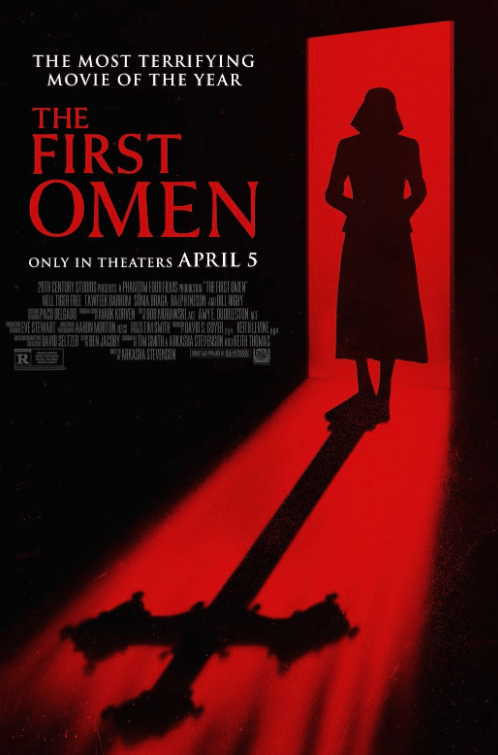
Prequels are a tricky business at the best of times; even a good one runs the risk of succumbing to pointlessness (as large segments of the audience will have already seen what happens after this story, so there won’t be any surprises in store), and lazy fan service (hey, here’s how this beloved character got her famous catchphrase or iconic item! Isn’t that neat?).
I guess for those reasons, I hadn’t had much interest in watching the 2024 film The First Omen, even though I’m a huge fan of the 1976 original and the two subsequent sequels (I admit I haven’t seen 1991’s Omen IV: The Awakening).
But on the late afternoon of Christmas Day, after all the holiday hubbub had passed and I was stuffed to the gills with glazed ham and mashed potatoes, I wanted to just chill and relax with a movie and a cup of joe. I saw The First Omen was streaming on Hulu, and I’d noticed that the film had turned up on a number of year-end “best horror movies of 2024” lists, so I thought I’d give it a shot.
And damn, it was actually way better than I was expecting, and honestly a much classier, more high-quality film than it had any right to be. It’s the feature film debut of Arkasha Stevenson—who previously helmed episodes of the series Legion and Briarpatch, as well as “Butcher’s Block,” the third season of Channel Zero—and she did a bang-up job, homaging the original in interesting ways without the story being a retread, and filling in blanks from the 1976 film with unexpected details that nevertheless fit in with the existing lore. The characters were also well-sketched, with the protagonist in particular being quite sympathetic and compelling to watch.
At the very beginning of the film, which is set in Rome in 1971, there’s a brief scene featuring Father Brennan (played here by Ralph Ineson; the same character was played by the late Patrick Troughton in the 1976 movie) speaking to another priest called Father Harris (Charles Dance). Just prior to their talk, there’s a great shot of a stained glass window that’s being hoisted into place on the building while Father Brennan looks up at it, and the angle at which it’s shot immediately puts you on your guard; you’ve seen the original movie, so you just know that window is gonna slice someone in two before too long. But the great thing about The First Omen is that it sets these kinds of things up on purpose, just to fuck with your expectations a little bit by doing something you don’t quite foresee.
Anyway, Brennan is asking about some sinister conspiracy in the church, and Harris hands him an old photo of two nuns and a Cardinal holding a baby. On the back of the picture, someone has written the word/name, “Scianna.”
As Harris is walking away, that pesky stained glass window indeed comes loose from its riggings, and there’s a wonderful slow-motion sequence where tiny shards of colored glass begin to rain down around the two priests. At this point you’re just waiting for the hammer to fall, assuming (as I did) that a pole from the scaffolding is gonna come plunging down right through Harris’s body (which is what happens to Brennan in the 1976 Omen). But that’s not what happens.
There is a noise and Harris does stop short, but the window falls some distance from him. Brennan asks if he’s all right, and Harris says he’s fine, then walks off, a tad unsteadily. We then see, after he turns his back, that a falling pipe or something has actually made a huge hole in the back of his skull, leaving his brain to peep through. It was a nice little surprise, giving a nod to the iconic scene from the original without slavishly duplicating it.
We then move on to our main character, a young novitiate named Margaret (Nell Tiger Free). She grew up in the United States, but she’s an orphan and has been in the care of the church her entire life. At the behest of her mentor/protector/father figure Cardinal Lawrence (Bill Nighy), she has come to Rome to work as a teacher in an orphanage and to take her vows as a nun. She’s a wide-eyed, naïve girl, devoted to the church with every fiber of her being, as it’s all she’s ever known.
This being Rome in the early 1970s, there are loads of protests in the streets, as the younger generation rebels against the authority of their elders, and particularly against the power of the church. This cultural conflict is a great backdrop for the story, as it gives an impetus for the nefarious shenanigans to follow.
Margaret settles into the orphanage, and almost immediately hones in on a slightly older girl named Carlita (Nicole Sorace), who seems very troubled and is constantly being disciplined by the Abbess, Sister Silva (Sônia Braga) by being locked into “the bad room.” Margaret admits she was a bit of a problem child herself and thus feels an affinity with the girl, but the Abbess basically tells her not to get involved with Carlita, as she’s a bad kid and is deliberately being kept away from the other children to prevent her from corrupting them.
Soon after arriving, Margaret meets her beautiful roommate Luz (Maria Caballero), who is also going to take her vows, but evidently wants to party hard up until the very moment that happens, reasonably arguing that if one is going to become a nun, one best have an idea of all the things one is giving up to do so.
To that end, Luz persuades Margaret to dress in some skimpy, fabulous club ho attire so they can paint the town. They end up at a huge nightclub and meet two decent-looking dudes who buy them drinks. Margaret, of course, is very awkward at first, and her “date” for the evening, Paolo (Andrea Arcangeli) is looking pretty disappointed at being saddled with the wallflower, but Margaret’s inhibitions begin to fall by the wayside as the alcohol flows more freely, and soon enough, she’s dancing and making out with Paolo like a champ.
We then cut to the next scene, where Margaret is waking up with a hangover and a complete memory blackout in Luz’s room. Luz assures her that she didn’t embarrass herself last night and that she pulled Margaret out of there before anything too crazy could happen. Luz does winkingly say that what did happen will be “their little secret,” so we’re led to assume that Margaret actually did have sex with Paolo, though this isn’t stated outright.
Despite the admonitions of staying away from Carlita, Margaret is still curious about her and is trying to interact with her. From the girl’s drawings, she believes that Carlita has the same terrifying visions she used to have when she was younger, and she tries to reassure Carlita that although these visions are scary, they’re not real and can be managed. At one point, for example, Margaret witnesses a woman at the facility giving birth (the orphanage also takes in unwed mothers) and sees a horrible clawed hand coming out of the woman’s vagina.
Not long after this, Father Brennan approaches Margaret. She’s wary at first because she doesn’t know him, but he seems to know exactly who she is, which makes her even more suspicious. He tells her that he has some important information that she needs to hear and to come to his apartment later so he can talk to her. Margaret takes the address but clearly thinks he’s a nut.
There’s one weird nun at the orphanage called Sister Anjelica (Ishtar Currie-Wilson) who seems to have a creepy, almost sexual fascination with Carlita. Margaret approaches them one day while everyone is out in the courtyard, and Carlita shows her a drawing of a pregnant woman that Anjelica drew the fetus on. Margaret tells Anjelica that this is inappropriate, and which point the nun gets somewhat hostile, suddenly kisses her on the mouth, and walks off.
Moments later, we see Anjelica standing on the balcony above the courtyard, with what looks like a rope or fabric around her neck. Again, we think we’re getting a repeat of the nanny’s “It’s all for you” hanging scene from the 1976 film, but this scene plays out slightly differently, as Anjelica actually first sets herself on fire before leaping off the balcony to dangle and burn, crashing through a window in the process as all the nuns and orphans look on in horror.
After all this, Margaret begins to suspect that something strange might be going on at the orphanage, so she decides to go see Father Brennan. He tells her about the conspiracy alluded to in the 1976 movie, that there is a radical subset within the church that is lamenting the church’s declining influence on society and has decided they need to frighten people back into the arms of the church by deliberately engineering the birth of the Antichrist. These radicals have a “beast,” Brennan says, and he suspects that Carlita is being groomed to be impregnated by this beast so she will give birth on June 6th. Brennan wants Margaret to bring him proof of what these miscreants are up to so he can expose them, but Margaret thinks Brennan is even crazier than she did before and flees from his apartment.
After that, though, several things occur that convince Margaret of the truth of what Brennan said, including a horrific scene involving Paolo, the man she met (and supposedly slept with) at the nightclub. She becomes terrified on Carlita’s behalf and vows to get the girl away from the orphanage, but her erratic behavior brings down the wrath of the Abbess and the Cardinal, who accuse her of being unstable and lock her away in “the bad room.” From there, things go from bad to worse as the radicals’ malevolent plot is put into motion and the situation turns out to be far more fucked up than even Father Brennan thought.
The First Omen was a refreshing surprise, a prequel that referenced the legacy of the 1976 film but told its own interesting story that expanded the lore of the franchise. I particularly liked how a couple of iconic sequences from the original film were subverted in a playful way without making me want to roll my eyes. And to be honest, this was quite satisfying as a stand-alone story, even removed from the parameters of the Omen mythology. It had some effectively eerie scenes, some good gore, and a fantastic lead performance that drew you into the tale and got you emotionally invested in the unfolding mystery.
The look of the film was also quite lovely, obviously homaging the 70s aesthetic of the original, but also dressing the religious characters as though they were from a few decades prior, as though emphasizing their diminishing power in the modern world, but in a nicely subtle way. I have to say that even though I hadn’t really been all that enthused to see this when it came out, I’m glad I gave it a chance because I enjoyed it quite a lot, and I would agree with several other reviewers who ranked this as one of the best horror films of the year.
Until next time, keep it creepy, my friends.


Hands down the best horror movie I saw in 2024.
LikeLiked by 1 person