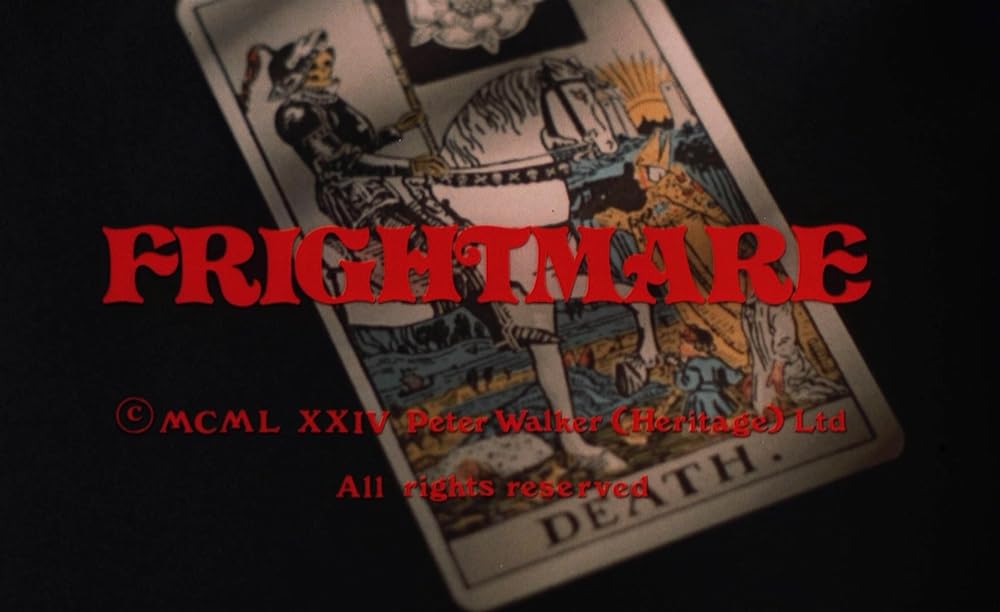
The other day, the mood struck me, as it sometimes does, to take in a forgotten film from the 1970s, one I hadn’t seen before but had heard a few people talking about here and there. And that’s how I stumbled upon 1974’s Frightmare, a British film that I remember seeing the cover of numerous times in video stores back in the day, but which I had never pulled the trigger on.
The movie, also known under the alternate titles of Once Upon a Frightmare and Cover Up (and not to be confused with the 1983 American slasher movie of the same name directed by Norman Thaddeus Vane), was written by David McGillivray and directed by Pete Walker, the same team that gave us the 1974 exploitation thriller House of Whipcord, as well as two 1976 slashers, House of Mortal Sin and Schizo. Frightmare, in particular, was clearly made to capitalize on horror audiences’ growing hunger (heh) for lurid pictures featuring lots of gore and cannibalism, and British reviewers of the time were suitably appalled by its subject matter, but it’s not a bad film for all that and is fairly tame by today’s standards. I’ll admit it’s sort of slow and talky in the first half and doesn’t really hold any surprises, but it does have some good acting performances (particularly by Sheila Keith, who was also in the aforementioned House of Whipcord and House of Mortal Sin) and a few nicely grisly set pieces, though it is somewhat restrained.
At the beginning of the film, we meet a young woman named Debbie (Kim Butcher), whose character is supposed to be fifteen but looks as though she’s in her early twenties. She’s at a nightclub with her biker gang friends and starts some trouble when the bartender won’t serve her, due to her being underage. She lies to her boyfriend Alec (Edward Kalinski), telling him that the barman called her a tart or some such thing, leading to Alec and the gang beating the absolute crap out of the poor man with a bike chain after his shift ends. The cops show up mid-pummeling, and the gang takes off, but Debbie stays behind, obviously for some nefarious purpose, though you don’t find out what the deal is until later in the movie.
We’re then filled in on Debbie’s situation: turns out she lives with her older half-sister Jackie (Deborah Fairfax), and their parents are ostensibly dead. Jackie is at her wits’ end with Debbie, who is a complete delinquent and runs around at all hours of the night doing lord knows what.
During an argument that ensues after Debbie returns home at two in the morning, though, it’s revealed that Jackie might have a few secrets of her own. Debbie knows that Jackie is also sneaking out at night, and points out that Jackie can’t exactly tell her what to do when she’s essentially doing the same thing.
Jackie doesn’t really have a comeback for that, so goes about her shady business. She takes a parcel of…something…out to a remote farmhouse some distance away. At this farmhouse, we learn, are Jackie’s very-much-not-dead parents, Edmund (Rupert Davies) and Dorothy (Sheila Keith), whose presence among the living Jackie has presumably been keeping a secret from Debbie. Edmund seems a sympathetic character, but Dorothy is obviously a nutcase, and by the end of this visit, you’re pretty sure you know what’s inside those parcels that Jackie brings every so often.
At some point in the story, Jackie meets and starts dating a psychiatrist named Graham (Paul Greenwood), and though she initially doesn’t tell him about any of her family struggles, she later relents and confesses that she doesn’t know what to do about Debbie, who is turning into quite the petty criminal. Graham offers to counsel the girl for free, thinking all she needs is a bit of talk therapy and she’ll be right as rain again.
As Graham starts researching the women’s background, however, he uncovers the fact that their parents, Edmund and Dorothy, were only recently released from a psychiatric hospital after fifteen years, supposedly cured of their problems. Dorothy, you see, killed and ate six people back in the day (!!!), and Edmund covered up her crimes. So devoted was Edmund to his wife, in fact, that he even faked his own mental illness so he could go into the hospital with her.
We also discover that Debbie might be even more of a criminal than we thought, as she shows her boyfriend Alec that she still has the barman’s body stashed in the trunk of a car in a garage. Alec is horrified by this disclosure; yeah, he beat the guy up pretty badly, but he was sure the man was still alive when he fled the scene. The barman has one eye gouged out and has some injuries not really consistent with being beaten by a chain, so obviously Debbie has some ‘splainin’ to do.
And while all that is going on, more unsavory business is revealed about Dorothy, who is apparently not as “cured” of her mental illness as everyone thought, as she’s been luring lonely young women to the farm with promises of tarot readings and then killing them and (presumably) eating them, though she’s never shown doing so. We also find out that the parcels that Jackie had been bringing all this time had animal brains she got from a butcher shop that she was trying to pass off as human brains because she thought that would satisfy her mother’s proclivities for murder. Um…nope. Edmund hadn’t realized his wife had relapsed, but when he finally twigs onto the fact, he sadly agrees to cover up her crimes again.
At the climax, several things happen at once. We learn that Debbie has actually known her parents were alive this entire time and has been helping Dorothy kill people because she’s evidently a chip off the old block. She even brings her boyfriend Alec to the farmhouse for Dorothy to munch on and watches coldly as Dorothy stabs the absolute shit out of him with a pitchfork.
Jackie, not realizing the extent of the horror unfolding, unwisely sends Graham out to the farmhouse on a reconnaissance mission under the auspices of getting a tarot reading, but he gets made pretty quickly, and by the time Jackie gets there, Dorothy and Debbie are already killing the hell out of him too.
In the end, Edmund reluctantly sides with Dorothy and Debbie, who have decided they must kill Jackie as well because she knows too much about what’s going on, and we freeze frame on his conflicted face as Jackie screams in the background. A dark ending, for sure, but this is a British movie we’re talking about here.
While this isn’t really a lost classic or anything of the sort, it is a fairly enjoyable exploitation flick with much better acting than you’d usually see in this type of thing, and some moderately gruesome scenes. Sheila Keith is particularly great as the deranged, passive-aggressive Dorothy, and I also thought Rupert Davies was fantastic as the sympathetic father who nonetheless allowed his monstrous wife to continue her horrible deeds to the detriment of his daughters.
The movie also has something of an undercurrent of social commentary, particularly a criticism of psychiatry, as not only was a dangerous murderer and cannibal released back into the wild after being ostensibly “cured,” but the character of Graham, while likable, was still portrayed as somewhat naïve in his belief that Debbie could be likewise cured of her pathologies, which no one realized the seriousness of until it was far too late.
If you’re into British horror from the 70s and want to see something that’s gorier and more trashy than Hammer, but still classier than its subject matter would suggest, then give it a whirl; I didn’t like it as much as House of Whipcord, but it was still pretty entertaining despite a somewhat draggy first half.
Until next time, keep it creepy, my friends.
 The Scare Salon