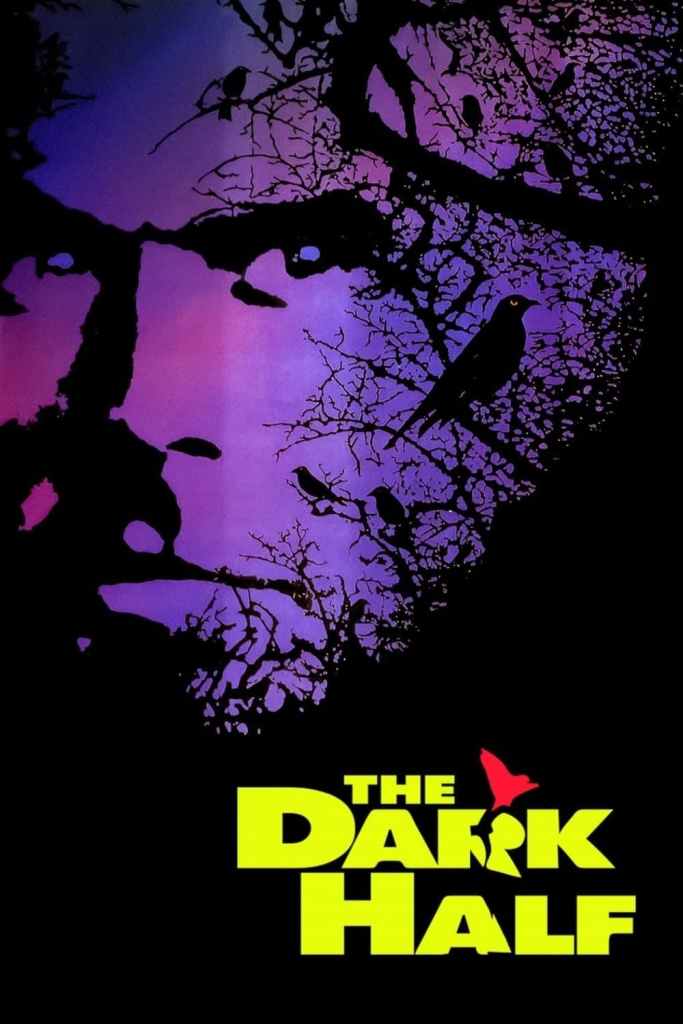
When I posted my review of Fright Night Part 2 a few days ago, a listener named Scott commented on my Facebook page that he’d like to see a review of the 1993 Stephen King adaptation The Dark Half. I could have sworn Tom and I had reviewed that movie on 13 O’Clock already, but a quick peruse of the channel demonstrated that we had not. So, seeing that the film was available for free on Tubi, I gave it a rewatch; this was probably my third or fourth viewing of the movie, and though I have also read the 1989 novel at least twice, it’s been probably twenty years since my last read-through. I will note that the film version of The Dark Half, though, is generally considered one of the most faithful of all the King adaptations.
Stephen King got the idea for the story from his own experiences writing under his pseudonym, Richard Bachman, and to an extent, he also fictionalized and exaggerated the real-life way that a fan exposed his alter-ego. In the novel, though, King plays with the idea that a writer who invents such an alter-ego runs the risk of that creation taking on a life of its own.
One thing I had completely forgotten was that The Dark Half was directed by none other than George A. Romero, who had of course collaborated with Stephen King before on the excellent 1982 anthology film Creepshow. The Dark Half is a completely different tone to that film, naturally, as it’s a much more serious, psychological story dealing with duality and doppelgängers, sort of like a more supernatural take on evil twins, or a Jekyll-and-Hyde-type narrative.
The movie was actually shot in 1991, but due to bankruptcy problems with its distribution company, Orion Pictures, it wasn’t released until 1993, and by then, it seemed audiences were growing tired of Stephen King adaptations (or maybe just the glut of crappy ones that had come out in the previous few years) and stayed away from the film in droves. It didn’t even make its relatively paltry fifteen-million-dollar budget back, and critical reviews were mixed to negative. Even today, it only holds a 59% rating on Rotten Tomatoes, which is kinda bullshit in my opinion. No, it’s not a classic on par with The Shining or Misery, but it’s a totally respectable adaptation with a good central performance by Timothy Hutton in dual roles and an interesting, vaguely gothic sensibility.
As mentioned, Timothy Hutton plays Thad Beaumont, a successful novelist and creative writing teacher with a wife named Liz (Amy Madigan) and twin baby boys. At the very beginning of the story, there’s a bit of a prologue of Thad as a kid, trying to realize his dream of one day becoming a writer. He starts having devastating headaches, though, and when he’s admitted to the hospital, it’s discovered that he has a tumor in his brain consisting of a partially absorbed twin, complete with one creepy, blinking eye. The tissue is removed and everything seems fine, but right after the surgery, the hospital is besieged by an enormous (and seemingly unnatural) flock of sparrows.
In the present day, Thad is working on his newest book, which his wife thinks is going to be brilliant. Thad, you see, is a very highbrow novelist, the kind who wins Pulitzer Prizes, but his cerebral novels don’t sell all that well to John Q. Public, as you might imagine. Thad makes the bulk of his money writing violent, sleazy, morally questionable crime thrillers under the pseudonym George Stark, and these popular stories feature a central character named Alexis Machine, who’s a cold-blooded killer.
Whenever Thad is working on a George Stark novel, it seems, his whole personality changes: he starts smoking and drinking heavily, even though Thad quit both vices long ago; and he says terrible things to his wife and has a much quicker temper. Additionally, he always writes in longhand with Black Beauty pencils, even though Thad always uses a typewriter.
Not long into the movie, a squirrelly fucker named Fred Clawson (Robert Joy) shows up in Thad’s class and gives him a George Stark novel to autograph. Thad denies he wrote the book, but Fred is onto him: he claims to have slept with a woman who worked at Thad’s publishing company, and she spilled the whole story. Fred is now asking for money to keep his trap shut, banking on the fact that Thad doesn’t want anyone in his fancy literary circles to find out he has a lucrative sideline in writing pulpy trash.
To an extent, Fred’s instincts are correct, but when Thad tells his wife about the dilemma, she sagely advises him to just go public with the information himself, to take the wind out of the blackmailer’s sails. It’s so elegant in its simplicity that Thad can’t believe he didn’t think of it. He calls his agent and his publishers to make sure they’re okay with it, then gets the ball rolling.
Because he’s a pretty well-known writer, he’s gonna get some publicity out of this announcement, so his agent arranges for a small crew from People magazine to come up to the family’s vacation cabin in Castle Rock to take some pictures. One of said pictures is a jokey photo featuring Thad and Liz standing in front of a fake gravestone with George Stark’s name on it, that also bears the epitaph, “Not a very nice guy.” Significantly, the photo shoot is staged on an empty plot that Thad’s parents bought for him to one day be buried in. Dun-dun-DUUUUUNNN.
As you may have surmised, George Stark has become such a forceful part of Thad’s psyche that he has essentially become a separate human being, albeit with the same fingerprints (and presumably DNA) as Thad. As you also may have surmised, this causes a wee bit of a problem when Stark digs his way out of the “empty” grave and starts killing everybody who had anything to do with the publicity stunt.
Stark’s shit list begins with the photographer who took the picture, and local police come knocking at Thad’s door because his bloody fingerprints are all over the poor old guy’s truck. Thad is aghast, stating (truthfully) that he just returned from New York City, so there’s no way he could have murdered the dude. Sheriff Alan Pangborn (played here by the awesome Michael Rooker; the same character was played by Ed Harris in another King adaptation that came out the same year, Needful Things) is a friend of Thad’s and is willing to cut him some slack, but things aren’t looking too good in the “Thad is possibly a stone-cold murderer” department. Liz, though, tells the cops that maybe that shifty-ass blackmailer Fred Clawson is setting Thad up because he’s pissed he didn’t get the money. She’s pretty sharp, that Liz.
However, when police go to Fred’s apartment in NYC, they find his ass dead too, and in a manner that Thad had previously made a joke about to his wife: with his dick cut off and shoved down his throat. And what’s more, Thad was still in New York when Fred got bumped off, so he doesn’t have an alibi this time.
Pangborn is able to stave off Thad’s arrest for a little longer, and as the story goes on, it starts to become clearer to even the police that Thad cannot be responsible for the crimes, as they put him under surveillance and watch his every move, but people—including his agent and the woman at the publishing company—get killed anyway. In desperation, Thad finally gives a description of the supposedly fictional George Stark to the cops: basically, he looks a lot like Thad, but broader and rougher-looking, with slicked-back hair, a penchant for Elvis, and prone to driving a black Oldsmobile Toronado with the words “High-Toned Son of a Bitch” emblazoned on the back.
Thad, meanwhile, is doing a bit of his own investigation, going back to where he had the tumor removal surgery as a child and asking the doctor what the deal was. Evidently, Thad was never told about the tumor actually being a parasitic twin, or about the flock of sparrows that mobbed the hospital after the operation, but now everything’s making much more sense, especially since Thad has been blacking out sometimes and when he comes to, he’s written “The sparrows are flying again” without remembering it. This same phrase was also written in blood at some of the murder scenes. According to another teacher friend he knows, sparrows are sometimes considered psychopomps, or beings who escort souls from the land of the living to the land of the dead.
The doctor gets murdered by Stark while Thad is still in the office, so Thad has to get the fuck out of Dodge before he gets blamed for that shit too. He also finds out that Stark can’t actually kill him since Stark only exists because Thad made him real, but obviously Stark can absolutely kill everyone else, and he threatens to do just that to Thad’s family unless Thad agrees to write a new George Stark book. It’s implied that by doing so, George Stark will actually be able to take over Thad’s life and be a real person, while Thad will slowly deteriorate to nothing. This is demonstrated by Stark looking sicker and sicker as the story goes on, and then Thad and Stark trading off looking shitty as each of them battles to be the victor and the ultimate owner of the soul.
At the end, of course, Thad is victorious, and a still-disbelieving Alan Pangborn arrives at the cabin just in time to see the last little scraps of George Stark’s bloody skeleton being carried back to the netherworld from whence he came by a metric shit-ton of sparrows.
As Stephen King adaptations go, this is definitely in the higher end of the middle range; it takes itself seriously and doesn’t get too goofy, the acting performances are good, and there’s a decent amount of gore and a compelling narrative at the center of it. The special effects toward the end are a tad sub-par, mainly because they had to be shot later after Orion shit the bed, but they’re not the worst I’ve seen and are significantly better than some other horror films that came out the same year. There might not be much inherent cinematic drama in a story about a guy wanting another guy to write a book, but honestly, I think the pacing and suspense are well done here, and you can tell that Timothy Hutton is having a blast playing the completely evil George Stark. It’s also cool that as Thad, he comes across as a likable everyman with a few personality quirks that are kept subtle, but still inform his character a great deal.
The Dark Half honestly doesn’t get brought up much when people talk about decent King adaptations, and that kind of sucks, because this is a really solid movie, and was even better than I remembered it being the last time I watched it. If you haven’t seen it for a while, give it another spin; I’ll bet you’ll find that it’s aged very well, and definitely deserves more attention.
Until next time, keep it creepy, my friends.

