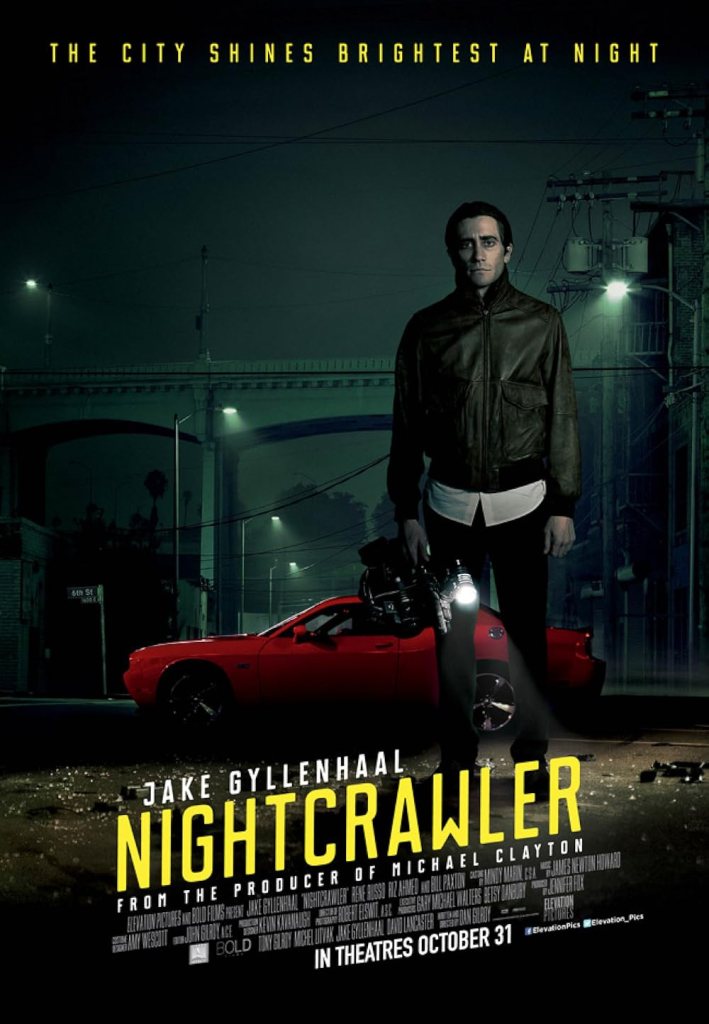
Okay, so how the hell did I manage to sleep on this flick for so long?!? I remember it getting a ton of buzz and praise and awards when it came out way back in 2014 (more than a decade ago now; Jesus, I’m old), and I think I’d always planned on getting around to it because it sounded interesting, but between one thing and another, I just never sat down to watch it.
Fast forward to 2026, and I was on some random Reddit thread about creepy movie characters (or something along those lines), and a couple people brought up Jake Gyllenhaal in Nightcrawler. Thus reminded, I fired up the film on Tubi one cold Saturday afternoon and took it all in. And hot DAMN, this is a legitimately GREAT movie, and now I’m really mad at myself for not having seen it sooner. Oh well.
The film is, amazingly, the directorial debut of screenwriter Dan Gilroy, whose previous scripts included 1992’s Freejack and 2012’s The Bourne Legacy, among many others. And fun fact, Dan Gilroy is also married to Rene Russo, who has a stellar co-starring turn here.
Anyway, I’m not exactly sure what genre I’d place Nightcrawler in; Wikipedia has it listed as a neo-noir crime thriller, which I guess is sort of accurate, but it also has elements of dark comedy and media satire (in the same ballpark as 1976’s Network, I guess, but a bit more low key than that). Jake Gyllenhaal gives an absolutely mesmerizing lead performance as an off-putting, cold-blooded sociopath who is nonetheless intensely compelling to watch, even while you’re completely appalled by the dude’s actions (he gives slight American Psycho vibes, but with a bit of a different approach). The supporting roles, notably Rene Russo and Bill Paxton, are also fantastic, and the whole movie just had me riveted to the screen the entire time, uncomfortably laughing in disbelief as each new fucked-up situation began to unfold.
So the aforementioned Jake Gyllenhaal plays Lou Bloom, an underemployed loner who, up to now, seems to be making his living by stealing manhole covers and rolls of chain link fence, and selling them to shady scrapyards. From the first few minutes of the film, we understand Lou’s capability for violence, as he brutally attacks a security guard who catches him on private property swiping some fencing. We also realize that something is not quite right about him, from his wide, dead-eyed stare to his not-quite-convincing play at being a harmless, kinda dweeby weirdo.
After being turned down for a job by the owner of the scrapyard where he unloads his stolen loot, he’s driving home in his shitbox car when he notices a one-vehicle crash on the side of the highway. The car is on fire and police are struggling to free an unconscious woman from the driver’s seat before the fire spreads or the car explodes. Lou is fascinated by the spectacle, but just then, he notices a couple of guys with cameras filming the rescue effort, trying to get as close as possible to the victim, much to the annoyance of law enforcement.
Lou speaks to one of the cameramen, Joe (Bill Paxton), as he’s leaving the scene, asking him what he’s doing. Joe grudgingly explains that he’s a freelance photojournalist, what they call a “stringer” in the biz, who goes around filming car accidents and crime scenes and such, then sells the footage to the TV news agency that pays him the most. Clearly intrigued, Lou asks Joe for a job, but Joe tells him to get lost.
Lou, though, seems to realize that he’s finally found his calling. Buoyed up by a staunchly corporate can-do attitude fostered through motivational YouTube videos and one business administration class at a community college, he takes the initiative to start his own freelance video news company. First, to obtain some much-needed start-up capital, he steals a very expensive mountain bike from a park and pawns it, using the store credit to buy a cheap video camera and a police scanner. Then he begins spending every night sitting in his car, listening to the scanner and waiting for a particularly exciting crime or accident to occur that he can go film.
The first couple attempts don’t really yield much, and it’s obvious that other, longer-term stringers resent the presence of this awkward, obnoxious little upstart, but at one gruesome carjacking scene, Lou manages to capture some up close, bloody footage of the victim that he’s certain will sell.
He takes the film to a local news station, the lowest rated in the area, and when news director Nina Romina (Rene Russo) sees what he shot, she’s interested enough to give Lou a chance. She forks over a few hundred dollars for the footage, advises him to get a better camera, and tells him that the best stuff to film is not only graphic and hopefully bloody, but should also sell the narrative that “urban” crime is invading suburbia. The victims should always be white and relatively well-off, she says; no one cares about gang members in the hood shooting one another up, so she tells him to not even bother shooting footage of that. This is where some of the media satire angle I was talking about begins to shine through; in her way, Nina is just as ruthless as Lou is, willing to cross pretty much any moral boundary for better ratings.
An eager Lou takes all of Nina’s advice to heart with great enthusiasm, using the money from the footage he sells to purchase better equipment. After a time, he even indulges himself by replacing his old jalopy with a sleek, fast, and very noticeable bright red Dodge Challenger, all the better to not only stroke his ego and draw attention to himself, but also to be able to get to crime and accident scenes much quicker. Eventually, as his business grows, he takes on an assistant named Rick (Riz Ahmed), a good-hearted but desperate homeless guy who monitors the police scanner and films secondary footage, all for a meager thirty bucks a night and a chance at “career advancement.”
A turning point in the story occurs when Lou and Rick happen to arrive at the scene of a home invasion and triple homicide before the cops do. The crime took place in a huge mansion in a very upscale LA neighborhood, and Lou manages to film all the carnage in lurid, loving close-up. He even captures clear video of the two killers fleeing the scene, as well as shots of their vehicle and license plate.
When he takes the footage to Nina, she’s over the moon; it is coming up on sweeps week, after all, and she fears she might get fired if she doesn’t get her viewing numbers up, so this grisly footage seems just what the doctor ordered. The other news managers are wary of airing the segment, given the ever-so-slightly unethical way it was obtained, but Nina basically says fuck it; if the station gets fined, she’ll gladly pay it.
Here’s the thing, though. Remember how Lou filmed the killers and their car? Well, he edited that bit out before selling the footage to Nina; turns out he’s got his own plans about tracking down the murderers in a way that will hopefully get him the most epic shots he’s ever filmed. This plan, in fact, is what leads to the film’s tense, horrific climax.
This movie was just outstanding from beginning to end. It was not only fast-paced and completely immersive, but Jake Gyllenhaal totally knocks it out of the park as Lou, a skin-crawlingly reprehensible person who you nonetheless can’t stop watching. Not only is he seemingly fearless, dogged, and utterly ruthless, but he’s also devoid of any pesky emotions or empathy, causing him to be chillingly laser-focused on getting the best footage, no matter who gets caught in the crossfire. The shit about him filming gory accidents and crimes without a care at all for the victims is bad enough, but as his business becomes more profitable over the course of the film, he also begins asserting his dominance over others, sabotaging his competitors and essentially blackmailing Nina into sex. He’s a terrible, terrible man, but you’re fascinated by him in spite of this, and the fact that he (spoiler alert) never gets any comeuppance for his deeds and in fact becomes even more successful because of them is both infuriating and depressingly accurate to real life.
If you’re at all into crime thrillers, media satires, or dark character studies in the vein of Taxi Driver, The Machinist, American Psycho, or maybe Zodiac, then you owe it to yourself to check this out as soon as possible; it’s a terrific film that earned every ounce of praise it got back when it was released. I just wish I hadn’t waited twelve years to see it.
Until next time, keep it creepy, my friends.
 The Scare Salon