Returning to our Night Gallery breakdown, we’ve now arrived at season 2, episode 15, another installment with three stories, two of which are decent and one of which is…well, decidedly less decent, let’s put it that way.
The first tale, “Green Fingers,” was directed by John Badham, who would go on to direct Saturday Night Fever, Dracula (the Frank Langella one), WarGames, and Short Circuit, among many other things. It was based on a short story by R.C. Cook, with a teleplay by Rod Serling. It also stars the Bride of Frankenstein herself, Elsa Lanchester, as well as Cameron Mitchell doing a really over the top Southern (?) accent.
The tale is straightforward, and within the first few minutes, you can pretty much tell exactly how it’s going to go. Mrs. Bowen is a seemingly dotty old widow, living happily in a cottage in the middle of nowhere and tending to her garden. Michael Saunders is a stereotypical, cigar-chomping real estate mogul who wants to buy Mrs. Bowen’s land to put a big-ass factory on. The old lady has lived on the property her whole life and has absolutely no intention of selling, no matter how much cash they wave in front of her. When Saunders tries to bully her into giving him his way, she first just regales him with all the amazing things she grows in her garden, saying she’s got the titular “green fingers” and can grow absolutely anything, then basically tells him to get lost because no amount of money is going to change her mind.
By the way, I actually laughed out loud at Cameron Mitchell’s line about how he didn’t care if she could plant a gas can in the yard and grow a filling station, or something to that effect; the mental image that conjured up for me was pretty funny.
Now you know and I know that an evil land developer like our boy here is absolutely not above having an old woman whacked if she’s standing in his way. And indeed, in the very next scene, Saunders is standing outside Mrs. Bowen’s house that evening, giving cryptic, wink-wink instructions to a presumed hit man named Crowley (George Keymas). Why they’re planning a murder for hire while literally standing on the property of their intended victim is a mystery for the ages.
Anyway, he never says outright that Crowley should kill the old woman, but he’s also not NOT saying that, if you know what I mean. There’s then an abrupt cut to police cars speeding toward the house, with some exposition that a neighbor heard a woman screaming, and you’re led to assume that the worst has happened and Mrs. Bowen is no longer among the living (well, you’d be led to assume that if you’ve never seen a horror story before, but I digress).
The cops find evidence of a disturbance and a bloody axe in the house, but to their surprise, Mrs. Bowen is still alive, somewhat traumatized and babbling, burying something we don’t see in the garden behind the house. We’re also informed that the perpetrator (presumably Crowley) ran into a wall somewhere while fleeing police (???) and died at the scene. Not sure how they knew Crowley was the suspect before they even got to Mrs. Bowen’s house, but whatever.
It transpires that Crowley had actually roughed up Mrs. Bowen and chopped one of her fingers off with the axe. Despite this fairly survivable injury, she dies later in the hospital, with the doctor lamenting that old age, shock, and blood loss likely did her in.
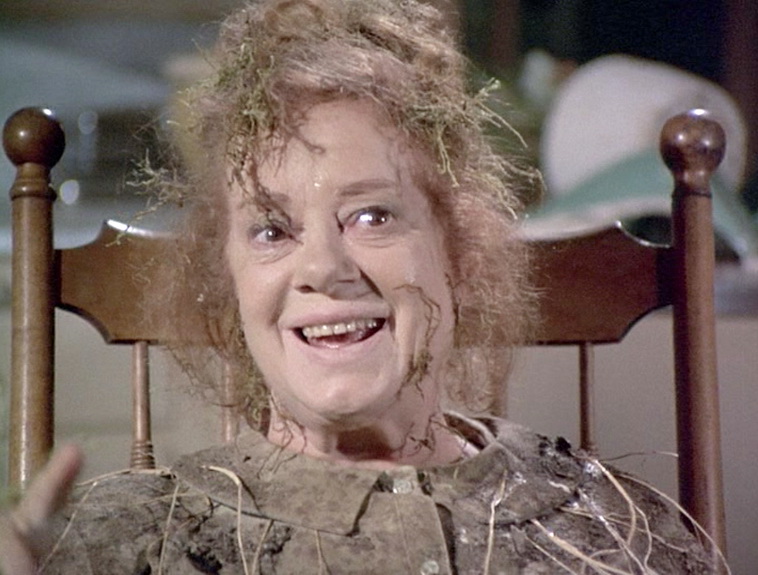
Later on, we see Saunders out at the old lady’s cottage, gloating over this little scrap of land that will now be part of his planned factory empire. But not so fast: remember how I said that Mrs. Bowen was burying something in the garden when the police got there? And that Crowley had chopped her finger off? Well, you can probably guess what happens next: another version of Mrs. Bowen crawls out of the dirt where the finger was buried, and when Saunders goes inside the house, he sees the old woman sitting creepily in her rocking chair, partially covered in vines and telling him how she can grow anything in her garden, “Even me.”
After this, there’s a very bizarre scene that goes on way too long in which Cameron Mitchell seems to lose his mind at what he witnessed, and starts talking crazily (and directly) to the audience for what seems like several minutes. It would have been cooler if Mrs. Bowen would have just grown back as Audrey II and straight up eaten the dude, but alas, we have to be content with Cameron Mitchell mugging and acting insane in weird close-up before cutting to black. Oh well.
This was an okay story; like I said, it didn’t hold any surprises at all and the ending was pretty lame, but Elsa Lanchester was fun, and the scene with her in the rocking chair was actually the slightest bit unnerving.
The second story, “The Funeral,” directed by John Meredyth Lucas, is one of those comedic relief installments that I’ve never been a fan of, and what makes this one especially cringeworthy is that the teleplay was written by horror legend Richard Matheson from his own short story. Despite its pedigree, though, it’s painfully dumb, which makes me very sad to say, because I’m a huge Matheson fan.
So we have an obsequious funeral home director named Morton Silkline (Joe Flynn), who presides over a fancy-schmancy establishment with the admittedly hilarious name of Silkline’s Cut Rate Catafalque. A man named Ludwig Asper (Werner Klemperer, probably best known as Colonel Klink from Hogan’s Heroes) shows up and wants to plan a funeral; he asks for the best of everything, and money is no object.
There’s a bit of back and forth, and then Silkline asks who the funeral is for. Asper says it’s for him, and even though you’d think funeral directors wouldn’t be totally unfamiliar with someone planning their own funeral—like what if the guy had a terminal illness or something?—Silkline acts like it’s the weirdest thing in the world.
As even amoeba have probably guessed by now, Asper is in fact not terminally ill, but is actually a vampire, and never got to have a big funeral with all his friends in attendance, so he’s spending some cash to get the epic party he felt he was denied. He flashes his fangs at Silkline to get the old man to comply with his wishes, then turns into a bat and flies out the window.
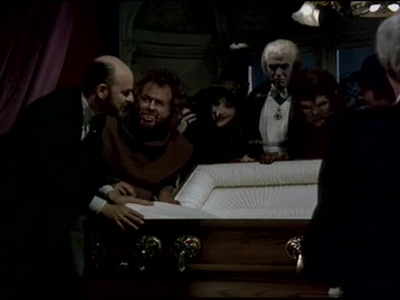
At this point, I thought the story was over; I mean, several of the Night Gallery stories are just “funny” little vignettes like this. But tragically, no; it keeps on going. So the day of Asper’s funeral arrives, and Asper shows up early, pleased that everything is exactly to his specifications. As he checks out the casket, his guests start to arrive, and oh boy, it’s like a Jaycees haunted house from the 1970s unloaded all over the set: there’s a cackling, Cockney-accented witch with a massive nose and a stuffed black cat perched on her shoulder; there’s a werewolf who just howls and barks; there’s a distinguished, blue-skinned male vampire with the requisite cape; there’s a female vampire (I think) who looks like Lily Munster; there’s a Peter Lorre-sounding Igor guy; it’s like every cheeseball Halloween cliché came clambering out of a low-rent costume shop and decided to do some bad community theater. I felt such contact embarrassment for everyone involved that I almost fast-forwarded through it, not gonna lie.
Well, as much as the older vampire tries to keep things dignified during the service as Asper lies happily in his coffin, the witch keeps talking smack, the werewolf causes constant disruptions because he has to leave soon for an “appointment,” and not-Igor invades the personal space of the funeral director, who is looking on in horror and disbelief.
The whole shitshow culminates with the impatient werewolf jumping out the window when the service goes on too long, and the witch burning half the place down with her witchcraft when Asper tries to get her to leave for acting an ass. It actually appears as though the place mostly goes up in flames and Silkline looks like he dies of smoke inhalation, but this wasn’t really what happened, because in the following scene, the funeral parlor appears intact, and Silkline is completely fine. In fact, he gets a new potential customer in his office, who was referred by the satisfied Asper evidently, only this monster is some kind of ghost or something with a red glowing face who chokes Silkline with thick smoke while he’s trying to write down the details. Komedy!
Man, where do I start? As I mentioned on past breakdowns, I don’t really see the point of these silly installments. Don’t get me wrong, I’m not averse to horror comedy as a subgenre, but it would help if the shit was, y’know, actually funny rather than making me want to jab roofing nails in my eyes (and ears). I still love Richard Matheson, but damn, he missed the whole entire flotilla of boats on this one. Woof.
The third story is easily the best of the bunch, even though the outcome is a bit murky and the narrative gets a tad repetitive. “The Tune in Dan’s Café” was written by Gerald Sanford and Garrie Bateson from a short story by Shamus Frazier, and it was directed by David Rawlins.
Joe and Kelly (played by Pernell Roberts and Susan Oliver, respectively) are in the middle of a marriage breakdown. They’ve presumably been on a road trip to sort out their issues, but upon arriving at a lonely café in the middle of nowhere one night, it’s clear that they haven’t spoken hardly at all during the journey and are heading for Splitsville.
They go into the café, and even though the door is unlocked and the “open” sign is lit, the place looks deserted, with most of the lights out and neither customers nor employees to be seen. Despite this, the couple slide into a booth; Kelly distractedly scans a menu while Joe desperately tries to talk to her, but she’s not giving him any answers.
Frustrated with the awkward silence, Joe moseys over to the jukebox against the opposite wall, exclaiming that it contains a somewhat obscure song that was playing when he and Kelly first met. He drops some change into the machine and saunters back to the table, hoping the tune will conjure up some pleasant memories, but to his consternation, a different song begins to play, a somewhat sad, country-ish tune. Joe figures he must have just pushed the wrong button, or the records in the jukebox weren’t placed in there properly. No big deal.
Finally, the proprietor of the place emerges, likely the titular Dan (James Nusser). He apologetically says he was out back and didn’t hear them, and after they order, he starts making them some burgers.
Joe tries to play the song he wants on the jukebox, but nothing doing; no matter which button he presses, it seems, the machine always plays that same sad country song. And not only that, but the song always starts to skip at the exact same spot, even though it appears that a different record plays every time.
Joe asks Dan what gives, and Dan says that he’s replaced every record in the thing multiple times, and even replaced the whole machine at one point, but it still does the same thing. He doesn’t come out and say that he believes the phenomenon is supernatural, but it’s obvious he thinks that.
He then explains that this particular song was “the song” of a couple who used to frequent the place whose names were Roy and Red (James Davidson and Brooke Mills, respectively). We as the audience know that something bad likely happened to them, because all during the story, we’ve been seeing brief flashes of this couple in a bar, and quick shots of the glass breaking on the front of the jukebox, causing the record to skip.
Dan says something about a deal gone bad, and speculating what would happen if Red ever came back, implying that he’s not looking forward to that day.
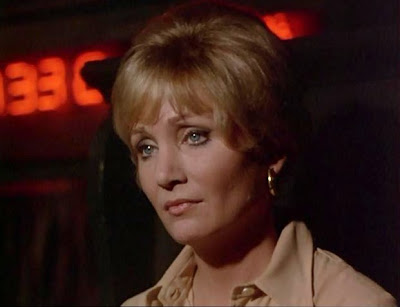
After a bit, the jukebox starts playing the song on its own, at which point Joe and Kelly get sort of creeped out and decide to leave. As they’re getting in their car in the parking lot, another car pulls up with a man driving, and a passenger who is clearly Red, although I was taken out of the story a bit at this point, because how would Joe have recognized her? He’s never seen her before, and even though Dan told him about her, it’s not like he can project his memories for Joe to look at. The audience knows what she looks like because we’ve seen her in the flashbacks, but unless Dan described her in great detail (which he’s never shown doing), then Joe wouldn’t necessarily have any reason to believe it was her, other than her also having red hair. Maybe he was just primed for it because Dan said something about her coming back, but I dunno.
Through implication and dialogue, we piece together that Roy and Red had stolen some money, then Red double-crossed Roy and turned his ass in, and he ended up being killed by police in a shootout at the café, where the jukebox was destroyed while that record was playing. It’s evidently been Roy’s ghost haunting the jukebox and waiting for his faithless girlfriend to come back, and indeed, when Red and what we’re led to assume is her new paramour enter the café, there’s a scream from inside, and we cut to black. We never get to see exactly what happened to Red, though; it’s left to the imagination.
As I mentioned, this was easily the best story out of the three; the acting was good, the setup was nice and eerie, and although the ending left things vague, there were enough clues scattered throughout to get the gist of what happened. I don’t think this one ranks among the best of the series, but it was pretty damn solid regardless.
That’s a wrap for this episode, but stay tuned, as I’ll eventually work my way through all of these (although obviously that’s going to take a while). Until next time, keep it creepy, my friends.
 The Scare Salon