As I alluded to in my previous post about my twenty favorite horror movies of 2025, I had made a big list of films I wanted to see before the end of the year to judge if any of them were in contention, but I just ran out of time. One of these movies was the independent neo-noir thriller A Desert, which was directed by Joshua Erkman and which I saw recommended on a few Reddit lists here and there and sounded interesting. I finally got to check it out when it recently dropped on Shudder.
As with most movies, this one is not for everybody; it’s very deliberately paced, and those looking for wall to wall action and gore should look elsewhere. This is a somewhat quiet psychological horror, steeped in desert hues and sweeping, empty vistas, with only occasional and somewhat shocking flashes of violence, but a vibe of palpable menace throughout.
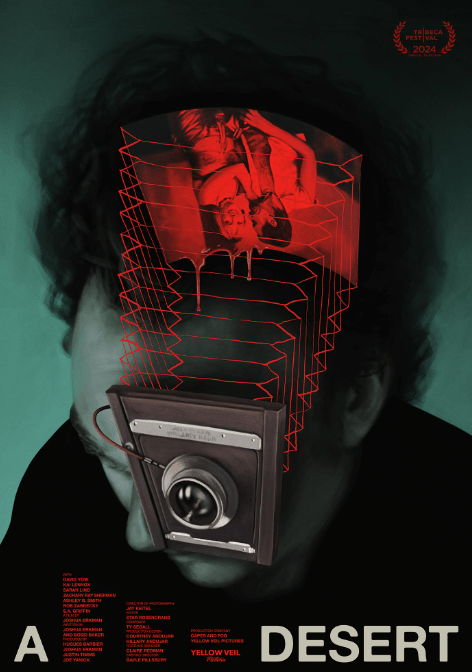
I’ve seen it put in the same ballpark as a Hitchcock film, the Coen brothers’ No Country for Old Men, or maybe a David Lynch movie, and those are sort of accurate, though admittedly A Desert doesn’t reach those lofty heights (but then again, what does?).
I’ll also note that while I’m not going to spoil the film, there is a pretty big event that happens about a half hour into the movie that sends it off in a different direction, and just mentioning that fact is probably a spoiler in itself, though pointing it out doesn’t really ruin the movie or anything. I’ll try to keep it vague, but if you want to watch it completely blind, then maybe come back and read this later.
So our main character is a photographer named Alex (Kai Lennox), who is on a road trip in the desert, trying to get his creative mojo back. We learn as he drives around and talks to his wife Sam (Sarah Lind) on the phone that although he was once fairly successful, he’s been sort of circling the drain recently and is trying to recapture the magic of what made his first published book of photographs such a hit. He mainly takes pictures of forlorn, abandoned buildings, and on this trip, he’s attempting to replicate the conditions of the trip where he took those first photos: bulky antique camera, no cell phone (he just uses landlines at motels), and no GPS. He wants to get deliberately lost and capture images he finds along the way.
Though his wife is supportive, she’s also, judging from her tone of voice during the phone calls, getting pretty worried that his income is drying up and that she’s going to be fully supporting them in the foreseeable future. The tension between them is subtle, but undeniably there, and we learn a little more about their history later on in the narrative.
For the first twenty minutes or so of the movie, we follow Alex as he drives around, looking for things to photograph, and talking to his wife on the phone in the evenings about what he discovered on his ramblings that day. But then, while he’s staying at a seedy desert motel, he hears alarming sounds coming from the room next door, as though a couple is arguing and someone is possibly getting beaten. Not wanting to be directly involved but still feeling like he should do something, Alex discreetly reports the fight to the sketchy dude at the front desk, specifically telling him not to tell the couple that it was him who reported them.
Well, that goes about as well as you’d expect, and the desk guy absolutely tells the couple that the dude next door reported them for noise. Moments later, a knock on Alex’s door reveals Renny (Zachary Ray Sherman), a twitchy, Charles Manson-looking motherfucker who is patently shady, but also apologetic about the disturbance. He says that he and his ostensible sister Susie Q (Ashley Smith) were just arguing and it was no big deal; she was just being a bitch, like she does.
Renny then spots Alex’s old school camera in the room behind him, and when Alex tells him what it is, he asks if Alex will take his and his sister’s picture. Alex is reluctant, not only because Renny seems like kind of a skeevy weirdo, but also because he doesn’t do many portraits. But then he reconsiders; he did, after all, take an old man’s picture at a junkyard earlier in the day, and he had said to his wife on the phone that maybe he should do more portraits. And hell, he reasons, the whole point of this trip was to try and free his mind, to get his creative juices flowing again by just letting things ride. So why not?
Renny goes to get Susie Q, and they both enter Alex’s room, armed with a bottle of extremely strong liquor (maybe moonshine, but it isn’t specified). Not only is Susie Q not upset or hurt at all about the earlier confrontation with her brother, but she’s smoking hot, pretty clearly a prostitute, and openly flirtatious with Alex.
Alex starts taking pictures of them, and the pair is able to convince him to drink some (okay, a lot) of their booze. Now, you know and I know that this isn’t going anywhere good, and as the liquor flows, sexual shenanigans begin to take place.
The following morning, Alex awakens alone in his room with a devastating hangover and only fragmented memories of what went down the night before. Neither Renny nor Susie Q are around, and it doesn’t appear as though they stole his money or swiped his kidneys or anything, so hoping to god he didn’t cheat on his wife during his drunken stupor, he heads to a convenience store for some water and antacids before chalking it all up to a silly misadventure and heading out of town.
But not so fast. Emerging from the store, he sees Renny walking up, friendly as you please. Alex asks what exactly took place and specifically if he had sex with Susie Q, and Renny messes with him a bit before laughing and telling him that nothing really happened. Relieved, Alex says he’s gonna scoot, but then Renny says that he knows a cool place nearby that would be great material for Alex’s photographs.
Unwisely, Alex eventually allows himself to be convinced to take Renny to the spot he was talking about, and although Renny wasn’t lying about the view being pretty awesome, things begin to go decidedly downhill after this point.
As I mentioned, there’s a large plot pivot here that I won’t spoil outright, but afterward, the movie mostly starts to follow a different (but related) set of characters (including a grizzled private investigator played by David Yow) and becomes a bit more like a mystery than a tense psychological thriller (though it still has aspects of that). Many reviews I read liked the first half of the movie but thought the second half wasn’t as strong; I’m not sure I agree, as I was just as invested in the story in the latter part of the film, but as usual, your mileage may vary.
A Desert makes great use of its locations, and although the landscapes in the film are wide open, they are also barren and somehow oppressive, giving the whole film an air of constant peril. Adding to the mood, Renny in particular is an outstanding character, obviously dangerous but unpredictable, with unclear motives about what he wants from Alex.
I ended up liking this quite a bit and found it riveting from beginning to end, but again, it has a slow pace and long stretches with no dialogue (especially in the first half), so if that’s not your thing, you probably should give this one a pass. But if you like more reserved, muted horror that every now and then busts out the brutality, then you might want to give it a look.
Until next time, keep it creepy, my friends.
 The Scare Salon