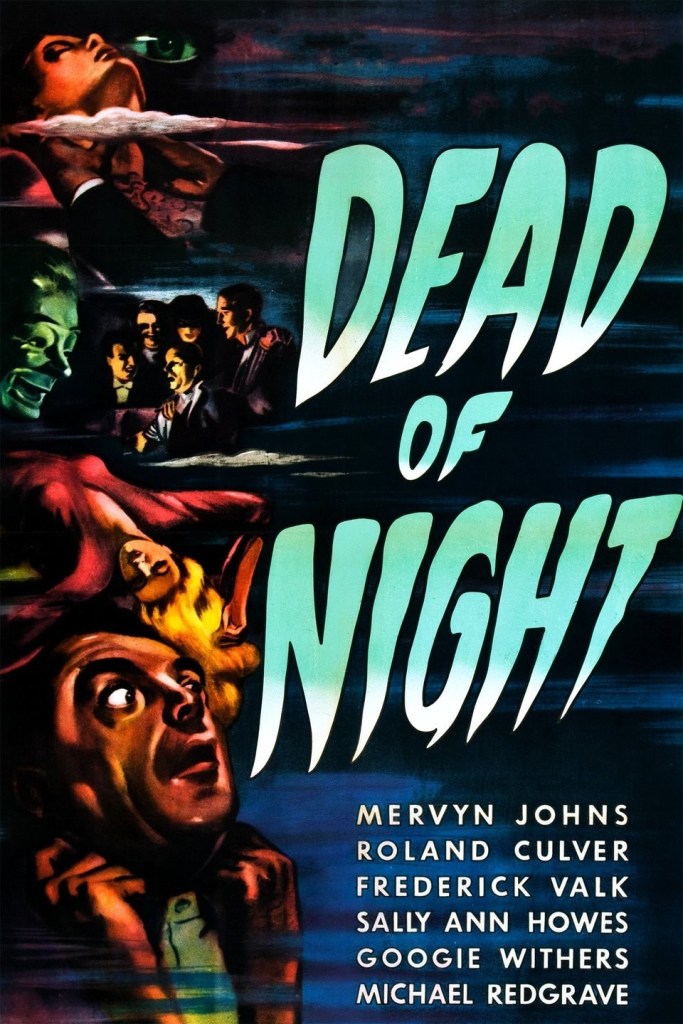
Most horror fans with knowledge of the classics will have likely heard of the 1945 British anthology film Dead of Night, which was not only one of the very few horror films to come out of the UK in the 1940s, but was massively influential in the horror anthology subgenre going forward. In addition to that, its iconic final segment about an evil ventriloquist’s dummy has turned up on several “scariest horror scenes” lists over the years and inspired many similarly themed films right up until the present day.
Dead of Night consists of five stories told within a fantastically suspenseful frame narrative, and although I admit I could have done without the one comedic tale, overall this was a decent slice of 40s horror goodness, spooky and fun and well-shot, and genuinely atmospheric at times.
The frame story sees an architect named Walter Craig (Mervyn Johns) arriving at a large old country house. He has been summoned there by Elliot Foley (Roland Culver), who wants Walter to consult on some renovations. Also present at the house is psychologist Dr. van Straaten (Frederick Valk), race car driver Hugh Grainger (Anthony Baird), teenager Sally O’Hara (Sally Ann Howes), and socialite Joan Cortland (Googie Withers).
The audience’s interest is piqued almost immediately, because within minutes of arriving, Walter insists that he has had a recurring nightmare about this house and all the people there, even though he’s never set foot in the place and has never met any of them before. Most of the guests are fascinated and eagerly ask him about his dream, but Dr. van Straaten is skeptical, claiming that Walter must have seen all these people somewhere before, such as walking around in town or perhaps when their pictures were in the newspaper for various reasons. This explanation becomes less tenable after Walter is able to accurately predict a few minor things before they happen, however.
Other than Dr. van Straaten, the remaining guests believe Walter really did dream about this situation, and in solidarity, they each begin telling their own story about a time when something seemingly supernatural happened to them, too.
The first to speak up is Hugh Grainger, who regales the group with an anecdote about the time he was hospitalized after a terrible car racing accident. This particular story was the most familiar one to me, as it’s a variation of the fairly well-known E.F. Benson tale, “The Bus-Conductor.” In this version, Hugh is recovering in his hospital bed, and though it’s ostensibly the middle of the night, the time on the nightstand clock inexplicably changes. Hugh pulls aside the curtains and sees that not only is it full daylight, but there’s a horse-drawn hearse parked below his window as though it’s waiting for him. Hugh looks down in horror, only for the hearse driver (Miles Malleson) to look up at him and say, “Just room for one inside, sir.” Hugh freaks out, but when he looks again, the hearse is gone.
Some time later, Hugh is released from the hospital and goes to board a bus to take him home, but the bus conductor looks just like the hearse driver from his vision, and says the exact same words the hearse driver did. A frightened Hugh steps back off the bus, and watches helplessly as it drives off without him, loses control, and plunges down an embankment, presumably killing everyone on board.
We return to the frame story then, and Dr. van Straaten attempts to explain away Hugh’s experience, saying the hearse thing was probably just a dream, and that the bus conductor may not have even looked like the hearse driver anyway, but Hugh just perceived that he did. The others chide the doctor for being such a stick in the mud, and then the teenaged Sally tells her story.
She says she was at a Christmas party at a mansion with a bunch of other teenagers who are all inexplicably wearing costumes (was it a Halloween Christmas party?). The kids decide to play hide and seek, and all scatter to find hiding spots. Sally initially hides in a sort of window alcove behind a curtain, but her friend Jimmy (Michael Allan) finds her right away and essentially tells her that it’s kind of a crummy hiding place. They go up into an attic type area and get separated, and then Sally finds a hidden door, behind which is a little boy who says his name is Francis Kent. He’s crying when she finds him, and he tells her that he’s afraid his sister Constance wants to hurt him.
Sally reassures the child and puts him to bed, then goes back downstairs. She tells the others about the kid, but none of them know what the hell she’s talking about because there isn’t supposed to be anyone else in the house. She tells them the boy’s name, and Jimmy says she must have heard about the murder that happened back in the nineteenth century. She insists she didn’t know anything about it, but the others explain that a little boy named Francis Kent was murdered in that very house by his sister Constance back in the 1800s.
Incidentally, Sally’s story is based on a real 1860 murder case, in which sixteen-year-old Constance Kent brutally stabbed her three-year-old half-brother Francis to death, then threw his body down the privy. There’s a fantastic book about the case that I read years ago called The Suspicions of Mr Whicher or The Murder at Road Hill House by Kate Summerscale, and I recommend it if you’re into true crime, especially murders from the Victorian era.
Anyway, Dr. van Straaten has a bit more trouble explaining Sally’s account away, but still condescendingly insists that there must be a rational explanation. At this point, Joan Cortland volunteers to tell her tale, which is a tad more intense than the ones that came before.
She says that she bought a beautiful antique mirror as a birthday present for her fiancé Peter (Ralph Michael). He loved it and installed it in his bedroom, but not long afterward, he began seeing a different room reflected in the mirror, one with wood paneling, a fireplace, and a big four-poster bed. Sometimes the reflection looked as it was supposed to, but as time went on, he started seeing the other room with more and more frequency, and it started to wig him out, as he felt as though the room was trying to trap him.
Joan and Peter get married and bring the mirror with them to their new home, even though Joan tells her new husband he can get rid of the mirror if it’s bothering him so much. He’s weirdly fascinated or enthralled by it, though, and seems reluctant to part with it. Joan attempts to get him to see that it’s all his imagination, which works for a short time, but Joan then sees firsthand that Peter is completely convinced he sees a different room than she does when he looks in the mirror. And what’s more, he can’t see Joan reflected in the mirror even when she’s standing right there.
Troubled, Joan goes off to visit her mother for a few days, and while they’re shopping, Joan passes the store where she bought the mirror. She pops in and asks the proprietor about where it came from, and also notices that there’s a four-poster bed in the shop, just like the one her husband described in the mirror room. The antique dealer tells her that both the mirror and the bed came from the same estate sale, and that the owner of both pieces of furniture had strangled his wife to death after suspecting she was having an affair, then committed suicide by slashing his own throat.
Joan, now certain that Peter is having a legitimate supernatural experience, goes back home to tell him what she found out, but Peter accuses her (wrongly) of seeing another man and attempts to kill her. Thankfully, she smashes the mirror before he can finish the job, which snaps Peter out of his spell. It’s implied that Peter was perhaps possessed by the man who had owned the mirror, and was doomed to repeat his crimes.
Everyone is pretty stunned by this story and expresses sympathy for Joan, due to all that “husband-attempting-to-murder-her” thing. And then the homeowner and host, Elliot Foley, throws his hat into the ring, as it were, and begins telling his own tale.
Elliot’s story, based on H.G. Wells’ “The Story of the Inexperienced Ghost,” is the sole comedic installment in the film, and while it’s entertaining, I admit it sort of lets the air out of the movie’s sails a little bit. I get the impression that because the previous story (and the one following it) are much darker, this funny one was wedged in there to lighten the mood and give the audience a breather. I’ve noticed some horror anthologies still do this, too, where they feel the need to put at least one lighthearted or funny story in there in order to break the tension, I guess. I’ve never liked it, but what are you going to do?
Anyway, Elliot’s story doesn’t actually involve him personally, but is instead an account of two golfing buddies, George and Larry (Basil Radford and Naunton Wayne, respectively), who are both madly in love with the same woman, Mary Lee (Peggy Bryan).
Because Mary Lee can’t decide which of these dumpy middle-aged dudes she likes the most, George and Larry decide to play a round of golf for her; winner gets Mary Lee, loser gets lost.
George wins the game, but it’s pretty clear he cheated, despite his arguments to the contrary. Bizarrely, after the game is over, loser Larry simply walks into the lake and drowns himself, while George and the two caddies stand there doing absolutely fuck all. No one even says, “Hey Larry, whatcha doing,” or tries to stop him. It was really, really weird.
George, not upset at all that his best friend is dead, starts to woo Mary Lee and soon enough, they’re engaged. But Larry isn’t done with him just yet, and starts haunting his cheating ass. George can see him but no one else can, so there are a few amusing scenes of people watching George talking and gesturing to someone who isn’t there, and things of that nature.
Larry basically says he’s going to hang around indefinitely unless George gives Mary up for good, since he got her by cheating at the golf game. George agrees to do that, but then just marries her instead. Larry subsequently becomes a real pesky pants, even threatening to fuck up all of George’s golf games in the future, and it’s this that finally convinces George to divorce Mary so that Larry will stop haunting him.
Not so fast, though. Seems that after the bargain is struck, Larry discovers he’s forgotten how to vanish. He keeps doing this series of ridiculous hand gestures that he claimed he learned in ghost school, but he’s not going anywhere. George, desperate to be rid of this cockblocking ghost, tries to help him remember the vanishing spell, but nothing doing.
The silly charade continues until George’s wedding night, and it’s actually sort of funny seeing George attempting to delay consummating the marriage because Ghost Larry is gonna be right there watching them bang (kinky). At last, George attempts to suggest some gestures of his own, and ends up making HIMSELF vanish, even though he is presumably still alive and this turn of events makes no sense within the context of the story. Ghost Larry, still stuck in the material plane, then shrugs and makes his way toward the bedroom, where Mary Lee is waiting for George to dick her down. Little does she know that she’s gonna get some invisible man action this evening rather than the corporeal pork sword she was expecting.
After this story, the assembled company in the country house chuckle heartily, and Elliot basically implies that the story didn’t really happen, but he just told it because everyone else was telling one and he felt left out. Way to be an attention whore, Elliot.
At this point, the rest of the party start asking Dr. van Straaten what his story is; yes, he’s a man of science and all that, but surely he must have had something strange happen over the course of his long career. The doctor admits that there was one really odd case, and he proceeds to tell the most fondly remembered story in the whole film.
He says he was a consultant on a case where a ventriloquist named Maxwell Frere (Michael Redgrave) had shot another ventriloquist named Sylvester Kee (Hartley Power), though the victim had survived his injuries. Maxwell was insisting to everyone that he wasn’t entirely responsible for what happened, for reasons that become clearer as the tale goes on.
You see, Maxwell performed with a dummy named Hugo, and anyone who saw his act immediately noticed that Maxwell and Hugo had something of a contentious relationship, with Hugo talking about how lame Maxwell was and how he was going to take off and work with another ventriloquist. I think this angle of the ventriloquist being berated by the dummy may have been a partial inspiration for the 1976 William Goldman novel Magic, which was turned into an excellent 1978 film starring Anthony Hopkins.
At one of Maxwell’s shows, an American ventriloquist named Sylvester Kee is delighted by the act, particularly when Hugo tells him outright that he’s going to ditch Maxwell and throw his lot in with him. Thinking, of course, that Maxwell is indirectly asking him to collaborate, Sylvester goes back to Maxwell’s dressing room, but is a little creeped out when Hugo, sitting alone on a sofa, seems to talk to him even though Maxwell is in the bathroom. When Maxwell comes out, he doesn’t appear to have any idea what Hugo said. At this point, Sylvester still thinks Maxwell is doing a bit, but for what purpose, he isn’t sure.
He becomes even less sure when he witnesses Maxwell getting his hand bitten when he tries to quiet Hugo down, and later in a hotel bar, a very drunk Maxwell gets his ass kicked when Hugo insults a woman who’s there with a male friend. Sylvester, who is staying in the same hotel, rescues Maxwell and takes him upstairs to sleep it off, leaving Hugo at the foot of Maxwell’s bed.
Sometime during the night, though, Hugo disappears from the room, and a livid Maxwell busts into Sylvester’s room, accusing the other ventriloquist of stealing Hugo and then filling the guy full of lead. Like I said, Sylvester isn’t killed, and he later visits Maxwell in jail. Dr. van Straaten relates how he surreptitiously watched Maxwell talking to Hugo as though Hugo was a separate person, and he concludes that Maxwell is batshit crazy. He gets thrown in an asylum, where he starts speaking in Hugo’s voice.
After this story, Dr. van Straaten assures the others that he doesn’t believe there was anything paranormal going on or that Hugo was actually alive. He opined that Maxwell just had a split personality type thing going on, and moved the dummy around himself without being aware of it.
We then come to the conclusion of the frame story, which has been building up suspense this entire time, with little creepy details being dropped in between each of the stories. Walter Craig had, as I mentioned, predicted a few things that ended up happening—such as Sally’s mother arriving unexpectedly to take the girl home, and Dr. van Straaten breaking his glasses—and he also said that the dream didn’t get really horrifying until after a man told him about the death of another man he didn’t know. This particular prediction was seemingly met when Elliot told the story about Larry drowning himself, but nothing terrible happened after that point, so Dr. van Straaten thinks the whole thing is hogwash. Walter tries to get the doctor to leave before the terrible thing happens, but the doctor won’t heed the warning.
With Sally gone, Elliot and Joan both go upstairs for different reasons, leaving Walter and Dr. van Straaten alone in the darkened parlor. Walter tells the doctor that he should have left when he was warned, but that now it was too late to stop what was going to happen. Walter, presumably under the influence of some greater force, then strangles the doctor to death.
You might think that’s the end, but again, not so fast. Right after the murder, Walter wakes up in what we’re led to assume is his own bed at home. His wife is there, and he tells her he got a phone call about a renovation job and has to go out to some country house to meet with the homeowner. We then see him driving up the long road to the house from the beginning of the film, and thus the loop begins anew. I’ll note that Walter mentioned during the course of the movie that he had the nightmare about the house all the time, but that he always started to forget it as soon as he woke up. The audience is thus left wondering whether his dream has predicted the coming events, or if he’s just beginning the nightmare all over again.
If you’re a fan of British golden-age horror and particularly a fan of anthologies, then this is a must-see; obviously it’s dated by today’s standards and likely won’t hold any surprises because the stories have been told many times since then, but if you want to see an early example of a horror anthology done right, then you owe it to yourself to give Dead of Night a watch. It’s a tad uneven in places, but the wraparound story is great, and the haunted mirror and evil ventriloquist tales are a real treat as well. A definite classic.
Until next time, keep it creepy, my friends.
 The Scare Salon