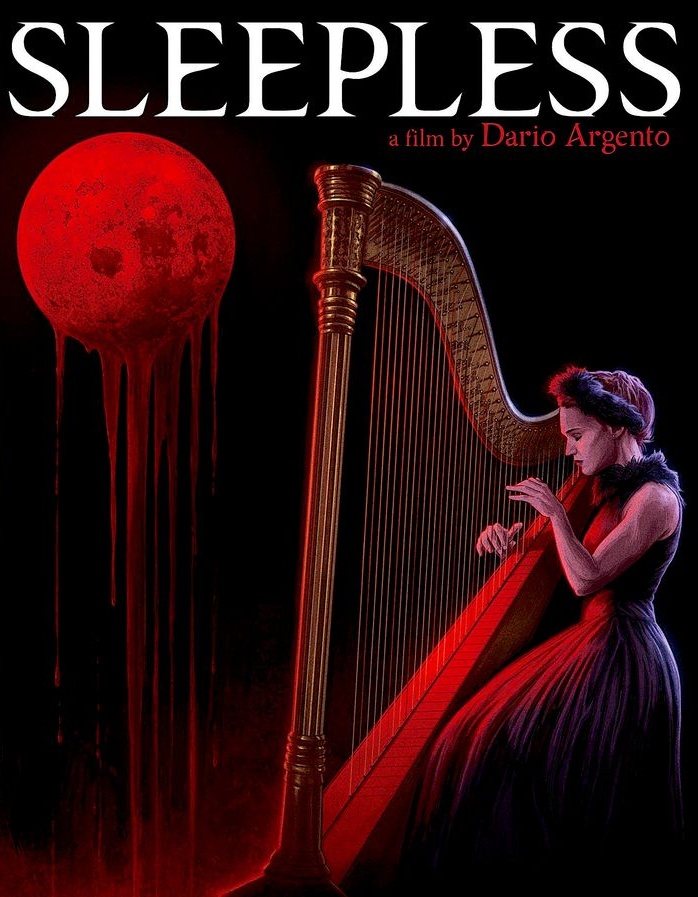
Y’all should know by now how much I love Dario Argento, right? Suspiria and Deep Red are two of my favorite horror films of all time, and pretty much all of his early work is brilliant. But as I’ve also mentioned a time or two (or fifty), his output after the 1980s is a mixed bag at best. I’ll happily go to bat for 1993’s Trauma and 1996’s The Stendhal Syndrome; hell, even 2022’s Dark Glasses wasn’t half bad. However, 2004’s The Card Player, 2007’s Mother of Tears, and 2012’s Dracula 3D can fuck all the way off, into the sun if possible.
All that said, I decided the other day to revisit one of his early 2000s films that I saw years ago and quite liked, though very scant details of it remained in my memory. The movie I’m talking about is 2001’s Sleepless (originally released in Italy as Non ho sonno), which I feel has sort of fallen in between the cracks of his filmography. You don’t really hear many people discussing it nowadays, either positively or negatively, so I wanted to give it another look.
And I’m pleased to report that Sleepless was actually much better than I remembered. Don’t get me wrong, it’s not a great film by any stretch, and it borrows very heavily from some of Argento’s classic giallo movies of old (such as its vague plot similarity to The Cat o’Nine Tails, the “witness struggles to remember one important but forgotten clue” angle from The Bird with the Crystal Plumage and Deep Red, and the “small walking puppet” deal from Deep Red), but it has some standout acting performances (particularly from the legendary Max von Sydow) and a lot of the visual and stylistic flair Argento is famed for (as well as some pretty gnarly gore). The score (by frequent Argento collaborators Goblin) is pretty rad too.
Please note, just as an aside, that I’ve heard the English dubbing on a common version of Sleepless is dire enough to be distracting, but thankfully the version I watched on Tubi is dubbed into Italian with English subtitles, and is perfectly satisfactory.
So after a very brief flashback scene in which police detective Ulisse Moretti (Max von Sydow) is reassuring a young boy in 1983 that he’ll catch the person who brutally killed his mother, we jump to the present day and go into a tense, well-executed opening sequence. A sex worker, Angela (Barbara Lerici), is in the apartment of an unseen client, angrily telling him that she won’t do any of that “gross” stuff. A shadowy wave of a significant handful of cash quickly changes her tune, however, though we’re left to imagine what “gross” acts she was referring to (Cleveland steamer? Never mind, I don’t want to know).
After the john falls asleep, he starts mumbling in a weird, childlike voice about all the people he’s killed and how nobody knows about it, and Angela wisely decides to make a hasty exit. Unfortunately, on the way out, she trips over something or other and the contents of her bag spill all over the floor. Scrambling to collect her shit before the purportedly murderous client comes after her, she mistakenly scoops up a blue file folder and crams it in her purse before fleeing into the night.
She makes it to the train shortly before three in the morning and calls her friend Amanda (Conchita Puglisi) to tell her about her close call, and to ask her to pick her up at the train station. While she’s talking, she opens the blue folder, realizing she accidentally took it from the john’s apartment. She’s horrified to discover that it contains newspaper clippings about a guy known as The Dwarf Killer, who perpetrated a series of murders back in the 80s, as well as some Polaroids of what are clearly his victims. She’s now more certain that ever that she just escaped a serial killer, and her fears are confirmed when a man with a creepy voice calls her and tells her he knows she has the folder.
Paranoid, she makes her way to the front of the nearly empty train, informing one of the porters that she thinks someone might be after her. He obviously thinks she’s being silly, but agrees to let her sit up front with him for her own protection.
It will surprise no one, though, that shit doesn’t work out the way she planned; somehow the killer is already on the train with her, and there’s a great, nail-biting sequence where she’s trying to hide from him after the porter she spoke to earlier ends up dead. It will also surprise no one that Angela doesn’t remain among the living for long either, getting first her finger cut off, and then her whole-ass throat sliced open.
The killer actually doesn’t find the blue folder immediately since it slipped between the seats in the compartment Angela was in before she left in a panic. But when the train arrives at the station, Angela’s friend Amanda is there to pick her up, and mightily troubled when Angela doesn’t disembark. Amanda hops on the train to have a look for her friend, finding Angela’s gold pin and also the blue folder, which Angela had told her about over the phone. Worried, she collects everything and jumps back off the train before it leaves. She gets in her car in the station parking lot, but soon enough, she is also dispatched by our mysterious killer, who drops an expensive-looking gold fountain pen as he rushes away from the scene.
We then check back in with Detective Ulisse Moretti, who is now retired and lives alone with his pet bird. Because the latest murders are similar to the ones from 1983, the authorities consult with Moretti to see if he might give them any insight. It’s here we discover that the Dwarf Murders of 1983 were so named because the main suspect was a little person by the name of Vincenzo de Fabritiis (Luca Fagioli), a crime writer who always maintained his innocence. His body was ultimately found in the river back then, the victim of an apparent suicide, so he was never formally charged with the murders. Moretti always had doubts about whether he was guilty or not, even though witnesses had described the Dwarf Killer as…well, a dwarf, obviously, and there apparently weren’t too many of them around to pin the crimes on.
We also follow a young man named Giacomo (Stefano Dionisi), who is the grown-up version of the boy whose mother was killed in 1983. He has some friends he hangs out with, one of whom is the very wealthy Lorenzo (Roberto Zibetti), and another of whom is Gloria (Chiara Caselli), who he starts to develop feelings for even though she has a (douchey) boyfriend; she becomes more receptive to Giacomo’s interest as the story goes on.
More murders begin to occur, and these are very clearly following the same pattern as the Dwarf Murders, in that each one is homaging a line in a nursery rhyme about a farmer whose animals wake him up in the middle of the night with their noise, so he slaughters them one by one in various gruesome ways. One of the victims is a dancer at a club called Zoo who dresses like a cat, for example, and one is in costume for a performance of Swan Lake; that kind of thing. The kills are pretty savage, all things considered; the swan lady gets beheaded, one victim gets her face repeatedly smashed teeth-first into a concrete wall, and in a flashback, we see Giacomo’s mom’s mouth and lower face being absolutely annihilated by an English horn, of all things.
Because the slayings eerily recall the Dwarf Murders, police are beginning to wonder whether they have a copycat, or whether main suspect Vincenzo might have somehow faked his own death and is now on the rampage again. The mystery is compounded by the fact that when investigators check Vincenzo’s tomb, they discover that his body is gone.
There’s also the small matter of a strange sound that Giacomo heard as he was watching his mother get murdered; it was a very distinctive noise that he’s sure he’d heard before, but for years, he hasn’t been able to place it.
Moretti also makes a map of the original Dwarf Murders and the recent ones, and can’t figure out why the 1983 killings were all confined to one neighborhood, while the newer ones are spread out all over the city.
The identity of the killer becomes clearer as the story goes on, though there are some twists and turns in there (such as some victims seeing what appears to be Vincenzo lurking in the shadows) that keep things interesting. I will note, though, that one clue that’s dropped early on in the movie telegraphs very obviously at least one of the people involved.
As I said, this isn’t a masterpiece by any stretch of the imagination; it’s a bit convoluted, drags slightly in parts, has some fairly gaping plot holes, and is derivative of Argento’s earlier work in a way that almost feels like pastiche. But let’s give credit where it’s due: when Sleepless hits, it hits. Argento’s knack for crafting visually stunning set pieces is still here, even if it’s a bit rusty. The murder scenes are operatic in their brutality, with enough gory detail to please pretty much any horror hound. And the camera work—those sweeping pans, tight zooms, and lurid close-ups—reminds you why Argento was once the king of giallo.
Max von Sydow, I have to say, is the film’s secret weapon, delivering a performance that’s equal parts gravitas and “I’m too old for this shit.” His Moretti is a weary, whiskey-soaked detective who’s seen too much and slept too little, and von Sydow plays it with subtlety and class. The man could read a phone book and make it compelling, so watching him navigate Argento’s chaos is pretty delightful.
Sleepless is not Argento’s finest hour, but it’s far from his worst, and I was pleasantly surprised by how much I ended up enjoying it. If you’re a die-hard Argento fan and haven’t seen it, it’s definitely worth watching just for Max von Sydow and the movie’s occasional flashes of the old Argento magic. If you’re new to Argento’s work or to giallo in general, I’d recommend starting with The Bird with the Crystal Plumage and Deep Red, then working your way through his earlier films before getting to this one.
That’s all for now, and remember to keep it creepy, my friends.
 The Scare Salon