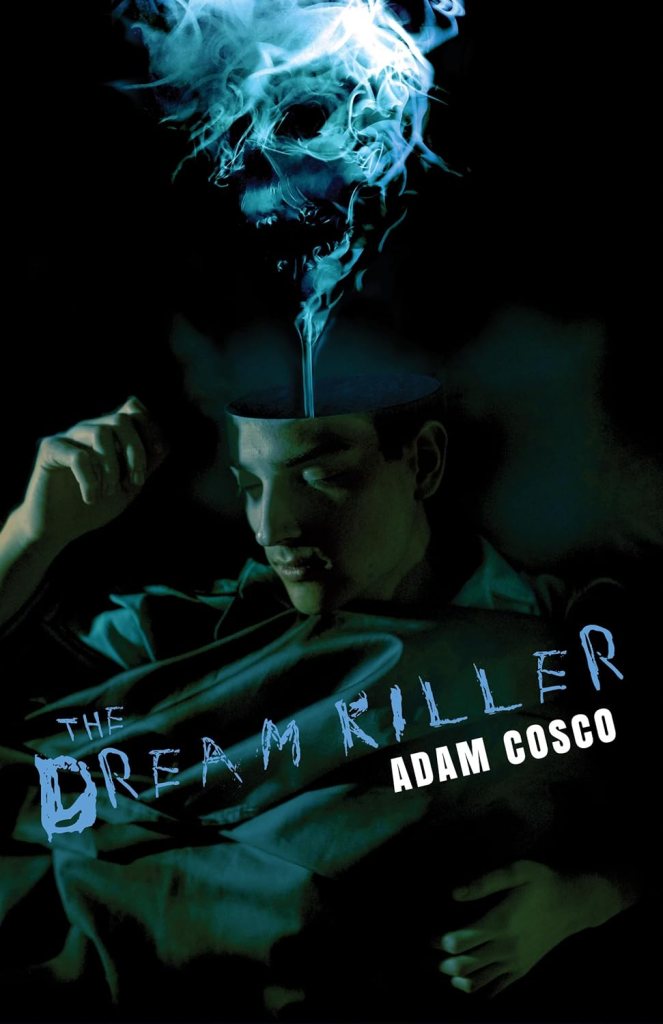
Canadian author Adam Cosco contacted me recently and offered to send me an honest-to-goodness print version of his latest novel, The Dream Killer, which was published on March 25th, 2025. I had never read anything by him before, but this appears to be his seventh book, and hot damn, if all of them are as dynamite as this one, then I’m gonna have a whole bunch of reading to do.
The thing about The Dream Killer is that it definitely goes in directions you don’t necessarily expect, and for that reason, I’m going to be careful what I say in this review to avoid any major spoilers. Knowing nothing about the story other than the most rudimentary set-up meant that I was taken along on a fantastically twisting ride that endlessly surprised me and tied my brain into knots.
That said, obviously I’m going to have to talk about the book a bit to review it with any depth, so if you’d rather know absolutely nothing about the story before diving in, then go read it and come back here after. I won’t be spoiling anything past the first third of the book or so, but this is your one and only blanket warning.
The first scene of the novel is very cinematic and pulls us into the events right away. A seemingly unremarkable man named Ethan Webman is awakened by the lights and sounds emanating from police helicopters hovering near his house. We find out in short order that the authorities are on day three of the search for a missing eleven-year-old girl named Mary Kay Redding, who disappeared on her walk home from school; the route she took had her passing right behind Ethan’s residence. Mary Kay was a prodigy, the youngest member of MENSA, and the media have speculated that she may have been working with the government for some undisclosed purpose.
The following day, Ethan returns home after a jog and goes to take a shower. Upon emerging from the bathroom, he spots a mysterious folded piece of paper that wasn’t there before. When he unfolds the paper, he sees a strange symbol: a black triangle with a white dot in each corner. Although the symbol seems uncomfortably familiar to him, he can’t quite place it, and the whole incident unsettles him immensely.
Shortly afterward, his mother comes over for dinner; she lost her husband, Ethan’s father, a year before, and it’s the anniversary of his death. She had given some of her husband’s things to Ethan to store because she couldn’t bear to look at them, but now that it’s been a year she decided she would like some of the items back. The first object she asks about is an old carpet that she and her husband had had for years; Ethan had been keeping it in his basement for her. He tells her he’ll go down there and get it.
Well, it turns out that rolled up inside the carpet is the body of Mary Kay Redding, and not only has she been murdered, but the killer has carved that same triangle symbol into the flesh of her back.
Ethan is horrified, as he’s certain he didn’t kill the girl. But if he didn’t, how did she end up here? Is someone trying to frame him? Ethan’s mother sees the body and immediately goes into damage control mode; she’s convinced that her son is innocent, but obviously, the girl’s dead body in his house is not a good look. She tells him she’s going to take care of it, and spirits the corpse away to dump it somewhere that it hopefully can’t be tied back to them.
Enter the lead detective on the case, Detective Harris. He interviews Ethan and his mother about Mary Kay’s disappearance as a routine since she vanished near his house, and Ethan’s mom covers for her son as slick as you please. Harris is no dummy, though, and he suspects that Ethan might be hiding something.
Meanwhile, a freaked-out Ethan starts trying to research the triangle symbol in the hopes that it will help him figure out what’s going on. He can’t find much, but eventually, he stumbles on a YouTube channel called Sophia in the Shadows. Sophia had posted a video called “The Dream Killer” that was taken down due to a copyright strike from something called The Krueger Institute (as in Freddy Krueger), but she still had it posted on her website, so Ethan watches it.
The video details the research of a man named James LaRoche, who was studying dreams; specifically, whether one could travel in their dreams and make tangible changes in the real world. Sorta like remote viewing, but actually having something you did in your dream have an effect in reality.
Because one of the things his research team did was to leave a triangle symbol on the subjects’ nightstands, Ethan becomes convinced that something like dream travel might be happening to him without his knowledge and that someone might be setting him up. He contacts Sophia and the two meet in person, trying to get to the bottom of Ethan’s terrifying experiences.
After this point, though, the novel goes into its second of three parts (which are called Lights, Camera, and Action, respectively), and the whole narrative shifts somewhat. I won’t reveal exactly what happens, but suffice it to say that the reality of the story up to now becomes upended in interesting ways, and as the book goes on, both the reader and the main character start to become increasingly uncertain of what’s real and what isn’t.
This was a great read, very immersive and pleasingly ominous, with a steadily building mystery that really kept your eyeballs glued to the page. Though it was a bit mind-bending at times, it wasn’t terribly hard to follow, and everything was adequately explained at the end without overdoing it. The whole vibe of it was so cool, in fact, that I would love for this to be made into a movie someday.
If I had one slight criticism, it would be that some words were overused, particularly in regard to the attributes of certain characters (Sophia, for example, was described several times as “sharp,” “commanding,” “precise,” etc.), but it wasn’t a big deal at all, and I only really noticed it toward the end.
I would definitely recommend this to anyone who’s into cerebral psychological horror, and is specifically a fan of stories having to do with shady government agencies using people’s paranormal powers as weapons (e.g. Scanners, Firestarter, Stranger Things) or anything involving dream narratives bleeding into the real world (e.g. Inception, Shutter Island, Altered States, A Nightmare on Elm Street).
Oh, and when you come across that QR code about three-quarters of the way through the book, please scan it; although the video it leads to is somewhat described in the text, it’s much better to see it visually, and I really admire that the author took the time to craft a piece of cool multimedia content that gives more detail and context to the story.
Thanks so much to Adam Cosco for sending me the book; I legitimately loved it and will definitely be reading more.
Until next time, keep it creepy, my friends.
 The Scare Salon