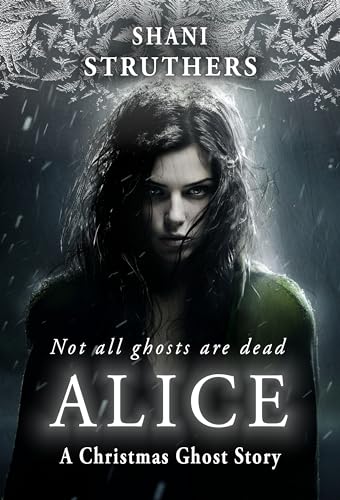
Since it’s getting to be about that time of year, I figured I should get into the holiday spirit by reading some Christmas-themed horror. And quite at random, I came across a spooky-sounding 2023 novel called Alice: A Christmas Ghost Story by prolific British author Shani Struthers. Just what Santa ordered!
Much like classic holiday ghost stories of old, this one is told as a frame story, but unlike classic ghost stories, this one doesn’t exactly have a ghost in the strictest sense of the word. I might not even call it horror; it’s almost more like a supernatural mystery. That said, it’s definitely an eerie, Christmas-heavy, and also surprisingly affecting tale of tragedy overcome by compassion; seriously, if you don’t tear up just a little bit at the end, then you might just be emotionally dead inside.
Our main protagonist is a nineteen-year-old woman named Lottie, who at the beginning of the story (set on Christmas Eve of 2023) is trying to get from Sunderland to London. The problem is, that a terrible snowstorm is blowing in, and both trains and buses have been canceled. Lottie is desperate to get to someone named Alice and tries everything she can think of, but no one, it seems, is willing to risk traveling so far in the worsening weather. Finally, at the end of her rope, Lottie phones a business called Tony’s Taxis, and Tony kindly agrees to take her, come what may. During their long, harrowing drive, Lottie tells Tony why she needs to get to London to see Alice so badly, and thus the tale then jumps back about a year.
In 2022, Lottie explains, she was at an awful place in her life. Her best (and pretty much only) friend in all the world, a young man named Matt, had recently died of leukemia, and she wasn’t sure how to go on without him. Also messing with her head is the fact that she’s somewhat psychic; more specifically, she’s an empath who can read people’s thoughts when she touches them, though generally only if they’re fairly close to death. Before Matt died, she was hugging him and felt his thoughts, which were all about how it wasn’t fair that Lottie got to live while he had to die, and how he wished she had been the one to get cancer instead. Understandably, Lottie feels horrible about this, not only guilty because she survived, but shocked at the depth of the anger, hatred, and blame he harbored toward her, and fearful that he took all of that with him into the afterlife.
So Lottie has fallen into a deep depression; she dropped out of school, has no plans for her future, and is sometimes unable to get out of bed for days at a time. Her mother Jenny, who she lives with, has been understanding up to a point but finally gives Lottie an ultimatum: either get a job and contribute to the rent, or get the hell out of the house.
Jenny actually has a friend named Patsy who owns a care home (or old folks’ home, if you’re American) called Silver Birches, and arranges for Lottie to work there. At first, Lottie can’t stand the place and plans to only work there for a couple of months to appease her mother. For one thing, Patsy is kind of an asshole, a tarted-up woman in her forties who cuts corners on her patients’ care but spends loads of money on fancy clothes and cars for herself, while also paying for lavish dates with a series of much younger men who never stick around for long.
Not only that, but the other employees aren’t all that compassionate about the people in their charge, treating them with somewhat careless efficiency and sedating them whenever they cause too much trouble. Initially, Lottie is sort of ambivalent about the residents of the care home, as many of them just stare off into space most of the time, but as she works there longer, she actually becomes more interested in them as people and seeks to show them the compassion that Patsy and the other workers won’t.
One of the things that contributes a great deal to Lottie’s change in attitude is her developing friendship with one of the residents, a saucy, feisty old lady named Bobby, who has absolutely no qualms about telling Patsy to shove it and who also doesn’t really like to hang out with the other “old people” in the place, even though she’s older than most of them. Lottie and Bobby become really close; Bobby loves Lottie’s blue hair, so Lottie dyes Bobby’s hair pink, and they spend all the time they can talking about their lives. Lottie even tells Bobby about her psychic gift, which no one but her mother knows about. Bobby, it turns out, has a bit of the same ability too, though not as pronounced as Lottie’s.
The thing that fascinates both women the most, however, is the story behind a mysterious patient in the care home named Alice, who lives in the room across the hall from Bobby’s. Alice has been in the home for a while, and as far as anyone knows, was transferred from another facility. She’s ninety-two years old and largely catatonic, just sitting in a chair staring out the window all day every day, and never speaking. Except on Christmas Eve, when she suddenly becomes very animated, fighting back against the care workers and screaming one word over and over: “Wish.”
Lottie senses a crushing sadness around Alice and becomes curious enough about her past to touch her hand to see what she can see. The visions she receives aren’t clear but comprise a completely black room, a group of seemingly uncaring medical personnel standing overhead, and an overwhelming sense of panic and terror. As time goes on, Lottie becomes determined to discover what happened to Alice that left her in such a state and also tries to learn to live with her abilities, which act as both a blessing and a curse.
This was quite a beautiful, sad, and sometimes disquieting tale that gave me wonderfully wintery vibes, and built up to an emotional crescendo at the end that was heartbreaking and uplifting at the same time. As I mentioned, the “ghosts” here appear as Lottie’s psychic visions mainly, so don’t go in expecting gossamer apparitions floating through darkened hallways; this is a more prosaic, internal type of ghost story. I have to say, though, that I loved every minute of this and read it straight through in one sitting; I was so immersed in the mystery of Alice’s past that I couldn’t stop turning the pages. Lottie herself is also such an appealing main character, a young woman with such a deep capacity for empathy, but whose past makes her reluctant to take on the burdens of other people’s pain.
I also loved that the story incorporated one of my favorite urban legends, a slightly more obscure tale that I first read about as a kid. I won’t say which urban legend it is, since that would be too much of a spoiler, but I was delighted by how the details of it were woven into the story. If you’re in the mood for a paranormal holiday read that’s tinged with melancholy, then check this one out; it gave me a lot of feels and made me long for an overcast, snowy Christmas Day in front of a roaring fire. Too bad I live in Florida and never get that, but a girl can dream.
Until next time, keep it creepy (and Christmasy), my friends.
 The Scare Salon