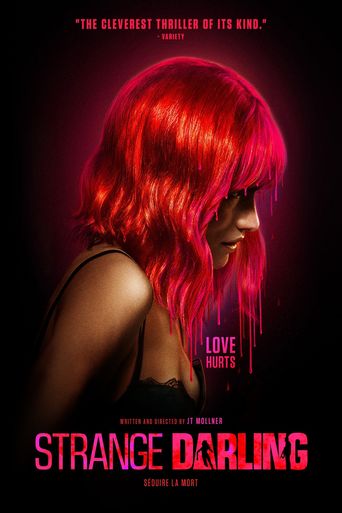
I may have mentioned it before, but 2024 has been a hell of a year for horror movies (despite its shittiness in other aspects), and for that reason, I’ve been more keen than usual to keep up with all the buzzy films that have been coming out. I’m even considering doing a year-end “best-of” post and video for my Scare Salon channel, which I’ve never done before, just because so much good shit has come out this year. Because of that, I’m trying to watch as many acclaimed flicks as possible before December 31st.
To that end, I finally got around to a horror thriller I’d heard about for ages, JT Mollner’s Strange Darling. Technically it was released in 2023, premiering at Fantastic Fest in Austin, Texas in September of that year, but as it wasn’t given a (limited) theatrical release until August of 2024, I’m counting it as a 2024 film, if that’s okay with everybody.
In my opinion, all films are better approached cold, with as little foreknowledge about them as possible, but in the case of Strange Darling, this is exponentially more true, so much so that it’s nearly impossible to review or discuss the movie without revealing its big twist. So while I won’t be spelling out the entire plot, I will by necessity have to talk about the elephant in the room, the major subversion at the heart of this movie. Again, I strongly suggest you see the movie first before reading further, but you’re a grown-ass adult and can do what you want; I can’t stop you if you want to plow ahead. This is, however, your one and only spoiler warning.
Strange Darling is essentially a slick, classic serial killer thriller, but filtered through the sensibilities of Pulp Fiction (particularly in its nonlinear narrative structure) and bearing some coy references to The Texas Chainsaw Massacre as well (in the sense that it’s purportedly “based on true events” and has an opening crawl of text specifying this, which is narrated by Jason Patric). Its visual style is also incredible, and probably no one was quite as surprised as I was that the cinematographer on this was none other than prolific character actor Giovanni Ribisi, making his debut behind the camera. He’s also credited as a producer on the film and loaned a great deal of his own equipment to the low(ish) budget production. And I have to say that holy shit, if this is Ribisi’s first gig as a cinematographer, he’s got (another) long career in front of him along that line because Strange Darling is absolutely a feast for the eyeballs.
Set in rural Oregon, the film presents itself as “a thriller in six chapters” (although it has an epilogue too), and also has a title card proudly proclaiming that it was shot on 35 mm film. This is only JT Mollner’s second full-length movie (his first was 2016’s Outlaws and Angels), but he’s really into using vintage equipment and real film for his projects, which is a purity I can always get behind, especially when you have the stones to stick to your vision and your principles.
Another thing Mollner wouldn’t compromise on was the non-chronological order of the film’s scenes. Though Miramax was super stoked to make the movie when Mollner first pitched it to them, when the rubber hit the road they were not huge fans of the scenes being shown out of sequence and even hired another editor to recut the movie into a standard, linear plot. Mollner threatened to take his name off the film if it was released like that, and when the nonlinear version was screened for test audiences, the reception was overwhelmingly positive, so Miramax eventually backed down and released it the way Mollner wanted. Hell, they even apologized to him for all the fuss, which kinda warmed my heart a little bit. The thing about the scenes being shown out of order is that it’s kind of a big part of what makes this movie work, what gives it its suspense, and what underlies its subversion of thriller tropes. If this had been presented in order, in other words, I don’t think it would have the same impact.
So after that opening text crawl saying that this story is based on the final few slayings of a serial killer’s 2021 murder spree, we see “Chapter 3” unfolding before us. In it, a frantic blonde woman (credited only as The Lady and played by Willa Fitzerald), dressed in red scrubs and bleeding from a fucked-up injury on the side of her head, is tearing down the road in a bright red 1978 Pinto (I think), being pursued by a man (credited only as The Demon and played by Kyle Gallner) in a pickup truck, who is shooting at her with a rifle. The car flips after The Demon shoots out the back window, and The Lady sets off on foot, eventually losing him temporarily and seeking help at a remote farmhouse occupied by two old hippies slash doomsday preppers slash Bigfoot believers, who are played by Barbara Hershey and Ed Begley Jr.
There’s also a very brief scene somewhere in here where we see The Demon in a car bathed in blue neon light. An unseen woman in the passenger seat asks if he’s a serial killer. He doesn’t answer, but then there’s a quick cut to him apparently strangling the life out of someone in a motel room.
The scenes then play out in their jumbled order, slowly revealing the set of circumstances that led to the state of affairs set up at the beginning. We see The Lady hiding somewhere in the farmhouse while The Demon searches for her, rifle at the ready; Ed Begley Jr. is dead on the kitchen floor. We see The Demon in the car again, talking to The Lady in front of a motel where they’ve presumably come for a one-night stand. The Lady, dressed in a sexier club outfit and a red wig, is flirtatious, and the pair seem to have a real connection. The Lady tells The Demon that a lot of women like casual sex just as much as men do, but that it’s far more dangerous for them, hence her asking the “serial killer” question from earlier. We also see The Lady and The Demon indulging in some BDSM in the motel, at The Lady’s request.
Now, the film is structured very deliberately to suggest that The Demon picked The Lady up at a bar earlier, the two of them hit it off and decided to repair to a motel for sex, and then The Demon showed his true proclivities. The Lady was able to escape somehow, and The Demon was then obliged to hop in his vehicle and give chase before she could report him to authorities. And indeed, in a standard thriller, this would be exactly what’s happening.
But in Strange Darling, the tropes are laid out the way they are only in order to pull the rug out from beneath the audience, as it’s eventually revealed that The Lady is actually the serial killer, and The Demon is a cop. Everything we’ve seen up to the point of the twist is thus recontextualized in a pretty clever way that upends expectations and gives us a fresh angle on a well-worn formula.
I will admit, though, that the implications of the gender politics here could absolutely be seen as problematic, playing into misogynistic beliefs about women as “crazy,” manipulative, and using their status as victims to in turn victimize men for their own sick amusement. I don’t think this was the conscious intent of the film, though it could be read that way; I believe Mollner was just trying to do something interesting with the established trappings of the thriller genre by turning assumptions upside down. That said, his decision to call the man The Demon may be an obvious nod to manosphere complaints that straight men are “demonized” by women assuming dudes they don’t know are predators, but honestly, I liked the movie so much that I’m willing to give the director the benefit of the doubt. There are a few female serial killers, after all, and even though Strange Darling isn’t actually based on a true story as far as I’m aware (despite its sly claims to the contrary), it’s also not outside the realms of possibility and makes for a fascinating examination of presumptions we make about how these types of movies play out, as well as how scenarios like this might play out in real life.
In sum, I can see why Strange Darling is ending up on so many “best of 2024” lists around the internet: it’s gorgeous to look at, features outstanding acting performances by the two leads, has a hauntingly beautiful score/soundtrack, boasts some welcome threads of black humor (particularly in the scenes with the weird hippies; gotta love those insane breakfast plates and the Scott Baio puzzle), and showcases some satisfying and realistic gore effects. The disordered nature of the plot only serves to heighten the tension and draw you into the story, getting you more and more invested as details of the situation slowly slot into place. Although the messaging of the film could be seen as questionable and feeding into some negative stereotypes, the whole of the movie itself is so sleek, edgy, vivid, and entertaining that you might not mind too much. Personally, I was content to admire the skill with which JT Mollner messed with my presuppositions and brought something fairly original to the table. The movie is definitely a vibe, and I was there for it.
Until next time, keep it creepy, my friends.
 The Scare Salon