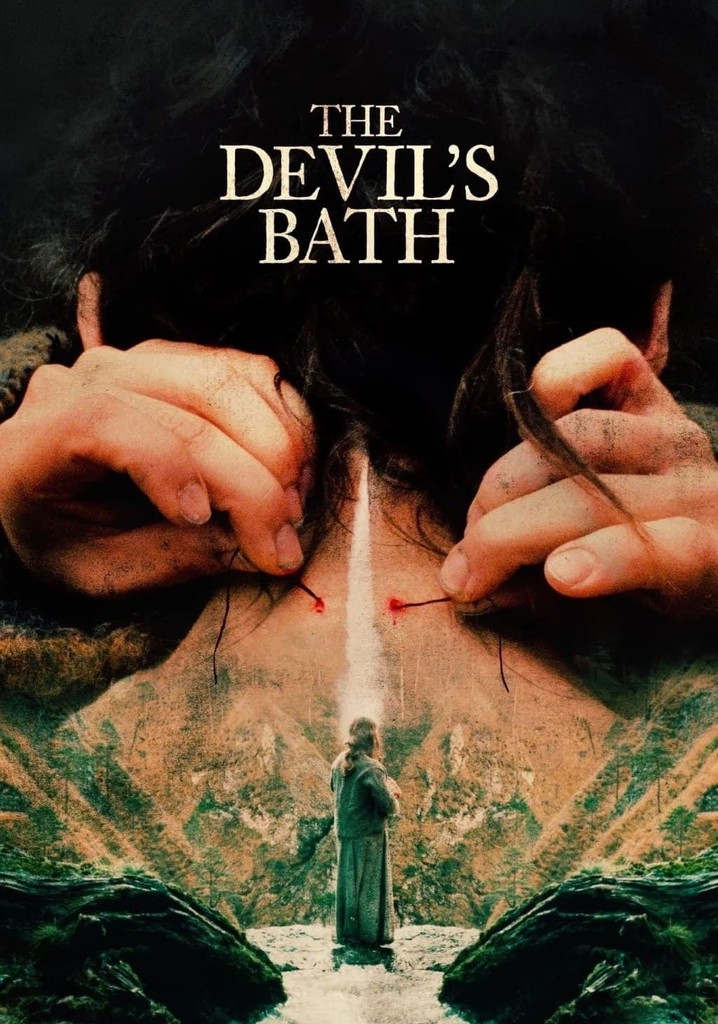
Returning to my newer international horror movie kick for this review, I decided to take a look at a film that had piqued my interest when I saw it pop up on Shudder a little while back. I hadn’t pulled the trigger on it immediately, but it so happened that a few days later, a friend recommended it to me, so I thought the stars were aligning for me to watch it.
2024’s The Devil’s Bath (aka Des Teufels Bad) is a German-Austrian co-production, written and directed by Veronika Franz and Severin Fiala, the team behind 2014’s Goodnight Mommy and 2019’s The Lodge. Like those two latter films, The Devil’s Bath is bleak and slow-moving, but with occasional bursts of extremely disturbing shit.
It won’t be for everyone, but if you’re into grim historical dramas with horror elements, like The Witch or Hagazussa for example, then you might be the intended audience for this film. I found it very thought-provoking, powerful, and uncomfortable to watch, and I’ll be thinking about it for a long time for sure, but if you’re more into “traditional,” faster-paced horror, you might want to skip it.
Set in Austria in 1750, the story is based on real events, and in particular the practice of “suicide by proxy.” In German-speaking countries in the seventeenth and eighteenth centuries, it was considered a sin worse than murder to kill oneself. So individuals—primarily women—who were suffering from depression or otherwise wanting to end their own lives would instead commit a murder and then immediately confess to it, knowing they would be absolved of their sins before their execution. These women overwhelmingly killed children, as there was also a widespread belief that children were without sin; therefore, killing them before they could sin would send their pure souls straight to heaven, so it’s almost like you were doing the little tykes a favor. It’s messed up, but no one ever accused religion of making any damn sense, now did they?
Our main protagonist here is Agnes, and she’s played by Anja Plaschg, an experimental musician who performs under the name Soap&Skin; she also, incidentally, composed the gorgeous, haunting score for this film. Agnes’s character is mostly based on a real Austrian peasant named Eva Lizlfellnerin, and I have to say, Anja Plaschg really crushes it here; she’s fantastic and absolutely heartbreaking in this role.
At the very beginning of the movie, though, before we even meet Agnes, there’s an opening sequence where a crying baby lies in a basket. A little boy comes and tries to comfort the infant, but then gets called away. We then see a woman, presumably the baby’s mother, pick up the child and start walking through the woods with it as the baby keeps wailing.
Eventually, the kid quiets down, but we know something pretty ominous is about to happen when the mom takes off her rosary and puts it around the baby’s neck. It’s then revealed that the woman is standing at the edge of an enormous waterfall, and with little fanfare, she throws the baby over it. Calmly, she proceeds to the nearest castle, knocks on the door, and tells them she’s committed a crime. Shortly afterward, we see that she’s been beheaded; her headless body is still sitting on a stone chair on an altar in the woods, and her head is in a little cage next to her. Nailed to a nearby tree, there’s a woodcut drawing depicting her throwing the baby over the waterfall and then getting executed.
We then cut to Agnes, weaving herself a crown out of flowers and grass she’s scrounged from the woods. It’s her wedding day, and her mom and brother pack up her dowry for the long walk to the next village where her husband-to-be Wolf (played by David Scheid) lives. There’s a huge, joyful celebration, and though Agnes doesn’t really know anyone and sort of keeps herself on the periphery of the action, we’re led to assume that she’ll adjust to her new surroundings eventually. At the end of the night, when her mother and brother leave to go back to their village, her brother gives her a severed finger, which was taken from the headless woman in the woods. This seems a weird-ass gift, but it turns out that the severed fingers and toes of an executed criminal are supposed to be a lucky charm that helps you conceive. How that little nugget of folklore came about, I have no idea, but here we are.
Wolf pulls Agnes away from the wedding and proudly shows her a big stone house he’s bought for them, but Agnes is worried that he took out such a big loan to purchase it that they’ll never be able to pay it back. She’s also despondent that it’s so far away from her family, and so close to Wolf’s mother’s place.
Despite this, Agnes tries to settle into her new existence, but right from the beginning, there are more niggling problems. For one thing, even though Agnes desperately wants a baby and expects that her husband will get her knocked up in no time, Wolf appears to have no interest at all in having sex with her. On their wedding night, he makes her turn on her side away from him, covering her eyes so she can’t see him, and he either just jerks it behind her back or works at his dick trying to get hard but isn’t successful. Then he just rolls over and goes to sleep. It’s implied, by the way, that Wolf is gay, and has feelings for his best friend Lenz, but nobody ever mentions it and it’s never revealed if those feelings were ever acted on.
Wolf’s mom Mother Gänglin (Maria Hofstätter) is also something of a busybody; not mean, exactly, just very stern and not shy about telling Agnes the “right way” to do things. She’s over at the house all the time, criticizing Agnes’s cooking, rearranging Agnes’s stuff without permission, shit like that. Wolf insists his mom likes Agnes, but honestly, Mom just seems exasperated with everything and clearly doesn’t think Agnes can do anything right, even blaming her for failing to get pregnant, even though it’s her son who won’t dip his wick because he’s secretly into dudes.
Most of the villagers are fishermen, and Agnes has to help out just like everyone does, scooping carp out of muddy ponds with nets on sticks. She tries hard, but she’s fairly hopeless at that too, which makes her mother-in-law even more annoyed.
What with the failure to get pregnant, the constant belittling by the mother-in-law, and the overall sense of loneliness from being an outsider—not to mention a later tragedy concerning a suicide that takes place in the village—Agnes begins to fall into a sort of melancholy; the phrase “the devil’s bath,” incidentally, is eighteenth-century vernacular for depression. She starts neglecting her chores at home, not bothering to care for the goats and chickens, and she wanders in the woods at all hours, becoming particularly obsessed with the altar housing the headless woman who killed her baby.
To his credit, Wolf—who is portrayed as a decent man that genuinely cares for Agnes and wants to get her help—tries everything he can (other than, y’know, humping her and getting her pregnant) to snap her out of it, but the situation seems to be getting worse by the day, and at one point Agnes even attempts to run back home to live with her family. Because Agnes has become so fascinated by the dead woman in the woods, you just know that something along similar lines is going to go down, and like watching a car crash in slow motion, you know it’s going to be bad but you can’t do anything to stop it.
As I said, this movie is a very slow burn, but I didn’t have an issue with the pacing at all; because it’s so beautiful to look at and because there’s such a sense of dread permeating the whole atmosphere, it really kept me riveted through the entire two-hour runtime (though of course, your mileage may vary). The acting is dynamite, and all the period details so accurate that it really immerses you fully into its world.
I particularly liked the way Wolf, the mother-in-law, and the villagers were portrayed as good people (at least in the context of the era) and not as abusive monsters who drove Agnes to madness. Sure, Mom was a pain in the ass, Wolf wouldn’t fuck, and some of the townsfolk were irritated that Agnes couldn’t get her shit together at work, but no one beat her or called her a witch or tried to exorcise her or anything like that. Wolf and his mom actually sent her to a barber (sorta like a doctor in those days) and attempted to get her well, but her illness was just too severe (and the barber’s ministrations worse than useless). It’s interesting to see a film like this, that explores how mental illness was not much understood at the time, but it’s also interesting to see one where the ill person is actually treated with some measure of compassion instead of just locked in a cell or left in the wilderness to die. Don’t get me wrong, these were still tragically backwards people, but again, they weren’t complete savages.
Although I would hesitate to call The Devil’s Bath a straight horror movie, it’s horrific for sure, and really sad and disturbing to boot. The fact that it was based on a true story just makes the whole thing even more distressing to watch. It’s not for all tastes, but if you’re in the mood for a somber historical drama showcasing some pretty dark history, then it might be up your alley.
Until next time, keep it creepy, my friends.
 The Scare Salon