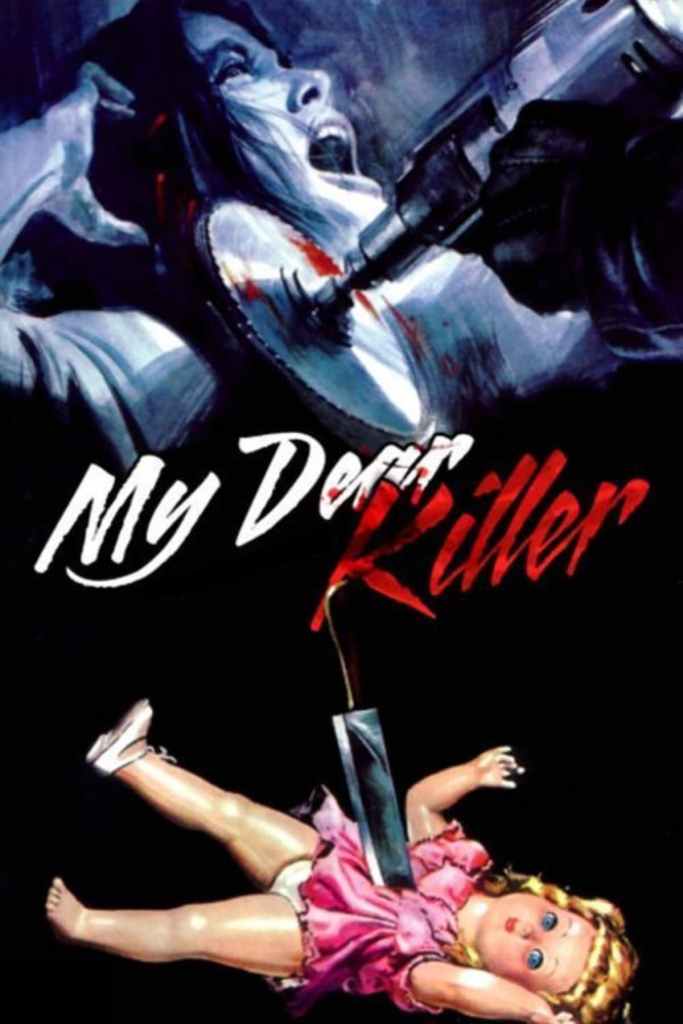
Yeah, yeah, I know I’d been on a “new international films” kick with my past few reviews, but for this one, I decided to get back to a genre I’ve been sadly neglecting for quite a while: good old 1970s giallo goodness. Shudder has a decent selection of some more obscure titles, so I chose one that grabbed my interest and that I had never seen before: My Dear Killer (aka Mio caro assassino), from 1972.
Directed by Tonino Valerii, who was mostly known for his spaghetti westerns (and actually got his start as an assistant director on Sergio Leone’s A Fistful of Dollars), My Dear Killer hews much closer to the police procedural end of the giallo spectrum than the operatic and overtly sexualized violence of some of the better-known examples of the genre.
Don’t get me wrong, it does boast a handful of surprisingly brutal kills, but they’re few and far between; most of the runtime is focused on the detective protagonist unraveling this highly complicated mystery. While this is a fantastic film and is very well-regarded by giallo aficionados, the plot is rather complex and can be hard to follow unless you’re paying scrupulous attention to every detail and word of dialogue. This is definitely not a movie you can watch while idly scrolling on your phone, in other words.
Since this is an older movie, there will be spoilers in this discussion, so if you don’t want to know the solution to the mystery, then maybe watch the movie first and then come back.
The opening sequence, I have to say, got me invested in this thing immediately just because of the sheer what-the-fuckery. We see a man, who we later learn is an insurance investigator named Umberto Paradisi (Francesco di Federico), who has hired an excavator for a day to dig around in a swamp for reasons that are not revealed until much further along in the story. It’s clear he’s looking for something—some evidence or a body perhaps—but we don’t know what it is.
As he stands there, waiting for the excavator to do its thing, the person operating the vehicle—whose face we never see—basically picks poor old Umberto up with the crane instead, and he struggles in mid-air as his neck is caught in the claw mechanism. Umberto is beheaded by the excavator, and the operator then flees the scene.
The police are mystified by the whole situation, not least because the man who was hired out to operate the excavator has been working for the rental company for many years and seemed totally competent and completely normal; not at all like someone who would pop a dude’s head off like a wine bottle cork, even accidentally.
Not long afterward, the man who had operated the excavator is found hanging in a barn, an apparent suicide. Shrewd police commissioner Luca Peretti (played by George Hilton, who was also in one of my favorite giallo films, The Case of the Scorpion’s Tail), however, insists that the man was actually murdered, which makes him delve even further into what the decapitated investigator Umberto Paradisi was up to and why someone would kill both Paradisi and the guy who was apparently hired to kill him.
Turns out that Paradisi was working on a cold case concerning the kidnapping of a little girl named Stefania Moroni, whose dad was a rich industrialist type dude named Alessandro (Piero Lulli). The child was abducted while she was playing out in front of the house, and the kidnappers asked for a ransom of a million lira. Alessandro offered to take the money to the drop point himself, following their exact instructions, but during this endeavor, the kidnappers beat the snot out of him and abducted him too. Both he and his daughter were then locked in a bunker, where they both eventually starved to death.
So Umberto the Headless had discovered a new lead in the case and was using the information to essentially blackmail members of Stefania’s family into paying him to reveal what he knew. After our hero, Commissioner Luca Peretti, figures all this out, he proceeds to question members of the family as well as their servants. In true giallo fashion, they’re all shifty as hell in one way or another: Stefania’s mom has understandably become something of a basket case, talking as though Stefania is still alive and is just away at school; there’s an uncle named Oliviero who lost his hand in the war and has a cranky-ass wife; there’s another relative or family friend who’s very clearly implied to be a creepy old pedophile (and just a heads-up, there’s a quite shocking scene where a naked little girl walks into his art studio where she’s been modeling for him, a scene that you absolutely wouldn’t get away with today).
And as if all this intrigue wasn’t enough, even more murders begin to pile up. The next person to get it is Umberto’s wife (Helga Liné), who is lured to the post office to retrieve something from her husband’s safety deposit box and then strangled in broad daylight. Luca Peretti finds a scrap of paper clutched in her dead hand; the killer clearly attempted to take the paper, but a fragment was left behind.
The scrap contains part of a child’s drawing and the partial stamp of a local Catholic school, which leads Luca to Stefania’s former teacher, Paola Rossi (Patty Shepard). While going through Stefania’s school notebooks, they find a page that was torn out, and it turns out that the drawing the killer was so keen to get his hands on was just a picture of a house with a kinda funny-looking thing sticking out of the roof. Luca is frustrated because he can’t see the significance or why the killer would even want it. Shortly afterward, the teacher is horribly and bloodily killed with a circular saw.
There’s also a garbage-picking old hobo named Mattia (Dante Maggio), who lives in a house that looks just like the one in Stefania’s drawing and is also situated right on the shore of the swamp where Umberto was doing the excavating that ended so badly for him. Mattia eventually gets murdered as well, savagely beaten to death with a small statue.
After all of this convoluted investigating and interrogating, Luca finally has an epiphany when he visits the bunker where Stefania and her father met their grim fates. He’s able to deduce that Stefania had attempted to identify her killer before she died by throwing something out of a slit in the bunker wall, which caused the object to go rolling down the hill and into the swamp below. This, we’re led to assume, is why Umberto was digging in the swamp at the beginning of the movie.
We discover, though, that the item Stefania threw—a round mirror about a foot wide—never even made it to the swamp, because it was found by Mattia the hobo, who just put it in his house without realizing the importance of it or where it had come from. The killer later tries to murder Mattia’s sorta-girlfriend, an older lady who eventually took a liking to the mirror and hung it up at her place, but Luca is able to intervene and save her at the last minute.
At the very end, there’s a Columbo-like scene where Luca gathers all the family members together and gives a long, threatening monologue about the killer and about what shitheels all of them are. He does a very dramatic demonstration, making each one of them look at their own reflections in the fateful mirror before revealing that the murderer is in fact the one-handed wonder, Uncle Oliviero, whose motive was simple jealousy over Alessandro’s wealth. He murdered all the other people too, just to tie up loose ends, but damn, that seems a tad excessive, bro.
The final shot of the film is the back of the mirror, where Stefania had drawn a stick figure man with one hand missing, so it was pretty obvious to whoever saw it that it was Oliviero she was talking about.
As I said, if you’re more into the lurid, boobs-and-blood-style giallo films, this might seem a little staid and slow-moving for your tastes. It’s far more centered on our lead investigator and his attempts to tease out the truth surrounding this intricate murder mystery. But it’s extremely well-written and impeccably constructed; you just have to stay on your toes and focus on each interaction and every new clue, or you’ll quickly become lost in the labyrinthine plot. Recommended for fans of more investigative giallo movies and poliziotteschi films; this one doesn’t get a huge amount of discussion, but it’s well worth watching for sure.
Until next time, keep it creepy, my friends.
 The Scare Salon