
As I mentioned in my post about Thriller episodes, I’ve decided to switch to a one-episode-at-a-time format for both my Thriller series and this Night Gallery series, rather than the six-episode chunks I was tackling before. It’s just a lot less daunting and time-consuming overall. Hope y’all don’t mind.
So when we last left Night Gallery, we were discussing season two, episode twelve, so let’s move on to episode thirteen. This one consists of two stories, neither of which are particularly scary or compelling, though the first tale has some great acting performances by a number of recognizable faces.
“The Messiah on Mott Street” was written by Rod Serling and directed by Don Taylor, an actor and director who not only starred in some classic films from the 1940s and 1950s like Father of the Bride and Stalag 17, but also helmed 1971’s Escape from the Planet of the Apes and 1978’s Damien – Omen II.
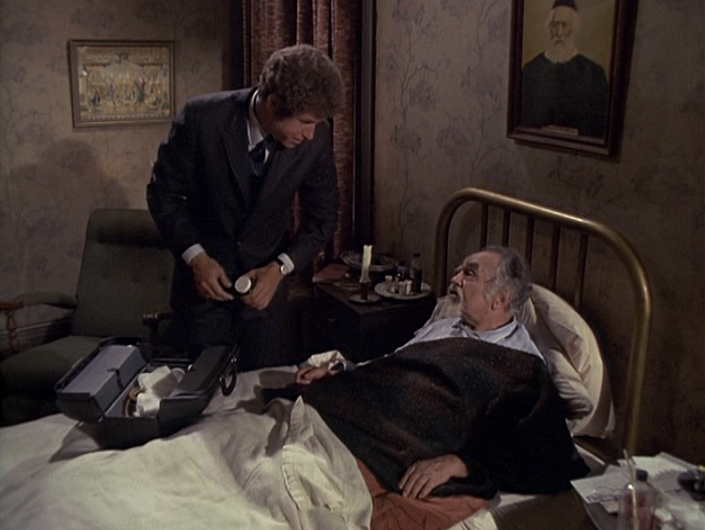
The story concerns an elderly, poverty-stricken Jewish man named Abraham Goldman (played by veteran tough-guy actor Edward G. Robinson), who lives in a shitty tenement and is starting to fear that his time on Earth might be growing short. His house-call-making physician Dr. Levine (played by Tony Roberts, who was in several Woody Allen movies as well as 1973’s Serpico) doesn’t seem to be disabusing the old man of this notion, basically telling him he’d better get his affairs in order sooner rather than later.
Abraham, sick as he is, is nonetheless adamant that he absolutely can’t die, because he has to be around to look after his grandson Mikey (Ricky Powell). Abraham loves the boy more than anything in the world, and the feeling appears to be mutual. Abraham also tells Dr. Levine not to worry, because his no-account brother in California sent him a letter and told him he was going to pay back a large amount of money that he borrowed from Abraham a long time ago. When that money arrives, Abraham insists, he’ll be able to get back to his old self and move out of this shithole apartment into a better house with Mikey.
Dr. Levine is caustically sympathetic, I guess, but he thinks the whole “coming into some money” thing is a crock of hot horse manure, because Abraham’s brother never paid back any money he borrowed or stole. He also finds out from a child welfare worker who stops by to assess Mikey’s living situation that Abraham’s brother is living in a mental hospital in California and says all kinds of crazy shit, so the letter might be just a bunch of hallucinatory BS.
Abraham has long discussions with Dr. Levine as well as Mikey, basically telling them that when the angel of death comes for him, he’s simply going to tell him to fuck off (not in those exact words, but you know what I mean). He then begins waxing lyrical about the arrival of the Messiah, who is going to show up right on their impoverished street and fix all their problems. Dr. Levine thinks he’s delusional, but Mikey buys right into it, at first thinking he’ll ask the Messiah for unlimited ice cream or some such nonsense, but then deciding that the only thing he’ll ask for is to make his grandpa better. Way to kiss ass, kid.
Anyway, all this talk of the Messiah and fending off the angel of death doesn’t seem to be doing jack squat, because Abraham’s illness is getting worse, and child protective services are threatening to put Mikey in a foster home because Abraham is too ill to care for him. On Christmas Eve (or Christmas Day, I forget which), it looks like the old man’s time has come; he sees a menacing shadow in his room and rages at it, though later he tells Mikey it was the Messiah, which I thought was a good thing, but whatever.
Anyway, Abraham is at death’s door, and a desperate Mikey runs out into the street, trying to find the Messiah that his grandfather promised was out there. The first guy he encounters is one of those nutbar street preachers who screams into the kid’s face that we’re all DOOMED! DOOMED!!! before a cop comes and shoos his ranting ass into the next block.
Then Mikey approaches another man (played by the great Yaphet Kotto, who will always be Parker from Alien to me) and identifies him as the Messiah, begging him to come help his grandpa. The man asks why the kid thought he was the Messiah, and Mikey says it was because his grandfather told him the Messiah would be “big and black.” I admit I cringed pretty hard at that, but Yaphet Kotto is indeed big and black, so I guess I’ll let it slide.
The man (whose name, we eventually learn, is Mr. Bruckner) neither confirms nor denies being the Messiah, but agrees to come back to the apartment to see what he can do, especially because the kid seems so distraught. Once he’s there, Dr. Levine says Abraham is going to kick the bucket any minute, and that if Bruckner does indeed have any magic powers (which he doesn’t believe, of course), then he’d better start using them tout suite.
A strange wind then blows through the room, and the front door opens by itself. As you might have guessed, when Abraham’s bedroom door flies open next, the old man is sitting up in bed, looking as fit as a fiddle. A shocked Dr. Levine examines him quickly and can’t believe the recovery; he then turns toward the living room and realizes that Mr. Bruckner has mysteriously vanished.
Minutes later, someone knocks on the apartment door and Mikey goes to answer it. It’s Mr. Bruckner again, but this time he’s in a postal uniform (he was just wearing regular clothes before), and he hands the kid a special delivery envelope. The envelope contains a letter from Abraham’s brother and a check for ten thousand smackers. Everyone rejoices, and it’s a Christmas miracle, even though all the characters are Jewish and even say Happy Hanukkah to one lady when she wishes them a Merry Christmas, which I thought was retroactively hilarious in light of all the pathetic War on Christmas bullshit the Christian right have been whining about for the past several years.
Also, I think I would wait to bust out the champagne and party poppers until I made sure the brother’s check cleared, but that’s just me. Incidentally, ten thousand dollars in 1971 amounts to about $77,500 in 2024 money, so that’s quite a nice chunk of change. Thanks, bro!
This was a sort of sentimental but entertaining enough episode; it didn’t hold any surprises, but I really liked all the characters, and even though the dialogue had that trademark Serling floweriness, it was still pretty fun and heartfelt. I also liked that it was a Christmas story, but more Hanukkah-focused (even though you never actually saw anyone celebrating Hanukkah); and despite utilizing the somewhat uncomfortable “Magic Negro” trope, I loved the ballsiness of making a black man turn out to be essentially Jesus. I wonder if any old church ladies called to complain about this episode back in the day. At any rate, I’m totally fine with Yaphet Kotto being Jesus, and I can’t imagine why anyone wouldn’t be.
The second story, “The Painted Mirror,” was shorter and more funny than scary, and I found myself not liking it as much as the first one. It was based on a short story by renowned science fiction and fantasy writer Donald Wandrei, who co-founded Arkham House with August Derleth. It was adapted for the screen and directed by Gene Kearney.
The situation involves a sad-sack old man named Frank Standish (Arthur O’Connell) who has long owned a dusty old antique shop and loves puttering around among his old things. But recent financial difficulties have forced him to partner with an obnoxious co-owner named Mrs. Moore (Zsa Zsa Gabor), who (rightly) informs him that he needs to modernize the store if they’re going to make any money. Said modernization translates to turning the place into a bougie boutique-type place, complete with loud, groovy music, pink walls, tacky bric-a-brac, and up-to-the-minute fashions.
Standish is of course horrified by the changes made to his store, and constantly laments about the good old days, which didn’t really endear him to me, if I’m being honest. I mean, the store was apparently circling the drain before Zsa Zsa even got there, so something had to be done to keep the place afloat. Don’t get me wrong, Zsa Zsa herself is just as insufferable, constantly insulting and abusing Standish and generally being a massive twunt. There are really no likable characters, and I have to say that I thought Zsa Zsa’s acting here was…not good. She seemed as though she wasn’t even bothering; her eyes always looked unfocused, like she was casting about for something better elsewhere, and she sounded sort of languid, like she’d just housed two fistfuls of Quaaludes.
Anyway, Standish has a chaste little crush on a regular customer, an older woman named Ellen (Rosemary DeCamp). Whenever she comes in, Standish takes her into his living quarters in the back, where they savagely rut like animals in heat. Just kidding, they sit there and drink tea and talk about how much better things were back in the day. Yawn.
So one day Ellen comes in wanting to sell this mirror she found in her attic. The frame is nice enough, but someone has painted over the glass (hence the name of the story) for some unknown reason. Standish says he’ll give her ten bucks for it (about $77 in 2024), but Zsa Zsa ain’t having it, screeching that they can’t sell the ugly old thing. She does offer Ellen a buck for the cart she brought the mirror in on, though.
Standish says he’ll keep the mirror on consignment, and sets about trying to scrape the paint off the glass. Once he gets it off, he finds to his astonishment that there’s some kind of Bert I. Gordon dinosaur world in there, and what’s more, you can just walk right into it, like a portal.
Standish and Ellen are staring at the thing in wonder when Zsa Zsa’s kitty cat jumps into the mirror, but just as quickly comes running back out all NOPE, clearly terrified of whatever’s inside.
While Ellen and Standish are quietly wigging out about the magic mirror, Zsa Zsa swans in and says she’s bought Standish out of his share of the store, and he needs to get his shit and get out. Standish is beside himself, not only because he doubts his ability to get another job at his age, but also because he was living in the store and is now homeless. I love how Ellen is all, well, I’d ask you to move in with me, but I live with relatives, so… Yeah, thanks for nothing, Ellen.
Standish, though, hits on a diabolical plan. He picks up a ball and tosses it into the mirror, and Zsa Zsa’s dog chases it in there. Zsa Zsa, apparently not at all fazed by the fact that there’s a portal to a prehistoric dinosaur dimension in the back room of her shop, goes after the dog. There then follows a sequence that seemed endless but was probably only a couple of minutes, where Zsa Zsa wanders around this Land of the Lost set, listlessly calling for her dog. Funnily enough, the dog’s name is Pooky (Pookie?), which is also the name of one of my cats. So I was mightily amused by Zsa Zsa sluggishly calling, “Pooky where are you? Pooky come here. Pooky where are you? Pooky come here,” roughly forty thousand times, and with the same inflections every time, which made me suspect they just recorded her saying each phrase once and then played them over and over. It was totally bizarre. Oh, and I forgot to mention that while she was aimlessly meandering around, the scene would quick cut to a janky-looking dinosaur that we’re supposed to believe was stalking her, even though it wasn’t clear where it was in relation to her.
So once Zsa Zsa twigs onto the fact that this hallway-sized lost continent is full of hungry hungry dinos, she screams and starts running back toward the mirror, but unbeknownst to her, Standish and Ellen have deviously (and very quickly) painted back over the glass, trapping her and Pooky in there with the dinosaurs. Honestly, I can’t be too mad that they’d let the papier-mâché-o-saurus eat Zsa Zsa, but leaving the dog in there to die was just too cold-blooded, and as such, I cannot condone Standish’s actions. Enjoy going bankrupt, you dog-murdering old coot.
So yeah, didn’t love this segment, but I had a lot of fun with Zsa Zsa’s oddly lethargic performance and the laughably amateurish dinosaur puppets.
The next stop in the Night Gallery will be season two, episode fourteen. Until then, keep it creepy, my friends.
 The Scare Salon