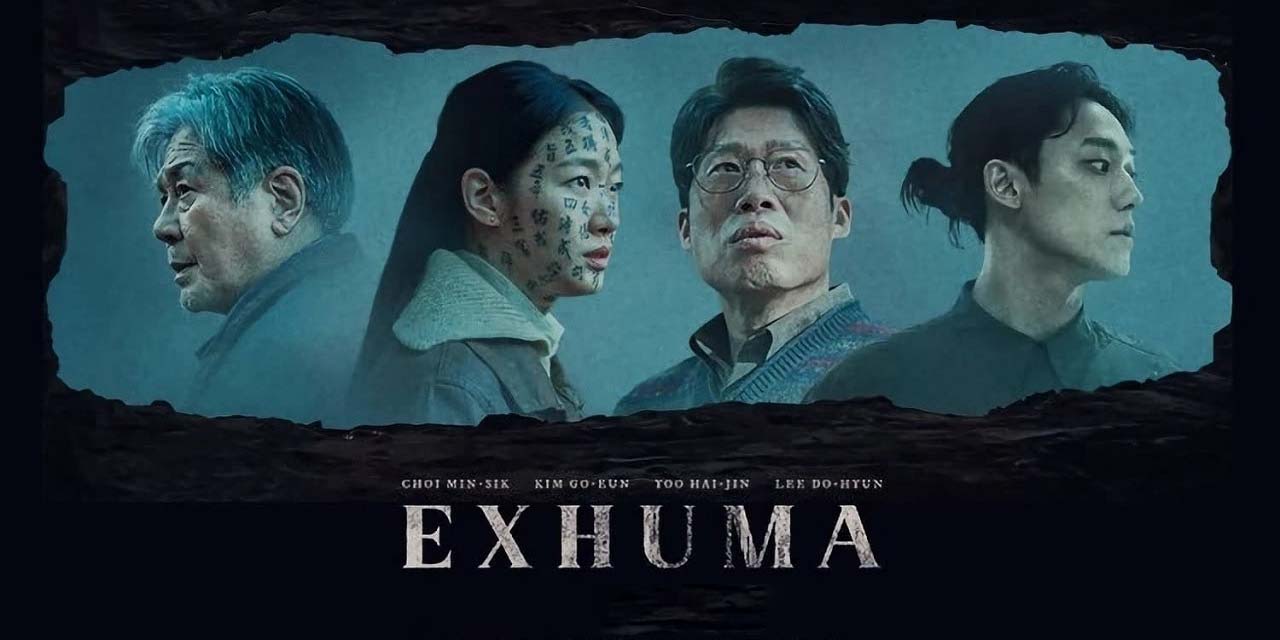
I figured it had been a minute since I’d gone delving into Shudder’s newer international fare, so I took a quick look around the internet for some recommendations on the best films currently available on the platform. And pretty universally at the top of many horror sites’ lists was the 2024 South Korean supernatural folk horror film Exhuma, directed by Jang Jae-hyun, which hit theaters in its native country back in February and has since gone on to become the sixth highest-grossing film in South Korean history.
It’s not hard to see why; this is a masterful movie, exploring some common horror tropes but in different ways, and not afraid to be complex and wide-ranging while still keeping the story grounded around its four central characters. If you loved 2016’s The Wailing (and who didn’t?), then Exhuma should also be right up your alley; it’s not slavishly similar to that film or anything, but it’s in the same ballpark, and like The Wailing, Exhuma had the balls to be considerably more than two hours long, with absolutely no flagging of interest on the viewer’s part, at least in my opinion.
The tale is told in several chapters, but in aggregate, it’s sort of like two loosely interconnected stories taking place one after the other. Steeped in Korean and Japanese folklore, some of the symbolism and historical context might be somewhat baffling to Western audiences, but I didn’t find the unfolding mystery terribly hard to follow, though I admit I did stop to look up a couple of things mentioned in the movie to get a better handle on the story.
At the beginning, we meet a shaman named Lee Hwa-rim (Kim Go-eun) and her partner/protégé Yoon Bong-gil (Lee Do-hyun). The pair have been summoned to Los Angeles by a very wealthy Korean American man named Park Ji-Yong (Kim Jae-cheol) who suspects that his newborn baby son is suffering from a curse. Upon investigation, Hwa-rim determines that the infant is indeed the victim of something called a Grave’s Call, in which a cranky ancestor spirit is tormenting the living for some reason or another. Hwa-rim tells Ji-Yong that she’s certain the culprit is the ghost of his grandfather, at which point Ji-Yong gives her permission to exhume Grandpa’s grave and cremate his grumpy ass, against the wishes of his other relatives.
To help in this endeavor, Hwa-rim (somewhat reluctantly) enlists the services of a geomancer and feng shui expert named Kim Sang-deok (played by Oldboy himself, Choi Min-sik), and his sidekick, undertaker Yeong-geun (Yoo Hae-jin). Hwa-rim has clearly worked with them before, and they seem fairly friendly with each other. The foursome is pretty jacked to be doing this job because Park Ji-Yong has already specified that money is no object; he just wants the curse lifted from his baby, which is totally understandable.
So the grandfather’s grave is located very near the border of North and South Korea, and right from the jump, there’s something mighty weird about it. It’s completely isolated on a mountain, for one thing, and there are no other graves around. A bunch of sinister-looking foxes skulk in the surrounding woods as well, watching the group suspiciously. Additionally, the grave marker is small and unadorned, and doesn’t even have a name on it; just a line of numbers that appear to be coordinates.
Sang-deok, who was initially gung ho about this gig, thinking it would be a very lucrative piece of cake, is completely freaked out by the whole set-up, and tells the other three ghostbusters, as well as their client, that he’s not gonna mess with whatever creepy-ass bullshit is going on here, no way, no how. He just has a really bad feeling about the entire situation and doesn’t even care about the big payoff anymore.
Hwa-rim, though, is determined to help her client’s infant son and tries to assuage Sang-deok’s fears by insisting that she and Bong-gil can do a ritual that should help neutralize all the bad mojo in the area until they can get Grandpa out of the ground and into the crematorium. Sang-deok is still uneasy but agrees to go ahead with it.
The ritual, which is pretty spectacular and involves intense drumming, dancing with knives, and several pig carcasses, goes ahead, and the coffin seems to be successfully exhumed without anything terrible happening. The coffin itself is beautifully carved out of juniper, and several of the onlookers comment that it’s fit for a royal burial. Sang-deok thinks the coffin should be opened so the remains can be “shrouded,” but Ji-Yong insists that the entire coffin be burned without opening it, which is totally against protocol, but he is the one paying for all this, so the four paranormal people agree to the terms.
A couple of things happen once Grandpa is out of the ground, though. First, a storm suddenly rolls in, drenching the area with rain, and causing the gang to have to delay the cremation since burning a body while it’s raining makes it more difficult for the spirit to find its way to the afterlife.
More alarmingly, one of the gravediggers sees a snake in the empty grave and drives a shovel into it before noticing that the snake has a woman’s head. Those familiar with Japanese folklore will recognize this as a nure-onna, and in the context of this story, it appears to be really bad news.
As you might imagine, the coffin ends up getting opened by an employee at the crematorium who thinks there’s treasure in there, and thus the murderous ghost of Grandpa is set loose to go after his descendants.
This part of the story comprises about the first half of the runtime and then gets resolved. There are still some lingering mysteries, such as why Grandpa was buried in such a weird-ass place to start with, why his grave had coordinates on it, and why he was saying such strange shit to his relatives while he was haunting them. These questions all get answered in the second half of the movie, which is connected to the events of the first half.
Several months go by after the Grandpa Ghost incident sorts itself out, but Sang-deok is still disturbed by the events, and later finds out that the gravedigger who killed the nure-onna is having a bad time, and has been begging the foursome to go back out to the grave and find the remains of the woman-headed snake, burn it, and say prayers over it. Sang-deok agrees to do just that, but during the course of this endeavor, he discovers that there’s something else in that grave a few feet beneath where Grandpa was buried, and it’s a lot more formidable than just a grouchy elderly phantasm. The second half of the movie, then, is the gang fighting against this monster, essentially, that comes out of the grave, which Hwa-rim calls an anima and whose exact nature I won’t reveal.
If you’re into Korean or Japanese horror I feel like you should probably love this; it’s pretty long for a genre film, sure, and it’s not really structured like a Western horror story, but honestly, I was so engaged with the mystery and the characters that I barely noticed the time going by. The special effects are nearly all practical, which was a plus, and the look of the monster is pretty unique and cool. I also liked that the story didn’t have the standard horror-movie “skeptic” character; all the folkloric and supernatural stuff was taken one-hundred-percent seriously by everyone in the movie, and the conflict only arose from the different characters’ preferred methods of dealing with the paranormal entities they encountered. I never realized how refreshing it would be to see a horror film where everyone is just already on the same page in regards to the ghosts and superstitions, without there having to be one character who is forced to become a believer when the shit hits the fan.
As I mentioned, it would help to know a little bit about Korean and Japanese folklore (particularly burial rituals), and also something about the fraught history between Korea and Japan, because those things play a lot into the narrative. That said, if you pay attention to everything the characters say, you shouldn’t have any problem figuring out what’s going on.
Another home run for Korean horror; what can I say, Korean filmmakers really seem to have a handle on the genre that many other filmmakers don’t. I’m not sure exactly what it is, but I honestly can’t remember ever seeing a bad Korean horror flick, and most of them are dynamite, like this one. A definite recommend for Shudder subscribers for sure.
Until next time, keep it creepy, my friends.
 The Scare Salon