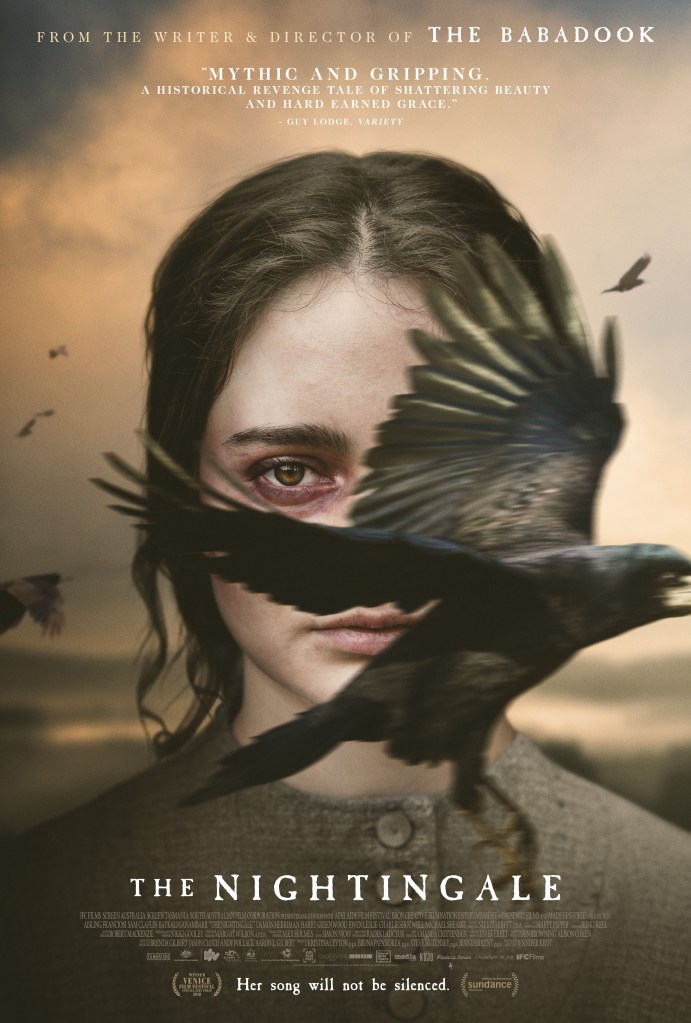
Australian filmmaker Jennifer Kent burst onto the horror landscape back in 2014 with her outstandingly creepy and well-received metaphorical horror film The Babadook (which I reviewed here), so when it came time for her sophomore effort to hit theaters, the community was abuzz, wondering what spooky delights she would come up with this time around.
And to most people’s surprise, she did something very, very different than the film that made her name as a director to watch. 2018’s The Nightingale abandoned the supernatural and symbolic trappings of her debut film and instead plunged into raw, brutal, and all-too-real historical horror, exploring a shameful, violent period of Australian history with an empathetic but coldly unblinking eye.
Though The Nightingale is not usually tagged as a traditional horror film—I’ve seen it called everything from a historical drama to a psychological thriller to a Western—the events it depicts are certainly horrific, and the film’s runtime of two-and-a-half hours puts the grueling, punishing nature of the narrative front and center. I’ve also seen it called a rape-revenge film, which it technically is, but it’s not along the lines of exploitation-era rape-revenge movies like I Spit on Your Grave or The Last House on the Left. In the case of The Nightingale, though the rape isn’t shied away from (and trigger warning: there is quite a lot of rape in this movie, among other atrocities), it’s not particularly graphic or filmed in a manner that’s in any way titillating. That’s not to say that it’s easy to sit through, because it absolutely isn’t; rape and cruelty to animals are two of the things I have the hardest time with in horror films, and I admit some scenes in this movie were extremely uncomfortable for me to watch. But the scenes are there for a reason, and I would argue that the relentless frequency of the barbarism on display in The Nightingale serves to plunge the audience into the position of its oppressed characters as they try to navigate a world that is completely hostile to them at every turn.
As with most of my film and book discussions, I won’t be spoiling the entire plot or the ending, but I will be talking about some aspects of the story that you might not want to know beforehand. So consider this your blanket spoiler warning.
The film is set in 1825 in Van Diemen’s Land, now known as Tasmania, just before the onset of the Black War, in which vicious conflicts flared between the Aboriginal Tasmanians and the British colonizers. Our main protagonist is Clare (Aisling Franciosi), a young Irish woman who was arrested for theft and has been shipped here to serve out her sentence as an indentured servant. She has recently married and has a baby, but even though she has technically served her time and should be allowed to go free, the nightmare of a man who is holding her in servitude—Lieutenant Hawkins, played to chilling perfection by Sam Claflin—refuses to sign her paperwork so she can move away to farm with her little family.
Because Hawkins keeps putting her off in signing the official release, Clare doesn’t have much choice in doing pretty much whatever he asks her to. He makes her sing and serve drinks at gatherings for his leering underlings, and after one such occasion, he summons her upstairs to his room at the inn and rapes her. Though clearly traumatized, she chooses to keep the rape to herself, knowing that she has absolutely no power and that telling anyone about it will just cause far more trouble for her.
Her kind, loving husband Aidan (Michael Sheasby) suspects that Hawkins has hurt her and is livid that the lieutenant is giving her the runaround about her freedom, but at her insistence, he stays quiet for fear of retaliation. That is, until he has a bit too much to drink one night and decides he’s going to give Hawkins a piece of his mind.
A brawl ensues involving Aidan, Hawkins, and a couple of Hawkins’s subordinates, Sergeant Ruse (Damon Herriman) and Ensign Jago (Harry Greenwood). It so happens that Hawkins’s superior officer walks in and sees the fight, and decides then and there not to give Hawkins a promotion that he’d thought was in the bag. So not only have Hawkins’s “inferiors” (i.e. Aidan and Clare) mouthed off to him and questioned his authority, but in his mind, they’ve fucked up his career path too, which causes him to become apoplectic with rage.
Later that night, Clare and Aidan have decided to just pack their shit and get the fuck out of Dodge, since they’re well aware of the shitstorm that’s about to descend on them. Unfortunately, they don’t escape fast enough: Hawkins, Ruse, and Jago enter the family hut with revenge on their minds, and oh boy, the next scene is a rough one.
Basically, Ruse and Jago restrain Aidan while Hawkins rapes Clare in front of him. Then Hawkins encourages Ruse to also have a go, and Ruse assaults her in front of her husband as well. Hawkins then shoots Aidan dead, and because the baby, Bridget, won’t stop crying, Hawkins screams for Jago to shut the baby up, at which point Jago slams the baby’s head against the wall and kills her too. They knock Clare out with a rifle butt, probably thinking they’ve taken care of her as well, then go on their merry way.
Said merry way is actually to the town of Launceston, a three- or four-day journey through the unforgiving Tasmanian bush. Hawkins, you see, thinks he can still save his promotion by appealing to the superiors of his superior officer, so he gathers up his men, hires an Aboriginal guide named Charlie (Charlie Jampijinpa Brown), and sets out on the trek.
Unbeknownst to them, Clare has awakened back at the hut, and realizes that her entire family has been wiped out by these evil English shitlords. She does report the attack to the Royal Military Police, but since she’s still technically a convict and also has a vagina, she’s obviously making it all up, and even if she’s not, the RMP seem to give less than a squirt of piss about the whole situation and are just as obviously not going to do jack about it. Clare realizes she’s on her own.
Through fierce tears, she asks her neighbors to bury Aidan and Bridget, and insists she’s going after the motherfuckers that did this, paperwork and propriety be damned.
She uses her last shilling to procure the services of her own Aboriginal guide, Billy (Baykali Ganambarr), and lest you think that Clare might be a little more charitable and understanding toward the oppressed locals, given her own situation, in a far more realistic fashion, she’s just as much of an asshole toward Billy as the English officers are toward Charlie. She calls him “boy” and keeps him at gunpoint because she’s afraid he’s going to eat her, and all poor Billy can do is shake his head in wonder and sadness at these uppity white folks who descended on his native land and started systematically subjugating and slaughtering his people.
As the long journey goes on, though, Clare and Billy start to realize they have more in common than they initially thought; Clare is Irish and of course has no love for the English either, and she and Billy start to bond over their shared hatred. Clare actually doesn’t tell Billy initially that she’s going on a mission to kill the officers who raped her and murdered her family; she just says her husband is with the group and she needs to get to him. Billy is suspicious of her motives, but by the time he discovers what her real endgame is, he’s got some reasons for revenge of his own.
The interesting thing about The Nightingale is that the revenge doesn’t play out exactly the way you think it will, and though some might feel that the resolution is unsatisfying in some way, in my mind that was precisely the point. When I said this wasn’t a standard rape-revenge film, this was another thing that I meant, because in more exploitation-styled rape-revenge flicks, the revenge is over the top and meant to be cathartic for the audience, a grand finale to slake their bloodlust and desire for rough justice. The Nightingale is a lot more complicated, playing instead with the (again, more realistic) idea that vengeance might not bring you the closure or gratification you sought, and instead might actually chip away at your humanity and possibly haunt you for the rest of your life.
The Nightingale is not a fun watch at all, and in fact was hard to sit through at times, but it’s an excellent film that doesn’t shy away from the real-life horrors that plagued this time period (and have never really gone away, sadly). The acting is incredible across the board, and there’s a palpable sense of dread with every new interaction between the characters. I wouldn’t recommend the movie to anyone who just wanted a good time, because this film is pretty soul-crushing, but if you’re a fan of films as an art form and films that have something to say about human cruelty, and particularly if you like Western-style films with horror aspects (such as Bone Tomahawk or The Proposition, for example), then The Nightingale will likely be right up your alley.
Until next time, keep it creepy, my friends.
 The Scare Salon