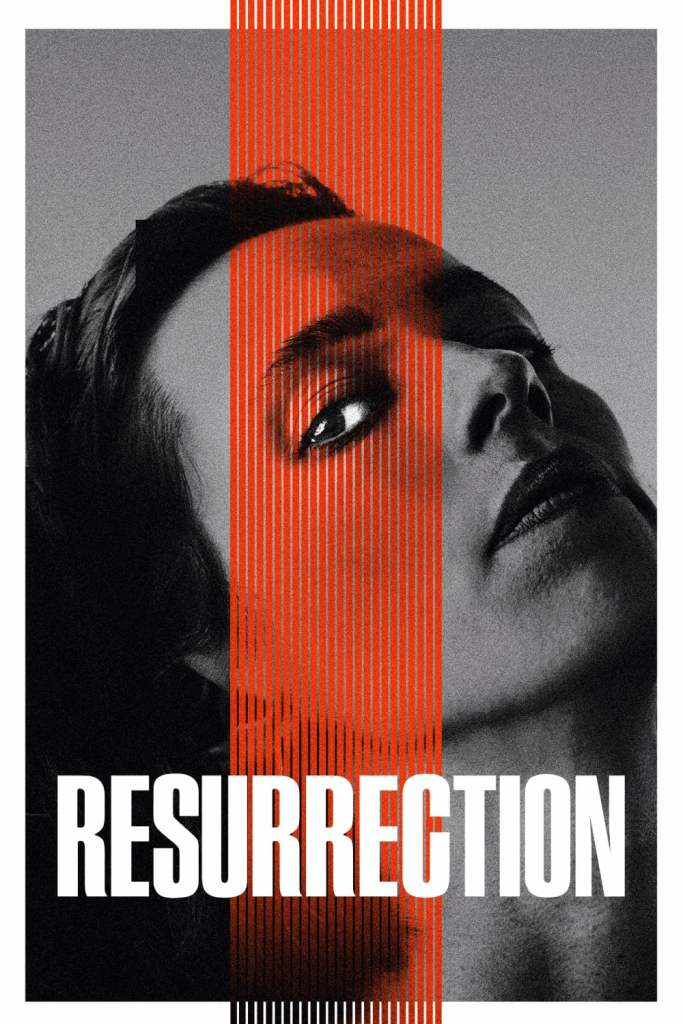
There was a bit of a convoluted path to how I ended up watching the 2022 thriller Resurrection. Just a bit ago, I watched and reviewed Ti West’s excellent 2023 film Pearl, and afterward, I was watching some YouTube videos from my favorite horror channels about the movie to get some more perspectives on it. The discussion on Sinister Cinema Reviews, I believe, mentioned the dynamite Mia Goth monologue from Pearl, and also mentioned in passing that Rebecca Hall had given a similarly fantastic monologue (and general performance) in Resurrection the year before. Curious, I discovered that Resurrection was streaming on Shudder (it’s on Hulu too, at least as of this writing), and since I love Rebecca Hall and I love thrillers, it was a no-brainer for me to sit back and have a look at it.
Resurrection is the second directorial credit for Andrew Semans (who also wrote the screenplay, which was on the Black List of most popular unproduced scripts in 2019), and premiered at Sundance in January of 2022 to a largely favorable reception. Tim Roth also stars as the antagonist, and although he doesn’t get nearly as much screen time as Rebecca Hall, he’s also outstanding, and skin-crawlingly creepy in his limited role.
Resurrection is indeed a thriller, loosely of the “stalked by an ex” variety, but it has a lot more than that going on, with some critics even arguing that the sort of bonkers shit that occurs toward the end is actually low-key supernatural. I’m not sure I agree with that assessment, but the ending is a bit of a head-scratcher for sure, likely metaphorical but possibly literal (though I doubt it). In other words, those in the mood for a more straightforward thriller tale with a realistic resolution might want to look elsewhere.
Now, as with most movies I review, I’m going to suggest you go into this one completely blind if you’re interested in watching it, because it does go in some strange directions that are a lot more intriguing if you don’t know anything beforehand. That said, to discuss the film with any depth or substance at all, I’m going to have to talk about some plot points that you might not want to know ahead of time, so keep in mind that there may be spoilers ahead (though not of the entire story).
The aforementioned Rebecca Hall gives a tour-de-force turn as Margaret, a high-powered executive in a biotech company who, at least on the surface, seems to have her life tightly under control. She has a soon-to-be-eighteen-year-old daughter named Abbie (Grace Kaufman), a charmingly wise-ass gamer girl who is heading off to college in a few short months. Margaret also has a touch of OCD, it seems, and runs obsessively, pounding robotically down the New York sidewalks with her arms pumping by her sides. Oh, and she’s banging her married co-worker Peter (Michael Esper), though it’s clear she’s just in it for the sex.
At the beginning of the movie, we see Margaret apparently counseling an intern named Gwyn (Angela Wong Carbone) about how Gwyn needs to dump her controlling, gaslighting boyfriend. Foreshadowing? Perhaps. Okay, yes, it’s absolutely foreshadowing, as Margaret is obviously giving Gwyn advice that she should have heeded herself many years ago.
So Margaret’s day-to-day is very locked down into a routine that works for her; she doesn’t seem happy, really, but she appears satisfied that she’s achieved such a firm grip on her own existence. The first tiny hint that something very bad might be lurking just over the horizon is her daughter coming home one afternoon and jokingly showing her a human tooth that she says she found in her purse (a scene which unsettled the fuck out of me, as it gave me flashbacks to Roman Polanski’s disturbing 1976 film The Tenant, which I imagine was probably intentional on the writer/director’s part). Abbie has no idea how the tooth got there but thinks the whole thing is amusing and no big deal. Margaret is obviously a little more troubled by how weird the situation is, but as there’s no context for the tooth’s mysterious appearance, she simply throws the nasty thing away and thinks no more about it.
Not long after this, though, something much more concrete occurs that sends her into a spiral of heightening paranoia. Margaret is at a conference and languidly starts surveying the other attendees in the room during a particularly boring part of the presenter’s lecture. It’s then she catches a glimpse of a man in the front row whose presence sends her into an immediate panic attack; she stares hard at him, hyperventilating, clearly unable to believe her eyes, then bolts from the conference room, running frantically all the way home in her business suit.
Abbie, seeing her sweaty, obviously anxious mother when she returns to the apartment, asks her what’s wrong, but Margaret just makes an excuse and tries to minimize it. She does immediately begin getting even more overprotective of her daughter than she previously had been, though, essentially forcing her to stay home even though she’d often let her stay with friends overnight before.
After this, events begin to ramp up: Margaret has a dream that she opens the oven and sees a dead baby in there, for example, and later she thinks she sees the man from the conference in the same department store she’s shopping in with her daughter. She grabs Abbie and hustles her out of the mall without explanation, but it’s clear from Abbie’s reaction that she’s more afraid of her mother’s suddenly erratic behavior than she is of any outside threat.
Not much later, Abbie is in a minor accident where she crashes her bike while drunk; though she isn’t badly hurt, the incident takes on slightly more sinister overtones as the story goes on.
Subsequently, Margaret sees the mysterious man sitting on a bench in the park near her work where she happens to be walking. At last, she decides to confront him, asking him point blank what he’s doing there and why he’s following her. The man, who we soon learn is named David (Tim Roth), initially claims he doesn’t know her, but as their disquieting exchange continues, it starts to become clear that he knows exactly who she is, and what’s more, before leaving her in the park, he smiles unpleasantly at her, displaying a missing tooth.
At this point, Margaret is convinced that David is stalking her and that both she and her daughter are in danger. She goes to the police to report him, but as he really hasn’t done anything directly threatening, other than happening to be in several places at the same time as she was, there isn’t anything they can do to help. It is here, though, that we learn that Margaret and David were “involved” twenty-two years ago, but that she hasn’t seen him in more than two decades and can’t imagine why he would suddenly reappear in her life unless he had some nefarious purpose.
It’s very obvious to the viewer, just from Margaret’s extreme reaction to seeing David, that something unimaginably horrible must have gone down between them to make her lose her carefully cultivated cool with such swiftness, but for a while, we’re not entirely sure what the nature of their relationship dynamic was. This is revealed in that stellar, enthralling monologue I referred to earlier, in which Margaret lays the whole bizarre story on her intern Gwyn, who is clearly not ready for this level of fucked-up-ed-ness. I don’t want to spoil all the details of the shit that went down between Margaret and David back when Margaret was a fresh-faced eighteen-year-old, but suffice it to say that it was a totally sick power game in which David manipulated Margaret into doing what he called “kindnesses”—essentially extended tortures or endurance tests—in order to “earn” his love and admiration. There was also a baby involved, as hinted by the baby-in-the-oven dream, but I won’t spoil what happened there either, because it’s really something else.
In sum, Margaret was extensively psychologically damaged by this man, explaining why she has taken such great pains to construct a rigid shell around herself since, and why just the mere reemergence of this man twenty-odd years later crumbles all her hastily assembled defenses pretty much immediately, putting her right back in his twisted clutches once again as though all the intervening years hadn’t even happened.
As the tale unfolds, Margaret starts to become more and more unhinged, and there’s some ambiguity over whether she’s actually imagining or overestimating the danger David presents. Abbie and Peter become terrified that Margaret might be completely losing her marbles, but Margaret herself is adamant that she is doing what she has to do to protect her daughter from David, even though she seems increasingly insane to everyone else.
Both Rebecca Hall and Tim Roth give absolutely amazing performances in this, and I’d also like to shout out Grace Kaufman, whose turn as Abbie was sympathetic and completely natural and real. I mentioned in my Pearl review how it was a shame that actors didn’t usually get much recognition for horror films, and Resurrection is yet more evidence of that charge, as had Rebecca Hall given this performance in a straight drama she probably would have been nominated for something. Oh well.
As I mentioned, the third act of this does go to some wild places, and it’s left for the viewer to decide how much of what we see is real and how much is Margaret’s possibly skewed perception. Although the first two-thirds of the movie are something of a slow burn (which I didn’t mind at all, as the mystery was so engaging), the last part goes kinda out there and does have some significant gore. While some may feel the specifics of Margaret and David’s relationship are just too strange to be believable, or might grumble about the possibly metaphorical or unreliable angle the story goes in toward the end, I didn’t mind either of these things and actually really dug the movie overall, just for having the stones to take something like a standard thriller and get weird with it. Your mileage, of course, may vary.
Until next time, keep it creepy, my friends.
 The Scare Salon