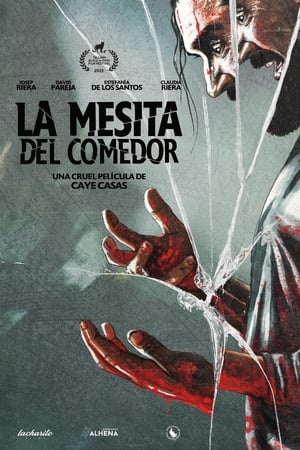
Starting a couple of weeks back, I was hearing a lot of people in the horror community suddenly talking up the 2022 Spanish film The Coffee Table (aka La mesita del comedor), which according to many reviewers is one of the most traumatizing films to come out in recent years. Because of all the buzz about how fucked up it is, you knew that I’d have to watch it as soon as possible because I evidently hate joy and goodness and want to make myself feel bad for no discernable reason. So I grabbed some snacks and dove right in one pleasant Sunday afternoon, which was unbeknownst to me about to become significantly less pleasant.
I’m going to say right up front that although The Coffee Table is, like most movies, better when you go into it not knowing anything about it, the subject matter of this one might make it an exception to that rule. This is one of those films that I feel most people will want to know at least partially what’s going to happen so they can decide if they even want to watch it in the first place. Honestly, I can’t say I blame you if you don’t want to watch it, because this was one of the most anxiety-inducing horror films I’ve ever sat through, and it has nothing to do with violence or gore or anything like that; it’s just the entirety of the disturbing situation that did the number on me (and apparently on most other people who watched it).
For context, just take a gander at some of the adjectives used to describe this thing around the internet: “bleak,” “gruesome,” “devastating,” “mean-spirited,” “unbearably cruel,” and “make[s] you feel sick for nearly 90 minutes.” And if that doesn’t accurately convey the vibe this thing gives off, consider that multiple reviewers also compared The Coffee Table to the aftermath of THAT scene from Ari Aster’s Hereditary (you all know the scene I’m talking about), but extended to feature length. This film also gave me a similar sensation of compounding dread as the 2022 Danish feel-bad flick Speak No Evil (which I reviewed here). Does all of that sound like a good time to you? Yes? Then have at it. No? Then you’re gonna have to take a hard pass on this one.
So given what I just said, I will be discussing some major plot points about The Coffee Table just as a sort of trigger warning, I guess. If you’d really rather watch the movie without knowing anything about it, then caveat emptor; come back and read this review after you watch it so we can process our shared trauma. This is your final spoiler warning.
Interestingly, the movie is billed as a horror film, but mostly as a black comedy, and trust me when I say that if it is meant to be a comedy, it’s a pitch-black comedy, if that. Although there are darkly funny-ish moments, on the whole, it’s the kind of queasy, uncomfortable funny where you’re sort of laughing and screaming and feeling like you’re going to throw up at the same time, and where you suspect that even thinking about laughing at such horrific circumstances makes you a complete psychopath. I think, though, that most normal people will not find anything about this funny in the slightest. It’s a little hard to explain, but at some points in the story I had my knees pulled up to my chest and my fists in my mouth, and I was sort of wheeze-laughing and repeating, “OH MY GOD IT’S AWFUL! OH NO!!! OHHHHH NOOOOO!!!” I’ll note that I also had to take multiple breaks because the sustained tension was giving me a stomach ache. Make of that what you will.
Directed by Caye Casas, the story of The Coffee Table is simple in the extreme. At the beginning, we’re introduced to a married couple, Jesús (David Pareja) and María (Estefanía de los Santos), who are at a bargain furniture warehouse place, haggling with a somewhat seedy and desperate salesman over the titular coffee table. They are accompanied by their newborn baby son in a stroller.
This extended opening sequence fills us in sufficiently on the dynamic at play with this couple. Jesús is bizarrely insistent on purchasing this expensive but ridiculously tacky piece of furniture, mainly because he feels he has no control over anything in his life anymore and wants to maintain some illusion that his choices and opinions still matter. María, on the other hand, absolutely hates this quasi-art-deco monstrosity and pushes back aggressively at the salesman’s absurd claims about how classy it is and how the glass top is “nearly” unbreakable.
As the exchange continues and the pair’s tempers flare, it comes to light that Jesús was not ready to have a child, and makes passive-aggressive swipes at the “horrible” name his wife chose for the kid (which was actually her grandfather’s name, Cayetano). María, who is admittedly pretty unpleasant but maybe understandably so, had wanted a child for years, is clearly of an age when it’s not going to be possible much longer, and so had been getting frustrated and tired of waiting for Jesús to get his shit together. In short, Jesús seems to resent his wife for “forcing” him into fatherhood and by extension resents his son as well; while María is filled with love for her son but resents Jesús for his ambivalence and what she perceives as his failure to step up.
At last, Jesús drops his nuts and decides to purchase the table after María simply gives up arguing in disgust. After she leaves the store, the salesman admits that he lied and that he doesn’t really like the table either, but that buying it will fill Jesús’s home with happiness. The cruel irony of this statement will resonate throughout the remainder of the film.
The table arrives and Jesús pushes the heavy thing in its box up multiple flights of stairs to the family apartment. At this stage, we’re also introduced to a thirteen-year-old girl named Ruth who lives upstairs, thinks she’s in love with Jesús, and aggressively insists that she knows he loves her back, misinterpreting every harmless gesture of his toward her as evidence of his forbidden feelings. He tries to fend her off, but her troublesome presence will hover around the edges of the tragedy about to unfold.
Jesús begins assembling the table but soon realizes to his annoyance that one of the screws for fastening the glass top to the base is missing. He phones the salesman at the furniture store and chews him out, demanding that he bring another screw out to his house as soon as possible. María, way past irritated by the whole deal, keeps making comments about how stupid it was for Jesús to buy this ugly table, that he’s an idiot, and that he’s getting what he deserves.
Jesús’s brother Carlos (Josep Maria Riera) and his new, eighteen-year-old girlfriend Cristina (Claudia Riera) are going to be coming for a visit that afternoon to meet the new baby, so María needs to go to the grocery store for food and wine. She tells Jesús she’s leaving the baby with him because she’s been caring for the infant since he was born and needs to have a couple of hours to herself. This will be the first time that Jesús has been left alone with the child, and spoiler alert, it will also be the last.
The moment María leaves the apartment, the baby starts crying, and Jesús picks him up and carries him around, trying to comfort him, though this doesn’t seem to be working. And then, long story short, Jesús somehow stumbles over the partially assembled coffee table with the infant in his arms, and the baby is cleanly beheaded by the broken glass. The actual incident is not shown; all we see is a shot of the long hallway from the front door to the living room, and we hear the shattering of the glass and the abrupt ceasing of the baby’s cries. It’s almost worse than seeing it happen because you can imagine it, and when we see the aftermath, it just compounds the split-second, overwhelming horror of the situation. The baby’s headless body still lies perpendicular to a bloody pane of glass, while the head has rolled under a nearby chair.
I have to say that David Pareja’s acting is chef’s-kiss perfect here; his face just portrays such a shocked blankness, undercut by the terrible knowledge that something has happened that he’s not going to be able to fix. You can almost see the wheels turning in his head, wishing he could go back a couple of seconds and undo it, but realizing with dawning devastation that there’s nothing left now but the grim, far-reaching outcome of his small mistake.
The rest of the film’s runtime, then, is Jesús trying to conceal the accident as long as possible, as though there’s going to be some way of correcting it, or coming back from it. He goes to the upstairs neighbors’ for cleaning supplies to try to get rid of some of the blood, and he puts the baby’s headless corpse into the crib and closes the nursery door. In an absurdly horrible but still understandable turn, he can’t bear to touch the baby’s severed head and leaves it in place under the chair.
Eventually, of course, the man from the furniture store arrives with the screw, and way overstays his welcome while Jesús desperately tries to get rid of him. Then María comes home and starts preparing food for their guests while a sweating, monosyllabic Jesús claims he’s not feeling well and that it took so long for him to get the baby to sleep that María shouldn’t disturb him. Shortly after that, Carlos and Cristina arrive, and there are whole new minefields to navigate. The oppressive apprehension of the story from that point forward comes from the audience knowing that the discovery of the baby’s grisly death is of course inevitable, but not knowing how or when it’s going to happen, and what the exact repercussions are going to be.
Although I don’t have any human children myself (though I have several fur babies), I could see parents of small kids or infants having a REAL hard time watching this film, because this is something that could absolutely happen in real life, and the believability of it is what makes it so harrowing and sickening to watch. The ghastliness is further heightened by the characters other than Jesús obliviously talking about the baby whose bloody head is under a chair only a few yards away.
While some reviewers found the ending too abrupt, I don’t agree with that assessment at all, and to be honest I think it ended the only possible way it could have. When the crucial revelation came, it was actually a relief and made me realize how ill and tensed up I’d felt the whole time I was watching, because all the pressure engendered by Jesús’s horrendous predicament was released at once. It’s a brilliant film, don’t get me wrong, but it’s not an experience I’d care to repeat, so I probably will not be watching it again.
I’m sure there will be some horror fans out there who aren’t affected at all by this movie, but I am not ashamed to say that I am not one of them; I couldn’t even sit through the whole thing in one go, and had to keep getting up and walking around to decompress from the brutal onslaught of misery. I’m glad I watched it, but it kept me up kinda late that night too, just thinking about it; I thought it was going to give me nightmares, but it thankfully didn’t (yet). It might be just me; beheading has always freaked me out big time, so the whole inciting incident of this film disturbed the fuck out of me, and the fact that I then had to spend the next eighty-odd minutes wallowing in the gruesome impact of said incident stressed me out so much that I sort of felt like I wanted to hurl.
This is a difficult movie to recommend for obvious reasons, but despite how soul-crushing it is, the quality is excellent: the acting is top-notch, the cinematography is interesting and impactful, and the simple story really goes in for the kill and rubs your face in the anguish, which is the true definition of horror. If that all sounds like a regular day at the office to you, then you might be the intended audience, but for everyone else, please exercise extreme caution where The Coffee Table is concerned.
Until next time, keep it creepy, my friends.
 The Scare Salon