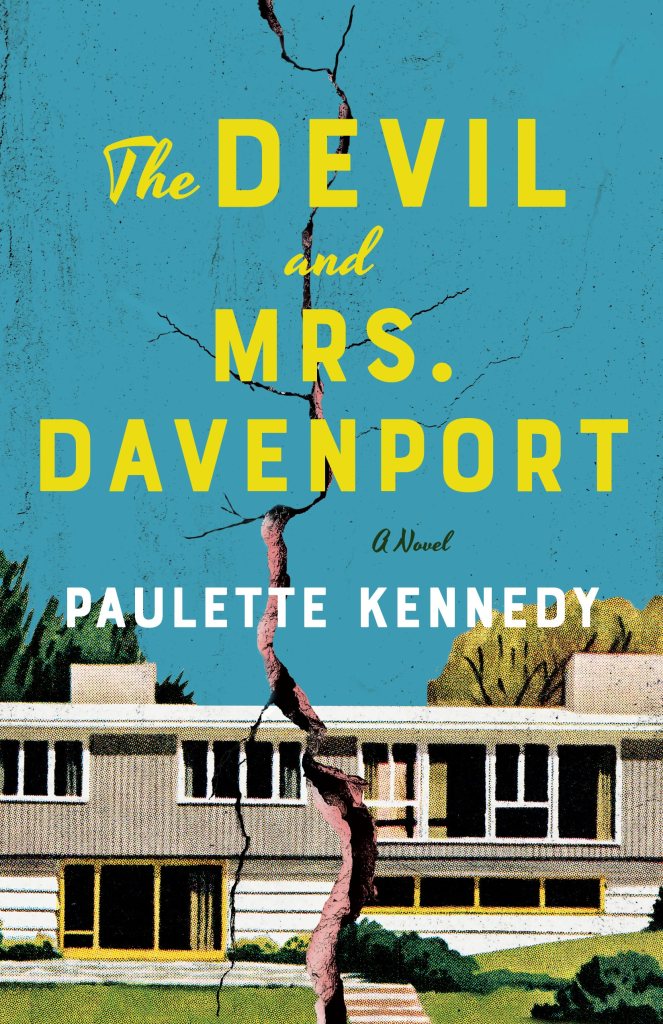
Another random spin of the Kindle Unlimited wheel has brought me yet another wildly entertaining read, thank goodness. I’m not entirely sure why I chose Paulette Kennedy’s 2024 novel The Devil and Mrs. Davenport over all the other recommendations on offer; something about the title and the “midcentury suburbia” vibe of the cover just really piqued my interest. And I’m really glad it did, because this was a very engrossing story, simply written but super compelling, with a main character you couldn’t help but root for.
In the endnotes, the author talks at length about her inspirations for this novel, and in particular her love of Daphne du Maurier’s and Shirley Jackson’s work. And indeed, this does have something of a Shirley Jacksonesque tinge to it, though framed more like a domestic thriller. I would, in fact, call this a gothic supernatural thriller more than a straight horror novel, and it has a few vague hints of a romance as well (but don’t let that put you off).
At times, it also reminded me a bit of Stir of Echoes (specifically Richard Matheson’s 1958 book more than the excellent 1999 movie adaptation), with the proliferation of status-conscious characters in the 1950s crossing paths with the paranormal, and a murder at the center of it all.
I have to say I had an absolute blast with this book, even talking aloud to some of the characters at certain points, especially one character that I badly wanted to punch in the dick. If you’ve read the novel, you’ll know exactly who I’m talking about, and also, is it weird that I sometimes talk aloud to book characters? Eh, I’m too old to care about doing weird shit, I reckon, so I withdraw the question.
As always, I’m not going to spoil anything about the book outright, especially as it’s so new, but I am going to give an extensive rundown of the setup and plot, so if you’d rather go into this blind, kindly read the book first and come back to this review later.
The prose, as I alluded to earlier, is very basic and unadorned, and at times has a bit too much “tell, don’t show,” but honestly, I didn’t mind that much at all, as it made the story just fly by. I felt the ending was slightly anticlimactic as well, but again, it’s a pretty minor criticism, and throughout the whole book, I found myself unable to unglue my eyes from the page until I got to the end. And even after it ended, I kinda wanted it to keep going, which is always a positive sign.
The story is set in 1955, in a fictional small town in the Ozarks that’s somewhat based on the author’s hometown of Springfield, Missouri. Our main protagonist is a twenty-seven-year-old housewife named Loretta Davenport. She’s a shy, sort of dowdy young woman, married to a man named Pete, who is a professor at a Bible college. She met Pete at a tent revival when she was sixteen years old, and he swept her off her feet; Loretta got pregnant and dropped out of high school so they could get married. Years later, the pair have two children, a son named Luke who’s about eleven or so, and a younger daughter named Charlotte.
Loretta grew up on a hog farm, and her mother died in a tragic accident when she was twelve years old, an accident that she witnessed. Because of her rural upbringing, her lack of a mother figure, a distant father figure, and her truncated education, she’s always felt somewhat inadequate: homely, backward, not good enough, and to blame for things that aren’t her fault. She always had dreams of living in a big city and doing glamorous things, but she’s sort of stuck in this very strict, Pentecostal household with a husband who won’t allow her to work, cut her long hair, wear makeup or flattering clothes, or hang out with other women who are “bad influences.” Pete is very concerned with his career and his image, and often admonishes Loretta if she doesn’t look or behave exactly the way he wants her to, which is like a subservient house-mouse. Loretta, who has self-esteem issues, feels that if she can just be the perfect wife for Pete, then everything will be wonderful again and they will be as happy as they were in the beginning.
At the start of the story, Loretta is just on the cusp of recovering from a terrible flu. Because Pete is like the quintessential 1950s man and is completely useless at anything having to do with taking care of the house or children, he’s been low-key trying to guilt-trip Loretta into getting the hell out of bed and getting back to her domestic duties. Loretta is still very ill, but she also feels ashamed of being “lazy” and “neglecting” her family, so she essentially forces herself to get up and get back to her wifely tasks before she’s fully ready.
Interestingly, though, the flu seems to have…triggered something dormant in Loretta’s psyche, in that she begins to hear voices and see random visions. At first, she thinks it’s just a by-product of the virus, but then, she gets a very clear and alarming vision of a nineteen-year-old girl named Darcy who went missing while walking home from work one night some time ago. The vision is so vivid that Loretta feels compelled to phone the police and report an anonymous tip as to where the girl’s body can be found.
Long story short, Darcy’s remains are discovered exactly where Loretta envisioned they would be. Darcy is all busted up, but her cause of death was suffocation: turns out she was buried alive.
After an incident where Loretta sees some spirits while another couple is over at the Davenport house, Pete insists she go to the hospital to see what exactly is wrong with her because he implies she’s being an embarrassment. At the hospital, a female doctor named Dr. Dixon can’t find anything physically wrong, but after Loretta tells her about the voices and the visions, she refers Loretta to a psychoanalyst. But not just any psychoanalyst; Dr. Dixon, who is very understanding of Loretta’s issues, tells Loretta that this psychoanalyst also has an interest in parapsychology. She writes out a referral and also tells Loretta that the psychoanalyst, Dr. Curtis Hansen, is giving a lecture at the library about metaphysical topics that she might want to check out.
Loretta is completely terrified by her visions at first, but after she sees the calming spirit of her mother and realizes that Charlotte might also be seeing apparitions, she starts to think that maybe God gave her this gift to be able to help people. She tries to explain this to her fuckstick of a husband, but of course, he is absolutely not having it, telling her that she’s either crazy or being tempted by the Devil.
Convinced that’s not the case, Loretta sneaks out and goes to the lecture, only to find that Dr. Hansen is young, handsome, and very open-minded about psychic abilities. After some trepidation, she calls his office to make an appointment, telling him about her visions. He’s very interested and offers to meet with her for free to see if her abilities are legit.
Dr. Hansen is kind, warm, and understanding; the complete opposite, in fact, of the shitheel Loretta is married to. She starts to go to sessions every week on the sly, even though Pete tells her not to, and through their meetings, Loretta begins to understand her gift much more. She also starts having visitations from the murdered girl, Darcy, who is trying to communicate with her to get the murder solved, and Loretta ends up teaming with Darcy’s living sister Dora as well, who is frustrated that the police haven’t made any significant progress in the case.
As events progress, Loretta begins to become much more confident in herself and starts to find her own identity. She starts writing, something she always wanted to do, and even finds a sympathetic detective on the police force who believes in her abilities and wants her to help them solve Darcy’s murder as well as an earlier cold case. She makes friends with a fun but somewhat “unacceptable” woman named Gladys, starts standing up for herself more, and even gets a job writing a weekly column for a newspaper. As Loretta blossoms, though, Pete’s controlling demeanor becomes ever more restrictive, and he starts trying to crack down on her (completely harmless) activities, taking her car away and having their busybody neighbor basically spy on her. Loretta finds herself having to lie to Pete more and more to keep from incurring his wrath.
It will surprise no one, of course, that hypocritical Pete has many secrets of his own, only the least of which is that he’s started drinking again after telling Loretta he’d stopped.
As Loretta’s visions become more urgent and she feels more motivated to solve the murders and free herself from the constraints of her increasingly abusive husband, events start getting ever more dire, and since this is 1955, Loretta has almost no recourse when Pete decides to curtail her freedom in any way he can, including subjecting her to a “deliverance” (read: violent exorcism) and having her thrown in an asylum at one point.
As I said, this reads very much like a fast-paced domestic thriller with a paranormal angle, and the fact that it was set in 1955 just gave it that added touch of paranoid horror, as Loretta is thwarted at almost every turn by frighteningly real bullshit like not being able to open a bank account on her own and never having her needs or grievances taken seriously. The religious angle also ratchets the terror up a notch, as Loretta’s psychic abilities become a focal point for the town’s Pentecostal elders to paint her as demon-possessed and therefore not in control of her own thoughts and faculties. Stories like this have always been very scary to me, as especially being a woman in this time period would mean you had very little power when any of this crap was pulled on you. I felt so bad for poor Loretta as she struggled to be her own person, and at times during the story, I wanted to reach through the virtual pages and wring her husband’s scrawny neck for her.
Though some of the plot developments will not come as any great surprise to the reader, this was still a pulse-pounding thrill ride of suburban, religious horror, and I especially liked how the paranormal stuff in the story was largely portrayed as a positive; the horror came from how the close-minded townsfolk reacted to it. I have to say I quite enjoyed all of the 50s-specific references to Duke’s parapsychology laboratory as well, and it’s clear that Paulette Kennedy did a lot of research about J.B. Rhine and the vanguard of parapsychological research in the era, as a bit of it is sprinkled throughout the story for added spice.
If you like Shirley Jackson’s fiction and also enjoy stories set in the stereotypically 50s suburbia with a dark underbelly, then this will probably be right up your alley; it does have a whiff of romance about it, but I couldn’t be too mad, and as I mentioned, Loretta was such a relatable, sympathetic character that you just wanted her to come out of this horrific situation unscathed and find her happiness. The end, as I said, was a touch anticlimactic and the messaging in the epilogue was a tad on the nose, but overall, this is a fun, straightforward, gothic/paranormal tale with a bit of a murder mystery aspect as well, so check it out if that sounds like your bag.
Until next time, keep it creepy, my friends.
 The Scare Salon