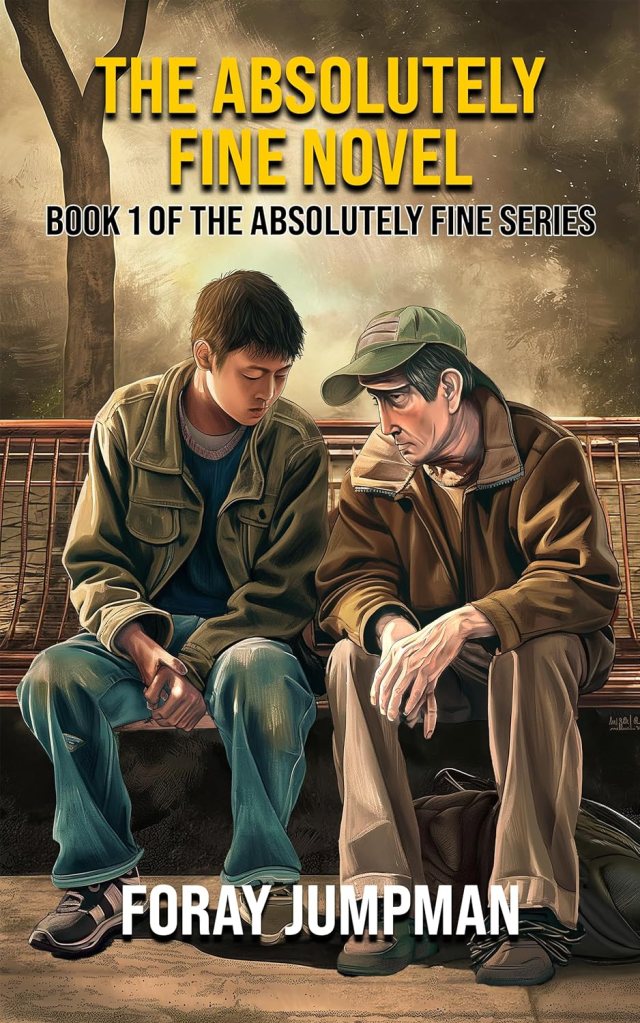
Some time ago, I was contacted by a California-based author named Foray Jumpman, and he asked if I would read and review his 2023 book The Absolutely Fine Novel, the first in a seven-book series. He acknowledged that it wasn’t a genre I would usually cover, but you guys know me, I’m pretty open-minded, so I told him I’d give it a whirl.
Honestly, I’m not entirely sure what genre I would call this novel if I had to pin it down; it’s literary fiction bordering on experimental, I guess. Jumpman, who is only twenty years old, has a unique voice for sure, but is clearly influenced by works like The Catcher in the Rye by J.D. Salinger and Ulysses by James Joyce.
How you feel about that is up to you, but I will note up front that if you’re planning on diving into The Absolutely Fine Novel, keep in mind that this is not a breezy, fun read that you can just skim through. The language is very prolix, poetic, and metaphorical, so much so that sometimes I found myself having to read a particular paragraph two or three times to get a handle on what was going on. It’s not a straightforward story at all, is what I’m saying, and in fact is comprised of several nested layers relating to several interconnected characters talking about events that jump back and forth in time. In short, this book is work, and it took me about ten times longer to read than a book of comparable length would normally take me to get through. So I found it challenging, and though it was ultimately fairly rewarding, I found it pretty frustrating at times too, not gonna lie, and it took me a long time before I really got into it, and even after I did I still sort of felt as though I was held at one remove from the text.
So what is this book about, you may be asking, and that’s not really an easy question to answer, because it doesn’t have much of anything resembling a traditional plot. I’ll give you a rundown of the setup, though, such as it is. At the very beginning, we’re in a psychiatrist’s office with our nominal main character, a high school student named Manuel Swan, who has been through some shit and is there for some help. He has brought with him a garbage bag full of notebooks that he’s filled to the brim with his thoughts and memories, some of which are told from the perspective of different people that he knows (or maybe they’re just characters in his head). Here’s a quote from the prologue that will maybe give you a better idea of what I’m talking about:
“Also, it must be said that the configuration of the text may confuse the ordinary reader. Manuel had a dear pleasure of the concept of looking inside the mind of the individual. Therefore, it shouldn’t surprise you to find the perspective change below the bolded letters of a ‘character’s’ name, as well as the implementation of years and dates—because in actuality, are these people actually characters? Heck, what’s the point of using the word itself if the point of writing is to represent what the world is? And, although this may be impossible due to the . . .absence of some, an attempt should suffice your enjoyment, and through careful deliberation, with the help of Manuel’s wit, we hope that our ambition would lead this work to be labeled as a document, not an embodiment.
“I remembered a discussion we both had, and Manuel cried, ‘I’d rather have the reader struggle instead of cookie-cutter this mess.’ Alas, the puzzle pieces were meshed, the business hands were shaken, and the real timeline was set. It is with great honor that I have the privilege of recounting the times when he found out this intriguing stuff around Langston, where Boris Avenue is. Enjoy!”
So after this opening, we find ourselves with Manuel in a restaurant/bar in Langston, California called the Laughing Stock on an open mic night. He’s supposed to perform with a friend of his called Desmond, but Desmond didn’t show up, so now he’s watching this girl named Daisy Welter up there singing, knowing that he’s supposed to be up next.
Manuel decides to leave during her set, though, hoping to catch an early bus home. While waiting at the bus stop, he meets a homeless man named Greg Zaledy, and the two of them start interacting. From then on, the two of them develop a sort of friendship, and the narrative switches back and forth between Manuel and Greg talking about events in his life (some of which happened in the 50s and 60s) and also has sections written from the perspective of a few other characters, such as the aforementioned Daisy (a popular girl who Manuel has a crush on); a former drug dealer and now dollar store employee named Zach (who I think is also Manuel’s dad); and another musician named Christina Pollen, who seems to have some kind of (possibly homicidal) beef with Daisy in that they used to be in a relationship but now no longer are. Over the course of the story, Daisy seems to have troubling visions of Christina at varying times, and seemingly falls in love with Zach, though she dates Manuel too, a somewhat awkward situation.
Manuel also has a brother named Maron, by the way, who is a genius and trying to get into MIT, and it seems that Manuel’s parents are always unfavorably comparing him to his much smarter and more successful brother. Manuel himself seems to have self-esteem issues concerning Maron, whom it’s implied he used to have a much closer relationship with. There are sections written from Maron’s perspective as well, particularly following an incident when he accidentally falls into a pool and embarrasses himself at what I believe is some sort of swim meet.
About halfway through the story, another character named Jerome Armaton is introduced, a middle-aged man pretending to be “millennial-like” who allegedly tricked Daisy into doing something she doesn’t want to talk about and has “a huge criminal record,” at least according to what homeless Greg told her. There are also sections written from his point of view.
There then comes part two, some of which takes place sixteen years previously and talks about Manuel’s mom Penelope as well as Jerome some more, who I thought for a second was the same person as Zach, though again, I might have totally missed the ball there. The story jumps ahead seven years shortly into part two as well, and goes into the POV of the elusive Desmond, the guy who didn’t show up at the open mic night at the beginning.
And I could also be wrong about all this, but since the whole narrative is supposedly told from Manuel’s perspective—as in, we’re essentially reading about stuff he wrote in his notebooks as he discusses these events with a psychiatrist—all of these people’s sections are really Manuel’s perception of them and how they experienced said events. I might just be talking out of my ass, but that was at least how I understood it.
The book progresses in this sort of fragmented way, more as a series of connected vignettes than a standard story where one event follows from the last, jumping from character to character and time period to time period. It does have a structure, but you really have to keep on top of it while you’re reading or you’re probably going to be completely lost. At times, it almost gave me a slightly similar vibe to Chuck Palahniuk’s Haunted, but not as cohesive, satisfying, or viscerally revolting as that.
I have to admit I had really mixed feelings about this book. On the one hand, it’s not a genre I would normally read, and to be honest I’m usually not a big fan of fiction that’s experimental for the sake of it, because I’m old and cranky and I don’t have the patience to parse through these occasionally evocative but needlessly convoluted sentence structures to get the gist of what’s happening. I’m generally more of a no-nonsense, get-to-the-point type gal, is what I’m saying (although I’d be lying if I said my own fiction writing wasn’t a tad overwrought and wordy as well, so maybe I can’t throw stones).
On the other hand, some of the turns of phrase in this novel are pretty spectacular, and you can’t help but admire some of the artistry of language on display here. It’s just that I don’t know how much of it is in service to the story and the characters, and how much of it is just flashy wordplay with no inherent purpose relating to the novel’s themes, just there to wow the reader with its wild creativity.
I will also mention here in passing that I came across numerous uses of the word “retarded,” and I’m not sure if the author was using it ironically or somehow didn’t know that it wasn’t a real cool word to just casually throw around like that.
In addition, I was somewhat amused by the fact that the author congratulates the reader on the last page for making it all the way to the end. Make of that what you will.
If you’re into more experimental or post-modern fiction, along the lines of David Foster Wallace or maybe Thomas Pynchon, you might be the target audience for The Absolutely Fine Novel, because it’s kind of along those same lines. It’s not really my thing, but I appreciated the imagination and off-the-wall energy of the novel. Not enough to read another six books’ worth of it, but as I said, I don’t feel like I’m the intended audience, as to me it came across as too try-hard. Foray Jumpman is still really young and has already produced a voluminous amount of work, which is an admirable feat in and of itself, so I definitely salute him for that.
All seven books are available on Amazon, and all of them can be read for free with a Kindle Unlimited subscription, so if you want to dip your toes in and see if this is something you’ll vibe with, by all means, get over there and check it out. From what I could determine, the subsequent books in the series explore different facets of things mentioned in the first novel. Book 2, The Absolutely Fine History, for example, looks like it covers some of the stuff from 1955 that Greg Zaledy was talking about; Book 3, The Absolutely Fine Mystery, appears to return to Manuel and Daisy and Maron and continues the events of the first novel; while Book 6, The Absolutely Fine Magic, has a flying horse on the cover and a description that simply reads, “It is here that the laws of physics have now been extinguished.” So there’s that.
Until next time, keep it creepy, my friends.
 The Scare Salon