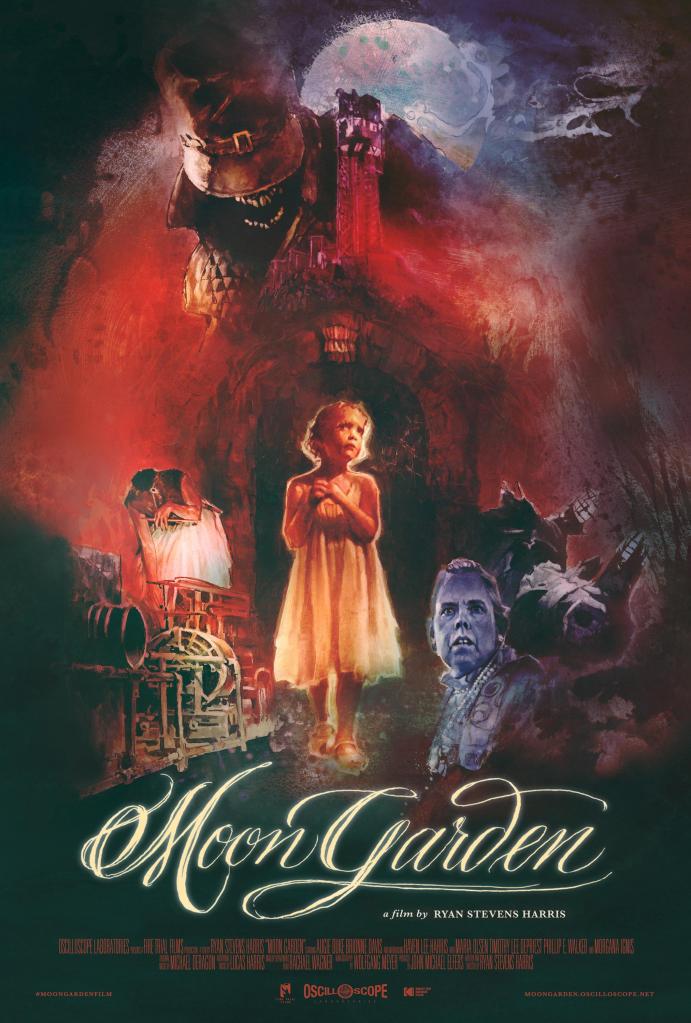
I have to admit that I had never heard of the 2022 film Moon Garden until I heard Jason and Kali talking about it over on Sinister Cinema Reviews; they mentioned it as one of their favorite films of last year. Moon Garden premiered at the Dances with Films Festival in Los Angeles back in June of 2022 but didn’t get a (minimal) theatrical release until May of 2023. It’s now available to stream on Shudder, at least in the US, as well as a few other places.
The movie was written and directed by Ryan Stevens Harris and stars his five-year-old daughter Haven Lee Harris in the main role. I will say right up front that the kid is ridiculously adorable and does a great job, as much of the film is riding on her tiny shoulders and her huge, expressive blue eyes.
Although this is less a straight-up horror film and more a mixed-media dark fantasy akin to something like MirrorMask or Pan’s Labyrinth but filtered through the aesthetics of Mad God, it does have some effectively creepy imagery, particularly in its main monster, and a gorgeously surreal look overall, utilizing live-action and both traditional and stop-motion animation. The narrative of the film is very simple and not super plot- or dialogue-heavy, but it looks so beautiful that you probably won’t even care. Some of the movie’s unique appearance, by the way, stems from the fact that it was shot on expired 35mm film stock and utilized vintage rehoused lenses.
At the very beginning of the movie, five-year-old Emma (Haven Lee Harris) is awakened in the wee hours of the morning by her mother (Augie Duke) and told to get some things together because they’re going to “chase the sunrise.” As it turns out, though, Mom is actually having one of her frequent crises relating to her checked-out and somewhat dickish husband (Brionne Davis), and is planning to take Emma and skedaddle to who-knows-where.
She never makes it out of the garage, though, because said husband wakes up and finds them in the car. He puts Emma back to bed, and afterward, lays into his wife for thinking she could take Emma away from him. It’s implied that this is not the first time this has happened and that the dynamic between the couple has been steadily deteriorating for a long time.
Although the exact causes of their rancor are not delved into very deeply, it would seem that Dad is a writer (perhaps of children’s stories), and tends to completely shut himself off from his family when he’s in the middle of some big project. Mom, who might be suffering from some type of mental issue, clearly feels neglected and makes passive-aggressive little criticisms of Dad (such as saying that tea always tastes weird when he makes it after he brings her a cup). But in her defense, Dad is honestly kind of shitty, low-key implying that his wife is a burden who has something wrong with her that he has neither the patience nor the compassion to deal with. It’s a very bad situation all around, even though they both obviously love their daughter Emma very much.
Not long into the story, the couple is having a terrible argument while Emma plays make-believe on the stairs. The little figures she plays with and the narrative she invents will map onto the events later on, by the way. When the parents’ argument moves to the bedroom and turns into a full-on screaming match after Emma has gone to bed, the poor child toddles to their room and tries to get them to stop fighting, but in her upset, she runs back toward the stairs and trips over one of the toys she was playing with earlier, tumbling down the stairs and cracking her head on the floor below.
From this point on, the film mostly goes into a dream world as Emma slips into a coma from which she is trying to wake, though she can still see and hear things going on in the real world at times. For example, she awakens in a sort of magical-looking forest, but there are two small screens flashing red and blue (like the lights on the police car that has come to the house), through which she can see her own body, the paramedics working on her, and her wildly distraught parents.
Emma then begins a journey through the world inside her head, which is sometimes lovely but often nightmarish. Her main antagonist is a sort of monster (called Teeth in the movie’s marketing materials but never called that in the film and played by Morgana Ignis) made out of an old coat and hat, who has no face but sports an unsettling set of chattering teeth that it can remove at will. Teeth also has scary clawed hands, gross bare feet, and has the ability to float along, as well as being able to deflate itself to squeeze through small spaces. The look of Teeth is wonderfully creepy, and easily the best visual in the movie.
Not everyone she meets in her Alice-in-Wonderland-type trek is out to get her, though: one of the first people she comes across is a kindly fellow called the Musician (Philip E. Walker), who reverse-smashes an old organ with a mallet and gives Emma a radio on which she can hear her mother’s voice talking to her. Later on, she also meets a man simply called Groom (Timothy Lee DePriest), who is a manifestation of the man her father pictured her marrying when she grew up. And near the end of her journey, she meets an older princess (Maria Olsen, who I immediately recognized from Starry Eyes), who comes out of a bizarre animated story that is analogous to one that her father is writing. Usually, Teeth destroys these people by turning them into small representative objects (it turns the Musician into a tiny piano, for instance).
Throughout all the dream images, there are also memories threaded through that explain where some of the ideas for the dreams came from; for example, it’s suggested that the concept of the Teeth monster might have come from Emma’s dad making a joke about her grandfather’s dentures snapping around behind the wall when she heard a funny noise back there once.
As I mentioned, the story here is very straightforward: it’s basically just a little girl in a coma fighting her way back to consciousness, guided by the voice of her mother. All of the visions she experiences are influenced by her memories and are symbolic of the emotions she feels about the animosity between her parents. In that sense, the movie doesn’t hold any surprises, and I admit that the parents’ relationship is very sketchily presented, though a lot of their issues could be inferred by bits of dialogue in the flashback sequences and by Emma’s figurative dream images.
Despite the lack of a solid plot and somewhat thin characterization, however, this was an absolutely stunning movie to look at, and some of the visual set pieces (such as the Teeth monster and the animated fairy tale) were just breathtaking. I think I mentioned in my recent review of 2023’s Stopmotion that even though the story here isn’t the strongest, the look of the thing is so cool that it really makes up for it, and to be honest, I ended up liking Moon Garden a lot more than Stopmotion overall, even though Stopmotion was more like a straight horror movie.
If you’re a fan of dark fantasy films focused around children’s dream worlds, and particularly are into the work of Guillermo del Toro, Jan Svankmeijer, or even Tarsem Singh, then you’ll probably dig this quite a bit; it’s light on plot and a bit slow in places, but every frame of it is gorgeous, and I’m always a big advocate of supporting independent filmmakers who are clearly working hard to achieve their singular vision.
Until next time, keep it creepy, my friends.
 The Scare Salon
One thought on “Movies: Moon Garden (2022)”