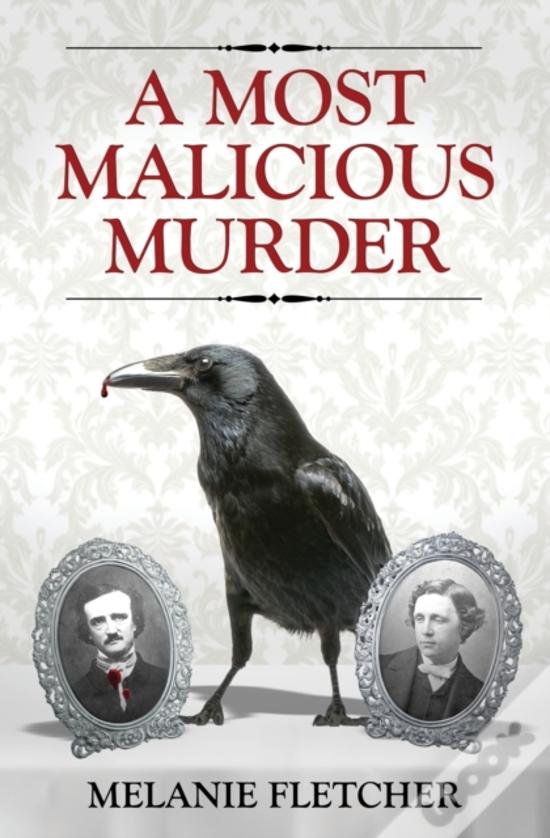
As I’m known to have something of a soft spot for murder mysteries featuring real historical characters, a longtime friend of the show bought me an ebook she knew I would most likely be into, A Most Malicious Murder by Melanie Fletcher, which was first published in 2021. And I have to say that my generous benefactor was correct, as this book was a hell of a lot of fun: a fast-paced Victorian thriller with real people and events woven through its alternate-history narrative.
A Most Malicious Murder is the first novel by Melanie Fletcher, at least under that name; from the endnotes in the book, I gathered that she also writes romance novels under a different nom de plume, Nicola M. Cameron, but had been working on the seeds of what would become Malicious ever since 2009, when she saw Jeffrey Combs starring as Edgar Allan Poe in the one-man play Nevermore, produced by Stuart Gordon and Dennis Paoli.
As I mentioned, the book is an alternate history, positing that Poe didn’t actually die under mysterious circumstances in 1849, as he did in real life. No, in this slightly different universe, Poe got his shit together, got sober (mostly), married his childhood sweetheart Sarah Elmira Royston (who he was engaged to when he died in real life), and launched a more successful publishing career that included founding his dream magazine, The Stylus.
The story also proposes that Poe met a young Charles Dodgson (better known as Lewis Carroll), and that the two became friends and got to the bottom of the murder mystery at the heart of the novel together. The author admits that Poe and Carroll probably couldn’t have met in real life (as Dodgson was only seventeen years old when Poe died) and might not have even liked each other very much if they had, but she was enchanted by the idea of them collaborating with one another and solving crimes like a literary Holmes and Watson.
So here’s the set-up. Edgar Allan Poe, now the toast of the US as well as Europe, has been sent by his publisher to the UK for a lecture tour, which is hoped will not only drum up sales for his own books, but will sell subscriptions to his burgeoning literary magazine The Stylus. His first stop is Christ Church College at Oxford, and though his beloved wife Elmira is accompanying him on the trip, she had a bit of a health setback on the voyage over and went to spend a week or so in Bath to recover, leaving Edgar to fend for himself.
He seems to be doing just fine at first, checking into a room at the Mitre Inn and later giving a successful and well-attended lecture. There is a bit of a kerfuffle at the book signing concerning an arrogant heir-apparent named Philip Stiles, but nothing comes to blows and the embarrassing incident is largely forgotten. Charles Dodgson and his friends also attend the lecture, none of whom have much patience for the insufferable Stiles either.
After the event, Poe’s minder/liaison Mr. Tomlinson persuades him to celebrate their success at a nearby pub. Poe initially declines; he’s given up drinking altogether as a promise to his wife, even though he’s always sorely tempted by his “imp of the perverse” to have a little tipple now and again. Well, Tomlinson wheedles him into drinking, claiming a few sips won’t hurt him, and as you can imagine, Poe loses control of himself and gets ragingly drunk, shouting abuse at all comers and eventually getting kicked out of the joint.
Tomlinson takes him back to the inn where he’s staying, and Poe is so blasted that he just crashes into his room and completely blacks out until well into the following day. When he wakes up, he panics because he thinks all of his things are gone from his room, but then he realizes (with relief as well as a good bit of shame) that in his inebriated stupor, he had stumbled into the empty hotel room across from his own room and slept there instead. Silly Poe.
But then, to his horror, he realizes something else: there’s a butchered dead woman in this empty hotel room, her stomach sliced open and strange symbols carved into her flesh.
This young woman is Jane Billings, a chambermaid at the inn whom Poe had met the day before when she shyly asked him to sign her copy of his poems. Poe can’t believe someone would want to do something so monstrous to such a sweet, lovely girl, but he also knows being found in the wrong room with a corpse is never a good look. He beats feet back to his own room before anyone finds the body.
When the police arrive, however, they of course suspect Poe anyway, even though he tells them that he was only made aware of the murder when he heard the scream of another employee upon finding the remains. The cops point out that Poe’s room was right across from where the body was found, that numerous witnesses could attest to Poe being drunk and belligerent the night before, and that Poe made his name writing stories about macabre subjects. Ergo, he becomes public enemy number one, and is told that under no circumstances is he to leave Oxford until the murder is solved, lecture tour be damned.
Because he wants to leave and continue his tour, and also because he liked Jane in the brief time he knew her and feels terrible at what happened to her, he decides he’s going to be like his fictional detective Auguste Dupin and try to solve the crime himself. He had copied down the symbols carved into the victim’s body, but there were two problems: one, he couldn’t read ancient Greek, which these symbols clearly are; and two, he didn’t want the police to know that he was in the same room with the body and knows about the symbols, because the authorities didn’t release that information to the public.
He happens across Charles Dodgson again, who is a bit of a fanboy it seems, and it so happens that Dodgson can read ancient Greek, as can many other students at Oxford. From this point forward, Poe and Dodgson team up (reluctantly on Poe’s part, enthusiastically on Dodgson’s) to try to find the fiend who slaughtered this poor, innocent chambermaid.
But as the tale goes on, things get even more complicated as more people turn up dead, savagely slain in ways not dissimilar to victims of Jack the Ripper. It’s clear that the killer has some kind of agenda here and a reason for attacking these particular victims, but what is it, and why is he taking gruesome trophies from the bodies?
As I said, this was just a bloody, rollicking good time, an easy read that just flew by but still effectively immersed you into its world. Even though you as the reader know it’s an alternate history, there’s enough real detail here to make everything seem completely believable, and even though the solution to the mystery is fairly straightforward (though I admit I didn’t guess who the killer was; I just knew who it wasn’t), it keeps you entertained all the way through with intriguing clues and interesting characters butting heads and trying to catch the murderer before he strikes again.
If you’re a fan of Victorian-era mysteries and alternate-history timelines, especially with a literary bent, you should love this; it’s well-written and perfectly paced, and just keeps you turning the pages until you can figure it all out. It’s a great concept to throw together these two famous men of letters and place them in the middle of a serial killer spree, and Melanie Fletcher made the most of her delightful idea and knocked it out of the park. Definitely recommended.
Until next time, keep it creepy, my friends.
 The Scare Salon