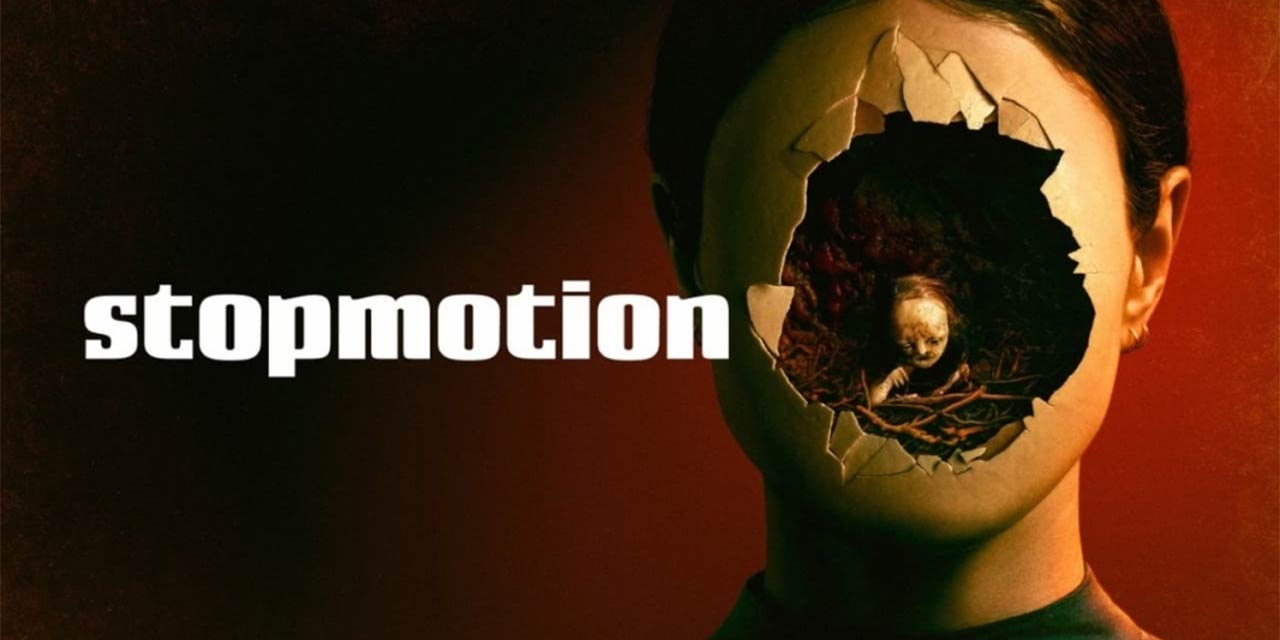
For the last couple of weeks, I’ve been on a bit of a mini-quest to actually watch some of the most-talked-about new horror films while they’re still (relatively) new, hence actually going to the theater to see the incredible Late Night with the Devil (which we livestreamed a review for here), and paying $6.99 to stream the movie we’re talking about today, Stopmotion, a British psychological horror that premiered at Austin’s Fantastic Fest back in September of 2023.
Stopmotion is the feature-length directorial debut of filmmaker Robert Morgan, who has won numerous awards for his short films since the early 2000s. His first feature-length film is clearly a labor of love for the artist, utilizing his signature stop-motion animation and blending it seamlessly with live action to craft a quietly unsettling narrative that draws influences from Roman Polanski’s Repulsion, David Lynch’s Eraserhead, Phil Tippett’s Mad God, and the work of the Quay Brothers.
Although those are some impressive shoes to fill, Morgan seems more than up to the task, though I will admit that although I loved the look and overall vibe of this movie, it fell a bit short of greatness for me, perhaps because I wish it had leaned harder into monstrous weirdness, rather than being a metaphorical but still fairly simple story with flourishes of surrealism.
Aisling Franciosi (The Nightingale, The Last Voyage of the Demeter) plays Ella Blake, a stop-motion animator who also happens to be the daughter of a legend in the same field: her mother Suzanne (Stella Gonet). We don’t spend a great deal of time establishing the relationship between these two characters, but we really don’t have to; it only takes a few minutes of interaction to make it clear that Suzanne is overbearing and controlling, essentially seeing her daughter the same way she sees the puppet figures she uses to make her movies.
Suzanne has developed crippling arthritis and has lost the use of her hands, so insists that Ella help her finish her last film before she dies, as well as care for her in every other way. Ella is obviously very resentful of this, as she’s an artist in her own right and wants to create her own work, not be forced to expend all her energy on someone else’s. The first few scenes of the movie establish not only the toxic familial ties here, but also the isolation and tedium inherent in the creation of stop-motion animation itself.
Not long into the story, Ella gets something that feels like a lifeline when her mother collapses from a stroke and goes into a coma. Initially, Ella’s guilt behooves her to continue work on her mother’s film, and though her mostly supportive boyfriend Tom (Tom York) offers to let Ella move in with him while her mother recovers, Ella opts instead to rent a small apartment on her own so she can work without distractions.
Shortly after settling in, she meets a strange, nosy little girl (who is never named but is played by Caoilinn Springall), who ostensibly lives in the same building, though we never see her parents. The girl is intrigued by Ella’s work, but doesn’t particularly like the movie she’s working on—which is her mother’s film about a pair of Cyclops monsters—proclaiming it “boring.” The girl suggests that Ella make something else, and starts giving Ella an idea for a new story.
In this new tale, the girl suggests that there’s a little girl in the woods who is being pursed by a monster she calls the Ash Man. As the movie goes on, the girl gives Ella tips on creating the puppets for the film, utilizing all kinds of yucky components such as mortician’s wax, raw steak, and a dead fox. As Ella and her little collaborator work on the film, Ella’s grasp on sanity begins to waver, as the stop-motion world of her movie begins to bleed into reality.
The story, as I alluded to earlier, doesn’t really hold any twists or surprises, as it’s essentially a descent-into-madness narrative about an artist sacrificing everything for her art. Though the film has metaphorical aspects to it with regard to the use of puppets and the human control of same, the metaphors aren’t obscure at all; this isn’t really a film with multiple interpretations, in other words. The story is very straightforward, even though the imagery tends toward the creepily surreal, so it reads very much like an accessible art-house film.
Stopmotion is also quite gory in places, so those who are bothered by squicky body parts and chunks of skin being pulled off in loving close-up might want to steer clear. It’s not a bloodbath by any means, but it does have a few uncomfortably gruesome sequences, so viewer be warned.
This film is not going to be for everyone (then again, what is), as it has a fairly slow, dialogue-light first act and is generally paced at a very patient rate of speed, mirroring the slow and steady theme engendered by the stop-motion angle of the story. The acting performances are great across the board, the visuals are disquieting and grotesque, and the squelchy sound design is also a real highlight.
Though I will say that this movie didn’t hit me nearly as hard as my other recent horror experience, the outstanding, instant-classic awesomeness of Late Night with the Devil, this was nonetheless a solid, creepy flick, one that was clearly made with love and meticulous care by someone with oceans of experience in the subject matter portrayed. It just makes me happy that creative independent horror like this is getting some mainstream attention and even getting limited theatrical releases, so do your best to support movies like this if you can, so we can get more of the good stuff. If you can’t see this in the theater (it wasn’t playing anywhere near me, so I get it), you can either pay to stream it as I did, or wait for it to come to Shudder at the end of May. I would recommend it if you’re into slow-burn metaphorical horror with a simple set-up and wonderfully disturbing imagery.
Until next time, keep it creepy, my friends.
 The Scare Salon
One thought on “Movies: Stopmotion (2023)”