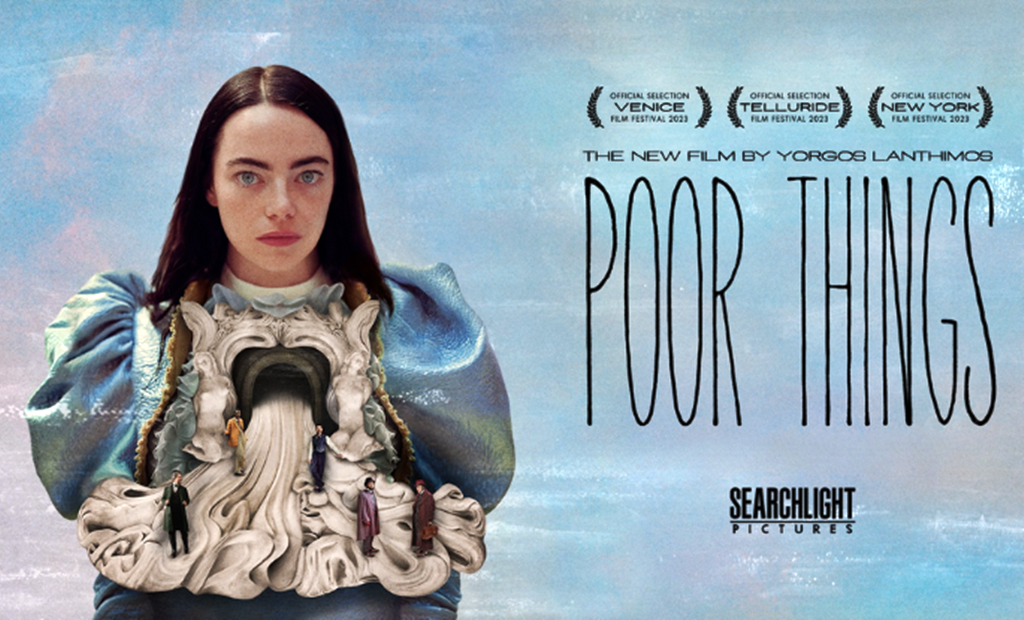
Not long after I posted my review of Yorgos Lanthimos’s 2017 film The Killing of a Sacred Deer, seemingly everyone and their mama crawled out of the woodwork and told me that I absolutely must make time for an immediate viewing of the latest work from the Greek auteur, 2023’s Poor Things (which is loosely based on a 1992 novel by Scottish author Alasdair Gray).
Since the film had such rapturous acclaim (including four Oscars, two Golden Globes, and five BAFTAs) and was available to watch on Hulu, I settled in with it one hung-over afternoon to see what all the fuss was about. And because multiple people had suggested I go into the film completely blind, I did exactly that, not even reading a synopsis or watching the trailer (which is generally how I like to approach movies anyway, so it wasn’t any big hassle).
Keep in mind that to discuss this film at all, I’m going to have to talk about things you might not want to know beforehand, so this is your spoiler warning. I’m not going to reveal the entire plot, but as I said, this movie is much better if you just go into it having no clue at all what you’re in for.
I have to say right up front that this was one of the most entertaining film experiences I’ve had in a very long while. Though I understand there have been some pretty substantial controversies around the movie’s subject matter (which I’ll address in a bit), I found this movie to be wildly imaginative, wickedly ebullient, gorgeous to look at, unapologetically batshit insane, and easily one of the funniest fucking movies I’ve ever seen in my life. I also feel like whatever I say about it, I won’t be able to do it justice, as it simply must be seen and experienced for oneself.
I’ll be the first to admit that I have no idea what genre, if any, I would place this movie in: it’s centered around a Frankenstein-like narrative, but it’s not a horror movie, though it does have elements of science fiction and a bit of a steampunk aesthetic, all wrapped around a blackly comic fantasia of sex and self-discovery. It had echoes of City of Lost Children, Bram Stoker’s Dracula, and Terry Gilliam’s films, but was most emphatically its own thing, and created an entire whimsical, artificial world that I admit I got a bit lost in.
No bones about it: I adored every beautiful, bonkers minute of this film, and wanted to watch it again the second it was over.
Obviously, like all of Lanthimos’s films, this is not going to be for everyone, and one particular warning I will give is that this movie is quite sexually graphic, so you might not want to watch it with Grandma and the kids or things are going to get REAL awkward. I saw some commenters complaining that it was essentially porn, which I don’t agree with at all because come on, have you even SEEN any porn? But there is a LOT of nudity and a LOT of sex that’s pretty frankly portrayed and also sort of problematic at times (though honestly not really intended to be all that erotic or arousing), so if that’s going to turn you off, then you should definitely give this one a pass because it’s a major plot driver of the movie’s two-hour-and-twenty-minute runtime.
So here’s the setup: at the very beginning of the film, there’s a stunning shot of a Victorian-era woman in a sumptuous blue gown throwing herself off a bridge to her death. We then switch perspectives and color stocks, moving into black and white film for a spell as we enter a surgery theater in Victorian London, where hideously scarred “mad” scientist Godwin Baxter (Willem Dafoe) is attempting to teach a room full of contemptuous medical students who simply see the good doctor as a monstrous freak who mocks God with his unholy experiments.
One student, though, is in awe of Dr. Baxter, and that student is Max McCandles (Ramy Youssef), who is soon asked if he’d like to be the eminent scientist’s assistant. Max is ecstatic and agrees immediately, showing up at Godwin’s sprawling mansion which features a number of hybrid animals (such as a duck with a pug’s head and a goat with a goose head) grazing around the grounds.
Max also meets Godwin’s ward, a lovely and strange young woman named Bella (Emma Stone), who at first seems to have some type of developmental disorder (Max calls her, in the parlance of the time, a “pretty retard,” clearly meaning no offense). He is tasked with keeping a meticulous record of her progress, noting down how many new words and concepts she learns a day, what and how much she eats, and so forth.
The viewer doesn’t discover this until some time into the film, but Bella is actually one of Godwin’s latest and greatest experiments. She was in fact the woman we saw jumping off the bridge as a suicide at the beginning of the movie; Godwin fished her out of the river, took her back to his lab, cut out the still-living baby in her swollen belly, and replaced the woman’s dead brain with the baby’s living one, curious to see how the brain would develop under such circumstances. So essentially, Bella is a baby in a grown woman’s body, and when Max first sees her, she walks, talks, and acts similar to how a toddler would.
Now, I’m going to address the elephant in the room, because as I mentioned there has been a bit of a brouhaha about the fact that Bella has a lot of sex in this movie and is in effect a child in an adult body (at least at first). While I can see why some people are upset, I would submit a few statements: One, it’s just a movie, everybody, please calm down. Two, the actress playing the character is an adult and not actually a child in an adult body. Three, even in the context of the movie, the bulk of the sex doesn’t occur until after Bella has reached the level of maturity of a teenager, and she is largely the one instigating the encounters. Which, while still a bit creepy, isn’t nearly as bad. Besides all that, I sort of got the impression that one of the things the movie was highlighting was not only Bella’s voyage of discovery with regard to exploring her own sexuality, but also the willingness of the men around her to want to exploit and take advantage of her “naiveté” in various ways, all of which ultimately end up failing as Bella remains stubbornly and awesomely herself throughout the course of the story.
Anyway, Bella, as implied, has been maturing very rapidly, her intelligence and vocabulary increasing at a breakneck speed. But because she was raised by a scientist and a materialist—who clearly loves her in a paternal way (he does also seem to low-key have the hots for her but is a eunuch so can’t act on it), but tries mightily to maintain his objectivity about her as an experiment—she has basically no concept of “polite” society or shame and doesn’t understand why she can’t just do and say whatever she likes, strictures of her gender and the era be damned. This aspect of Bella’s character is the source of much of the movie’s uproarious humor, as Bella just cuts through all the bullshit with her completely guileless pronouncements and actions, much to the scandalized horror of most of the people around her.
Along those lines, I’d like to mention here that Emma Stone totally kills it in this movie, and she fucking deserved the mountain of awards she got for the role. This is legit one of the most extraordinary and fearless acting performances I’ve ever witnessed; you can literally see her character “growing up” from scene to scene, and Emma Stone uses her physicality and her facial expressions to convey a great inner depth that informs the character far beyond what she says (which is also bloody hilarious, oddly stilted but still coherent, and wonderfully matter-of-fact).
Once Bella has reached a certain point in her development, Godwin (whom Bella always refers to by the very on-the-nose but also somewhat sardonic nickname God) offers Max her hand in marriage, possibly because Godwin is curious how Bella will respond when made to conform to a Victorian woman’s role. He cautions, though, that if Max does marry Bella, both of them must sign a contract that they will live there with him until his death so he can continue to monitor the experiment and keep his subject safe, a condition that would make Bella nothing more than a prisoner in her own home. We see here that even the two men who do genuinely care for Bella are still very paternalistic and controlling toward her, as they don’t initially ask her what she wants to do (though to be fair, Max is very keen to make sure that he’s not taking advantage of her and never fails to ask her what her feelings are about it).
Bella seems fine with the arrangement at first, as she’s also voraciously curious and seeks to experience as much of the world as she can. But a curveball appears in the form of sleazebag lawyer Duncan Wedderburn (an absolutely hilarious Mark Ruffalo), who is brought in to draft the nuptial contract. A shameless and completely amoral rake, Duncan immediately takes a shine to the oddball Bella, offering to take her on a trip around the world to break her free of her constraints.
Bella, quite wise and savvy despite her “young” age and her sheltered “upbringing,” seems to know exactly what Duncan is, but is nonetheless intrigued by what he offers. She agrees to go with him on a whirlwind tour around Europe and Africa, and though Godwin at first tries to keep her from going, he finally relents after she tells him that she will hate him forever if he clips her wings. Max, of course, is incensed and vows to beat Duncan up, but Bella simply chloroforms him and goes on her merry way.
The movie then becomes a fantastical (and fuck-heavy) journey through Lisbon, Alexandria, Athens, and Paris, and along the way, Bella and Duncan have lots (and lots and LOTS) of sex, which Bella refers to as “furious jumping,” further wondering why people don’t just do it all the time because it’s so pleasurable. And even though Duncan was insistent in the beginning that Bella not develop feelings for him, as he was only traveling with her and banging her for fun, in truth the exact opposite happens, as Duncan falls hopelessly in love with Bella and she loses interest in him and begins to harbor feelings of contempt once he also attempts to treat her as his possession.
Many, many more things happen in the film, including a hysterically funny stint on a cruise ship where Bella meets two companions (an elderly white woman and a younger black man) who are more on her wavelength and excite her intellectual and philosophical curiosities before also showing her the tragedies of the world; a sequence where Bella works for a time in a Paris brothel and expands her sexual horizons; and a final act where Bella returns home to reconnect with a dying Godwin and also discover her true identity and facts about the life she had before jumping off that bridge so long ago. The whole narrative plays as a vaguely surrealistic coming-of-age story, a tale of a woman achieving self-actualization and growing into her own independent person.
Because of the controversial tone and subject matter, this is a film that could be read as either an inspirational tale of female empowerment, a lurid odyssey of exploitation, or maybe a little bit of both. I’m not sure if the movie has a message per se, other than the fact that maybe those two extremes aren’t mutually exclusive and that life is much more complicated than it appears. Poor Things seems to be more concerned with the development of the character of Bella, and how she grows into her own woman despite the constant pressures and rules forced upon her by others, who seem to want to keep her infantile for their own different purposes. At least that was how I interpreted it; the film came across as so joyful to me and Bella’s character so self-possessed that it was difficult for me to see her as a victim, especially since the main male “antagonist,” Duncan, was portrayed as a preening, arrogant buffoon. The characters of Godwin and Max were much more nuanced, but also sought possession of a sort over Bella; though Max, at last, learns to accept her exactly as she is by the end.
Just as with Lanthimos’s other works, this is a divisive film, but honestly, a lot of the best art does provoke strong emotions in people, and triggers interesting discussions, as Poor Things definitely has. I personally loved this movie with all my heart, and had an absolute blast with it from beginning to end. It made me laugh more than almost anything I’ve seen in ages, the acting performances were all top-notch, the dialogue was incredible, and the visuals were breathtaking and impeccably composed. I’m already looking forward to a second viewing to catch all the subtleties I’m sure I missed the first time around. I’m not going to argue with anyone who hated this film (for whatever reason) because everyone’s going to have their own take on it, but for me, it immediately became one of my favorite films of the last several years. Just a brilliantly absurd and wonderful work of art all around, one that makes me actually believe in the power of cinema again.
Now, if you’ll excuse me, I must go punch that baby. Keep it creepy, my friends.
 The Scare Salon
One thought on “Movies: Poor Things (2023)”