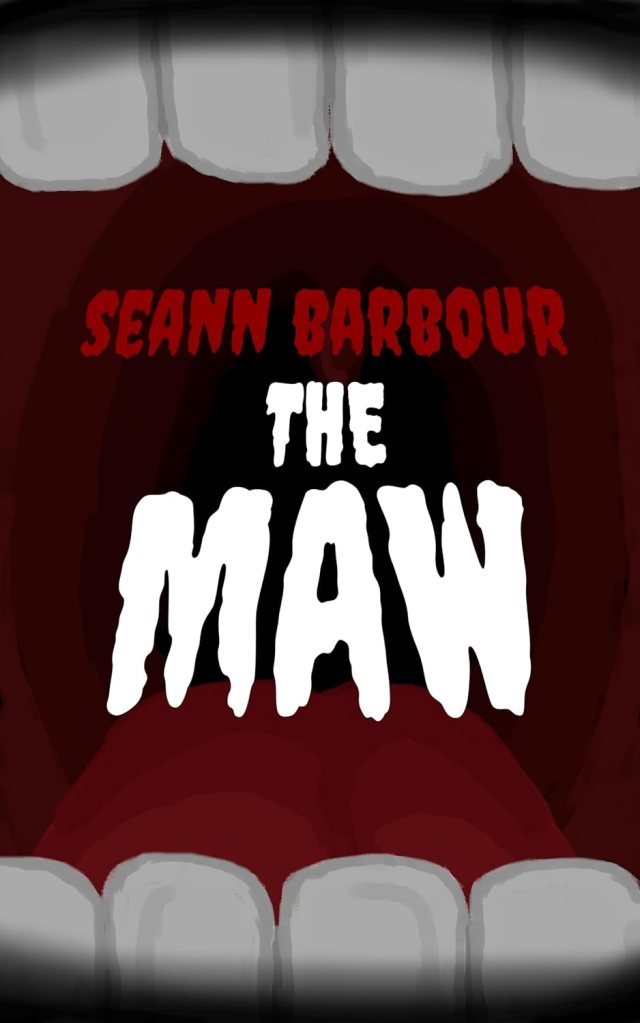
Back in late 2023, I reviewed a novella called The Last Day by Seann Barbour, which was sent to me as an ARC by the author himself and which I ended up enjoying very much. So when the same author sent me another message recently and asked if I’d have a look at his latest work, I of course happily accepted.
The Maw is due to be published on March 29th, 2024, and though it’s a largely different vibe than The Last Day, I found myself loving it just as much, if not more. While The Last Day, as I mentioned in my earlier review, was akin to an apocalyptic version of Groundhog Day, The Maw is more like a coming-of-age tale filtered through a lens of small-town surrealism.
In his acknowledgments, Seann Barbour explains that The Maw started as a 3400-word short story that just missed being published in an anthology due to the editor feeling as though it needed to be fleshed out. Barbour took this advice to heart and expanded the original short story to novella length, which seemed to be absolutely the right decision. If anything, I think this concept could have been even longer, because I got so involved with the protagonist and the oddness of the story that I could easily have read a story three times the length about it, but honestly, part of me was glad it was the length that it was; sure, the tale could have been expounded upon even further, but there was something about just getting the right amount of detail and depth, and not a smidgen more. I think this was exactly the right length.
Because this is such a new book, I won’t spoil the entire plot, but I will give a brief synopsis to set the stage. Set in the present day, the story is told from the first-person perspective of a boy named Simon, who is fourteen at the start of the tale, just on the cusp of starting high school. He has an older brother named Freddie who he looks up to a great deal; “King Freddie,” as he’s referred to, is popular and beloved at the high school, and seems one of those cool guys who everyone likes and admires.
In the small town where Simon and Freddie live, the main place where all the teenagers congregate is a large parking lot behind an abandoned strip mall called the Fairgrove Shopping Center. Most weekend nights, all the cool kids head on over there to drink, smoke weed, ride skateboards, blast music from their car stereos, and go off in the woods to make out; you know, your standard teenager stuff. The summer before Simon is due to begin high school, Freddie takes him to the Lot (it’s always capitalized) to introduce him to everyone and initiate him into the world of the big kids. If Freddie is the King, Simon thinks, then he is the Prince, and when school starts in the fall, he’ll already have a head start on popularity.
So the first part of the story is just sketching in the relationship between Freddie and Simon, giving a brief mention of some of the other kids who gather there, and cataloging some of the “firsts” that Simon encounters while hanging out at the Lot: his first beer, his first girlfriend, his first breakup with said girlfriend, and so forth. This was a great buildup; I tend to really like coming-of-age stories in horror, and this one, while somewhat brief, gave just enough description to get you invested in the character and get a sense of what he was about before the horror elements came crashing in.
This happens only about ten pages into the novella. One evening, Simon goes to the Lot as usual only to find everyone standing around staring at this seemingly impossible development, most of them filming it with their phones. You see, it seems that a ten-to-twelve-foot-tall mouth—complete with tongue, teeth, gums, the whole nine yards—has inexplicably appeared in the back wall of one of the abandoned stores, and is just gaping there, wide open and completely incongruous. Obviously, no one knows what to make of it, but as you would, the kids start trying to rationalize what they’re seeing, even breaking into the abandoned stores on the other side of the wall to see if the mouth goes all the way through. Bizarrely, it doesn’t, yet there it is in the back wall, open and unmoving.
The first night that the kids find the Mouth (again, it’s always capitalized), something happens that I won’t spoil, but that spins the story off in a tragic and horrific direction, and along the way, Simon ends up learning some things about his brother (and himself) that he hadn’t realized before. There’s also an underlying theme—or at least something that I picked up on in the story—about the human tendency to quickly grow bored with the newest thing, no matter how strange it is, as there’s a sort of subplot of a small tourist attraction growing up around the Mouth that barely lasts more than a year or two.
This was another great story from Barbour; I vibed with the tone of voice of the main character right away and immediately got invested in his struggles and insecurities as he became integrated into the world of his cooler older brother. The sudden appearance of the Mouth was just the right touch of surrealism, focusing the story on its strangeness while everything else remained “normal” around it. I felt as though the author conveyed pretty much exactly what it would be like if a random mouth appeared on a wall in a small town somewhere; he effectively captured what the general reactions would be like.
In some ways, I do actually wish The Maw was even longer, because I enjoyed spending time with it so much, but on the other hand, I also feel like it was probably better to leave things lean and streamlined, rather than bogging the story down with unnecessary detail. There seems just enough story here to get the gist of what’s going on, and even though the appearance of the Mouth is never explained, it didn’t need to be; it just is, and it’s the way people react to it that comprises the main thrust of the story.
The novella also includes a handful of bonus short stories at the end, which are titled “Lamplight,” “A Witness in Gossamer,” and “Necropolis!” Of these, the latter is the longest and the best in my opinion, being essentially a monster-type story told from the point of view of the monster.
The Maw is definitely another winner from Barbour, and I’d recommend it if you’re into coming-of-age style horror with an air of surrealism.
Until next time, keep it creepy, my friends.
 The Scare Salon
The Maw sounds like an interesting piece of work. Horror in general requires “killer” titles like this, and titles like “3-inch teeth” by C.J. Box are illustrative of the thought that goes into making up a header. Stephen King rarely had horror-esque titles, though. “The Shining” — doesn’t sound very scary, does it? Like a pilot light on a stove that’s burning through the night. Or “Salem’s Lot” — a used car dealership that offers great specials.
It’s all in the perception, I suppose.
Come visit my website, and leave some comments, if you like
http://www.dark.sport.blog
LikeLike