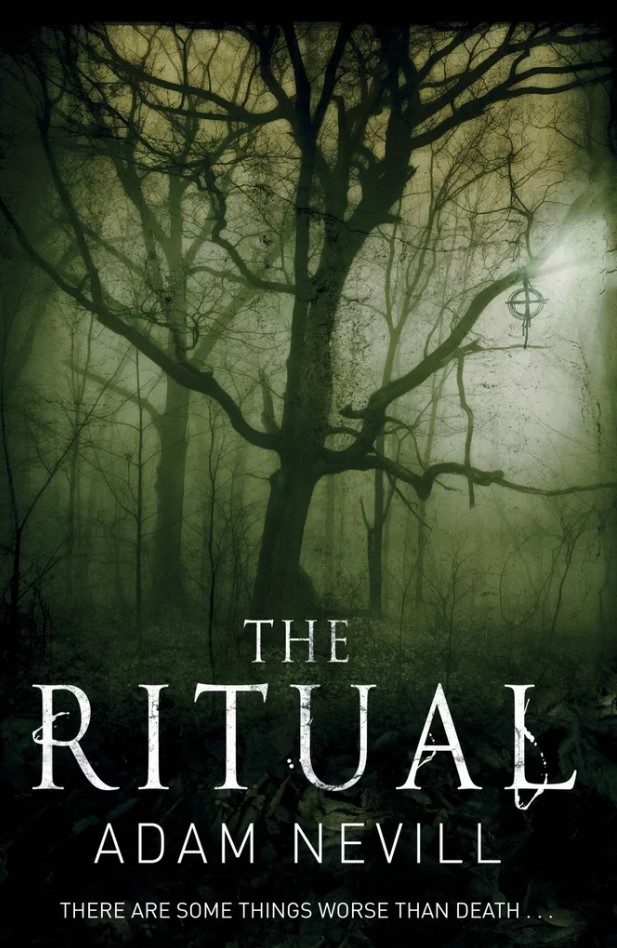
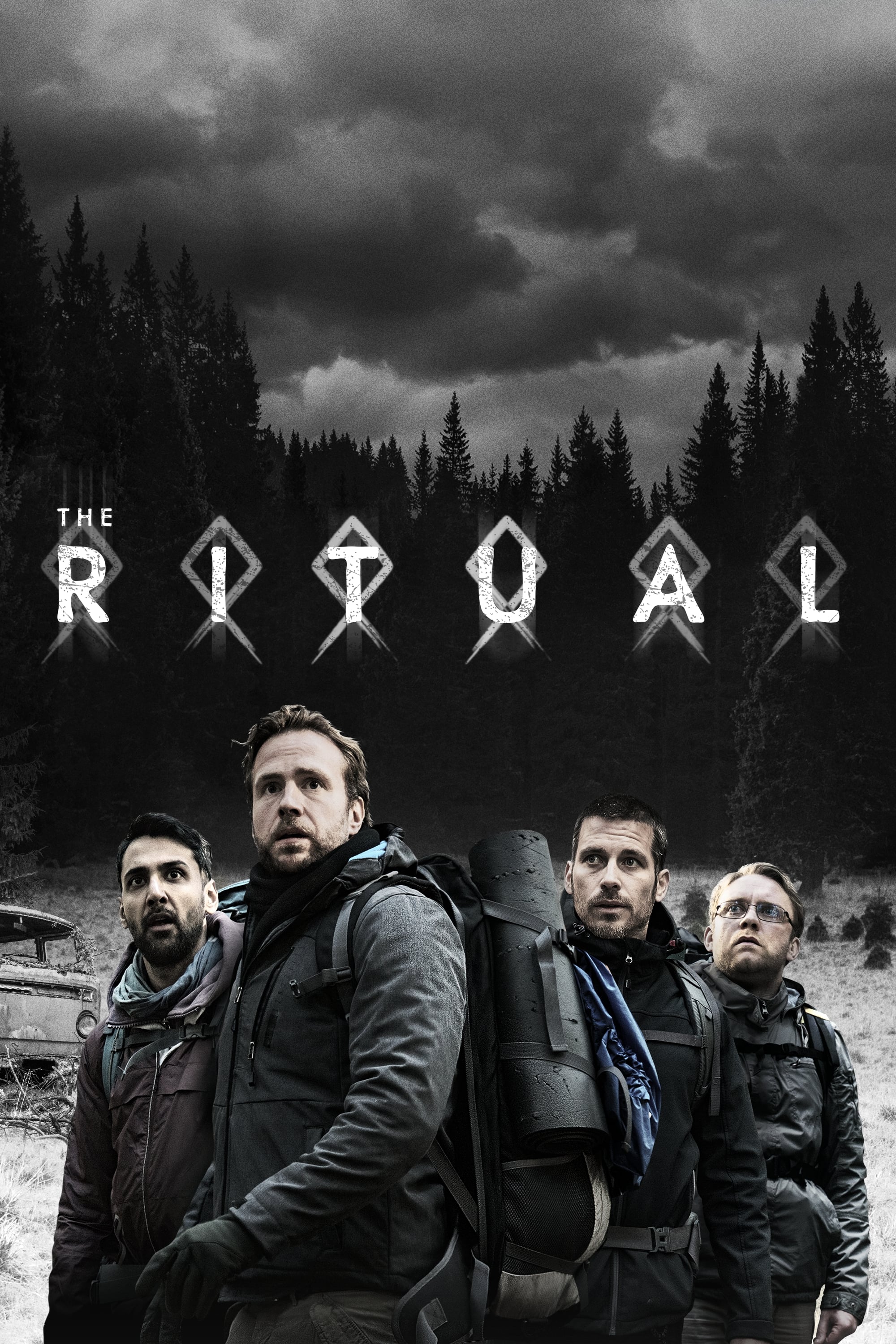
I figured it had been a while since I did a good old-fashioned book-to-movie comparison, and it so happened that the subject came up somewhat fortuitously, as I noticed that Adam Nevill’s 2011 folk horror novel The Ritual had become available to read for free on Kindle Unlimited. I had seen the movie years ago and loved it, but I had never read the book, so I thought now would be the best time to not only take that plunge but also revisit the 2017 film (directed by David Bruckner of The Signal and The Night House fame) for comparison. As a side note, this isn’t the first Adam Nevill-related book-to-film comparison I’ve done; a while back I also discussed the vast differences between his excellent 2014 novel No One Gets Out Alive and its middling 2021 Netflix film adaptation.
Because this is going to be a detailed comparative synopsis of both the book and the film, obviously there will be spoilers for both mediums. You have been warned.
Just from the outset, I’m going to say that this is one of the very few instances where I can unequivocally say that I liked the movie a hell of a lot more than the book. Don’t get me wrong; the novel is decent, has loads of glowing reviews, and won the 2012 August Derleth Award for Best Horror Novel. But as I browsed through some of the negative reviews on GoodReads (of which there are quite a few), I saw some of my own criticisms reflected there, which made me feel a little bit vindicated. The first half of the novel is pretty great: suspenseful, scary, and relatively fast-paced. The characters are generally not that likable, sort of misogynistic, and not that well delineated (I actually had a hard time distinguishing one from the other), and the descriptions are a tad verbose, but the story itself was a fairly simple survival narrative, straightforward and quite terrifying at times.
Then, at about the halfway point, the novel takes something of a turn; not a hard right turn necessarily, but one that I didn’t really vibe with as much as the first part, as it got a little ridiculous, repetitive, and tiresomely wordy, especially in regards to the dialogue. Reading the novel, I can see why the makers of the film adaptation chose to change the second half significantly, and I think they made the right decision, as the villains in the movie version are much more effective than the kinda silly ones in the book.
That said, let’s start with a plot breakdown of the novel, which I’ll interject with scenes from the movie where they differ markedly.
In the book, we’re following four English friends named Luke, Dom, Hutch, and Phil, who met years ago at university (in the movie, the characters are played by Rafe Spall, Sam Troughton, Robert James-Collier, and Arsher Ali, respectively). All we really know about them and their dynamic is that Dom, Hutch, and Phil have all settled down with wives, girlfriends, kids, careers, and so forth, while Luke is something of a “free spirit,” working a dead-end job at a record store, being perpetually broke and rootless, and casually dating girls but never committing to any of them. Some tension and distance have arisen among the friends because of this; Luke likes to think of himself as a bit superior for not being tied down by the old ball-and-chain routine and believes the other guys are envious of him, but deep down he suspects he’s a shiftless loser and envies the connections and stability the other guys have. On the other hand, Dom and Phil’s marriages aren’t as solid as they like to convey, and in fact both are undergoing divorces that they failed to tell Luke about.
The friends don’t see as much of each other as they used to, so they decide to take a hiking trip to Sweden (fun fact: in the film, the famous Carpathian Mountains of Romania stand in for the Kungsleden trail in northern Sweden). It’s explicitly mentioned later that the hiking trip was chosen specifically because it was cheap; the other guys have the money to do something more luxurious, but Luke is always skint, so they wanted something budget-friendly so he wouldn’t feel left out. This fuels a bit of resentment toward him later on in the story.
I’ll note that in the film adaptation, there’s a whole initial plot point about a fifth friend named Robert (played by Paul Reid), who was the one who suggested the Swedish hiking trip in the first place but was voted down. Robert is then killed in a convenience store robbery that Luke feels guilty for not intervening to prevent, and the four other guys decide to do the hiking trip in Robert’s honor, six months after his death; they even build a little memorial to him while they’re up in the mountains. This entire motivation for the trip is not in the book at all; there is no character named Robert, there is no robbery, and there is absolutely no time spent with any of the characters before the trip commences. In the book, the story starts with the four men already in the Swedish wilderness on the verge of being lost, and discovering a horribly mutilated animal hanging high up in the trees, as though it was put there by someone (or something) for their benefit. In the film, after the brief robbery prologue, we follow the four men on the second morning of their hike, when they’re still in good spirits and presumably still know where they are.
I’m not entirely sure why the very specific incident of Robert’s death at the robbery was put in the movie, but I’ll admit it does provide a stronger sense of conflict, lingering guilt, and trauma among the four men as they set out on the trip than the more mundane clashes between them in the book. I’ll also comment here that even though the four characters in the movie are just as laddish as their book counterparts, the movie guys are eminently more likable, less idiotic and whiny, and have much more distinct personalities.
In the novel, Hutch and Luke are said to go hiking quite a bit and are in decent physical condition, but Dom and Phil are overweight, and although they were admonished to get into shape before the trip, they failed to do so. Phil bought new hiking boots for the trek and didn’t break them in, so can barely walk because of the blisters; while Dom slipped on easy terrain on the first day of the hike and injured his knee. Therefore, more animosity arises as the two “fatties” (as Luke constantly thinks of them) are seen to be slowing the group down. This is similar to the film version, though only Dom is slightly overweight in the movie.
The forest where they’re hiking is known for its remoteness and its virgin, impenetrable nature, which Hutch is very excited about. He has a map, but at the beginning of the book, due to Dom’s and Phil’s injuries, he proposes a shortcut to shave a few days off the hike. It’s at this point that the four become lost, however, and the discovery of the disemboweled animal in the trees makes them terribly uneasy as they try to make their way out of the dense forest with their two injured and slow compatriots. This is pretty much what happens in the film version as well, though in the movie, they hadn’t planned on going in the forest at all, but took a shortcut through there and went off the open trail.
In both the book and the movie, the gang comes across an abandoned cabin, though in the novel, they first stumble upon a super creepy ruined church that’s surrounded by standing stones and trees with weird runes carved into them. The church, originally built for Christian worship, had been decorated with pagan symbols, and when Hutch falls through a rotted bit of floor, the guys find to their horror that there are loads of human and animal bones down there, perhaps used as sacrifices to some ancient god. The stop at the church is not in the movie.
Once the guys find the cabin, they decide to bed down there for the night to get out of the punishing rain that’s been pissing down on them for days, but the place is spooky as all get out, and it’s implied that all four men begin having disturbing nightmares that are more like visions. The cabin is festooned with rune symbols hung all over the walls, and in an upstairs bedroom, there’s a very unsettling effigy of some kind of goat-headed deity (in the movie, it’s more a headless straw thing with antlers for hands). One of the men (I think it’s Phil) sleepwalks into the room and wakes up to find himself in front of the effigy as though he’s praying to it, while one of the other men (I think it’s Dom) wanders naked into a nook, mumbling incomprehensibly, and awakens in complete terror. This is, again, close to what happens in the film, though in the movie version, Luke specifically has a vivid nightmare where he’s back in the convenience store where Robert got killed, in what is actually a really eerie scene, with bits of the convenience store mingled into the wilderness surrounding them. Also in the movie, when they leave the cabin in the morning, a bunch of trees are knocked down and there are runes carved into the trunks that weren’t there the night before.
Another detail that’s in the movie but not in the book is that while Luke is having his “nightmare,” he appears to be outside in the trees and some invisible thing makes claw marks on his chest. This will be important later on in the movie adaptation but doesn’t happen in the book. In my opinion, it’s also more clearly conveyed in the movie that the creature in the woods is making the men have these visions; it’s doing that in the book too, but I don’t think it’s as neatly spelled out.
The men wander through the seemingly endless forest and get more and more lost and cranky, and pressures start to mount as their supplies begin to dwindle. Luke, giving in to a blinding, purposeless rage that has been plaguing him for the past few months, punches Dom repeatedly in the face, at which point the friction between the men rises exponentially. In the film, Luke also punches Dom in the nose once, but it’s after Dom calls him a coward for not intervening to save Robert during the earlier robbery.
Hutch tries to broker peace, but it’s an uneasy truce for sure, and the men angrily agree that after they get out of this godforsaken forest and back to civilization, they will no longer be friends. Hutch is also blamed for suggesting the shortcut and getting them into this mess to begin with. In the film, Luke is blamed, as had Robert not died, they wouldn’t have come on this trip at all.
In the movie version, the guys come across the remains of a campsite, and there’s a wallet with a picture of a smiling family. The wallet also contains a credit card with an expiration date of 1984. This incident does not occur in the book.
Because Dom and Phil are getting close to the end of their endurance, Hutch suggests that Luke hike out alone and try to find help. Luke is reluctant but finally agrees to leave the following morning.
Overnight, though, Hutch is snatched out of his tent by some unseen thing in the woods which no one gets a good look at. They only know it’s big, smells like carrion, and moves much faster than a human or animal should be able to. The men are understandably freaked out by this, not least because Hutch had been the most experienced hiker and was the de facto leader of the trek, having been the one who had planned the trip from the beginning.
Sometime later, as Luke takes over the leadership position and tries to steer his two injured friends out of the vast forest, the trio comes across the grisly remains of Hutch, who is hanging high up in the trees with all his guts scooped out. The men are terrified, not only because it would take a massive creature to place something so high off the ground, but also because the body seemed to have been deliberately placed where they would see it, as though it’s a purposeful display, suggesting the creature is intelligent and is fucking with them.
A bit more time passes, and the men continue in a southwesterly direction, as Hutch had advised. They reach a ridge and Luke climbs up a tree, overjoyed that he can see the edge of the forest only about a day’s walk away (in the movie he doesn’t climb a tree, but just looks over the high ridge). In the film, he also sees what appears to be a bunch of small fires, as from a village, in the distance, and prior to this the three men had seen some human footprints in the mud, but I don’t remember these details being in the book.
It’s at this stage when the book and the film begin to deviate. In both mediums, Phil is snatched by the creature shortly after Luke sees a way out of the woods, and Phil is then found disemboweled in a tree as Hutch was. But in the book, Dom also disappeared a brief time later during a ferocious attack by the creature; Luke is knocked unconscious in the mayhem, and when he wakes up, he’s lying in a stinking box bed in a house, his head smashed all to buggery.
In the movie, both Luke and Dom are pursued by the creature, at which point they find a wide trail through the trees that’s clearly marked with torches. They follow it to a house, where they see what appears to be an old woman worshipping another effigy, and then they’re both knocked out, tied up, and put in a barn.
In the book, Luke discovers that he’s being held captive by three sort of dimwitted, black-metal-loving Norwegian teenagers called Fenris, Loki, and Surtr. They wear big creepy animal heads and do the requisite corpse paint, and they have a band called Blood Frenzy. Fenris tells Luke that Blood Frenzy’s music can conjure up the spirit of Odin, which you’re led to surmise has something to do with the creature in the woods. Also in the house is an ancient woman who speaks no English, and at first, you’re not entirely clear what the relationship between her and the obnoxious teenagers is. A bit later on, the creature (you’re led to assume at the behest of the teenagers or the old woman) hangs Dom’s flayed carcass in the trees right outside the house where Luke can see it.
This is where the book started to get a bit tiresome for me; the black metal band angle was just a little too silly to be scary, and the teenagers were annoying edgelords who were constantly drunk and yammered on and on and on about their quasi-fascist beliefs and their purported adherence to the old Norse ways. They had killed people before and burned churches and all that, but even so, they didn’t seem like all that much of a threat. I get what the author was maybe trying to go for: Luke had struggled through all of this hardship and had escaped from not only an ageless and indifferent forest but also from an awesome, ancient beast after seeing his three friends torn apart, only to wind up in this ludicrous situation with these dumb-ass kids whose stupid beliefs were nonetheless going to get him killed. It still didn’t really resonate with me, though, and there were only so many times I could read about Fenris having the same condescending conversations with Luke in his stilted English before I wanted to hit something.
By contrast, the movie wisely keeps the creepy old lady but changes the dimbulb teenagers into older, grizzled men who also can’t speak English, which is much, much more frightening. I also kind of like that Dom was kept alive a little longer in the movie so that Luke had someone sympathetic to interact with during his captivity instead of having to listen to Fenris’s asinine, pseudo-profound philosophizing. Dom doesn’t last too long for all that, though; the old lady comes in and gives Luke some water but pointedly doesn’t give Dom any, and then the two scary guys drag Dom out of the barn. You’re not sure what happens to him until later; Luke just hears him screaming in the room above him and hears something growling.
We’re then introduced to a younger woman who comes into the barn and tells Luke, in English, that they’re preparing for a sacrifice. Dom is subsequently brought back into the barn, looking all roughed up but still alive. He tells Luke that while they were in that creepy abandoned cabin days ago, he’d dreamed about these people offering him to “that thing.” He then says he’s going to die here, but he tells Luke to get the fuck out of there and burn the fucking place to the ground on his way out.
In the book, entirely too much time is spent with Luke mostly confined to bed with a terrible head injury, listening to the teenagers blathering on and occasionally blaring their music through a boombox as they dance around a bonfire outside. At one point, Luke is taken upstairs to the attic, where he sees a whole bunch of ancient, tiny, goat-legged humanoid creatures that are impossibly alive even though they look like they’re thousands of years old and partially mummified; these are apparently the offspring of the creature in the woods, and the old lady is presumably their caretaker. It’s also implied that this is the old woman’s house and that the teenagers just came here to commune with the forest god after hearing about the creature in the woods and these ancient people who were its children. Luke finds these beings in the movie too, though it happens a bit later in the timeline, and he doesn’t hesitate to just set them all on fire without much preamble (in the book he stabs them in the tops of their heads, by the way).
In the film, Dom is taken outside and tied to a pole by the villagers, who start chanting to call the monster. Meanwhile, Luke desperately tries to loosen his bonds so he can escape from the barn, eventually breaking his own thumb so he can slide the ropes off. The creature approaches outside and the villagers bow down in supplication, but at first, when the creature walks out of the woods, Dom inexplicably sees his wife, Gayle, confirming the fact that the creature is indeed a god and can make you see whatever it wants you to. But then we get to see its true form, and woo, is it a doozy, looking like an enormous elk-like wendigo thing with a hooded, vaguely human face. It impales Dom on a tree branch, leaving him hanging there.
In the book, after a seemingly endless period of time, Luke is prepared for sacrifice; the teenagers put a bloodied gown on him, slap a crown of dried flowers on his head, and tie him upside down to a cross that they then erect in the front yard. But then there’s some sort of conflict between them and the old woman; apparently, they wanted her to call the creature, who she calls Moder (or Mother), but she refuses to, so the angry teens cut Luke down again.
Luke awakens early one morning to find that someone—presumably the old woman—has unlocked the door to his room and left him a knife. Luke deduces that the old woman wants him to escape and kill the teenagers since they’re interlopers. Because you later find out that the old woman is an offspring of the monster too (with goat legs and all) and can call it whenever she wants, I’m not sure why she didn’t just get rid of them herself, but whatever.
Back in the movie, the younger woman who can speak English explains to Luke that the creature is an ancient god, a bastard son of Loki whose name they never utter. She tells them that they worship it and make periodic sacrifices to it, and in return, the monster has essentially given them immortality. She then tells Luke that he will be given a chance to bow before the god tonight, but if he refuses, then the monster will kill him as it did to Dom. It’s here that we refer back to the mark the creature made on Luke’s chest; the old woman has the same thing, as does the young woman. Apparently, Luke has been chosen because he bears greater pain than the others did, because of his guilt over not saving his friend Robert.
After escaping from the barn and setting the ancient creatures on fire, Luke punches the old woman in the face, grabs a shotgun, and tries to get the hell out of Dodge. The monster is approaching outside, though, drawn by the screams of its burning offspring, and the terrified villagers kneel before it, but it’s pissed and kills the young woman. Luke shoots one guy dead during his escape but is then confronted with Moder, and can only watch in absolute horror at its terrifying form silhouetted against the flames, the young woman dangling lifelessly from the human arms that sprout from its face like tusks.
Luke shoots at the thing, but that just makes it mad, and it starts chasing him through the woods. Luke starts seeing visions of the robbery again, the details of the convenience store intertwining with the reality of the forest around him. The creature forces him to his knees to worship it, drawing up to its horrifying full height (and I have to say that I absolutely love the monster design here; it’s amazing looking), but Luke doesn’t play that and strikes Moder between the eyes with an axe he took from another one of the villagers. This doesn’t kill her either, but it enables Luke to run like hell and get out of the forest. As soon as he’s clear of the trees, he realizes that Moder can’t follow him, and he screams at her in triumph before setting off across the open plain toward what is clearly a road in the distance.
The book version of the ending has some similarities to this, but is also quite different. Despite his grievous injuries (seriously, his skull is fractured and he has deep cuts all over), he’s able to get the drop on Fenris, stabbing him in the throat while the old woman watches impassively from the sidelines. He then picks up Fenris’s shotgun and blows away Loki when he comes downstairs to see what the commotion is. Surtr runs downstairs and flees the cabin; Luke shoots at her but misses. He then realizes that the old woman is standing at the edge of the tree line calling the monster to come and take him as a sacrifice, at which point he shoots her in the back, blowing her heart out, to shut her up.
Luke finds the keys to the truck that the teenagers drove to the house in, and he starts driving away from the place. The monster pursues him through the woods, and Luke realizes that the creature has killed Surtr and left her in the back of the truck. The monster gets out in front of the truck and Luke plows into it, destroying the vehicle, but while the monster is on top of him, he’s able to stab it in the throat and escape.
Just like in the movie, Luke then wanders out of the forest, but in the book, he’s naked, has no food or water, and is much more severely wounded than he was in the movie, his brain kinda swelled through his skull fractures and at least two bleeding cuts down to the bone, one on his chest and one on his hip. It’s left hanging whether he will ever be rescued, and I may be reading it wrong, but I thought the implication was that he wouldn’t be. The last bit of the book is simply Luke coming to the realization that the only thing that mattered was being alive, and perhaps becoming resigned to his fate.
It was an interesting experience comparing these two similar but also very different stories; in my comparison of the book and movie of No One Gets Out Alive, I sort of lamented a lot of the changes that had been made from the book to the film adaptation because I thought it made the movie less scary, but with The Ritual I think it’s the exact opposite. The first part of the novel, where the four guys are hopelessly lost and being picked off one by one by the creature, had some fantastically scary parts, and a lot of the descriptions of the massive forest, while prolix, were evocative and painted a clear picture in your mind.
Once Luke got taken in by Blood Frenzy, though, I admit I sort of checked out a little bit; the “villains,” while crazy and violent, seemed more silly than threatening and talked entirely too much and too repetitively about their ridiculous plans and beliefs. I also doubted whether Luke would have been able to do all the stuff he did in the book, given how horribly wounded he was. In the aggregate, I sort of felt as though the book was two loosely related stories that had been strung together into one narrative, and not entirely successfully. It also had a disturbing streak of misogyny running throughout it that kind of bothered me, particularly in the descriptions of Surtr, who was called some iteration of fat every single time she was mentioned. Luke also thinks of how much he hates Fenris and Loki, and calls out their “feminine” looks and mannerisms in this context. That’s not to mention all the discussions in the first half of the book when the four guys are discussing what bitches their wives are.
By contrast, the movie was lean and mean and no-nonsense, taking the best parts of the story and laser-focusing in on those, keeping the bulk of the narrative centered around the four men being pursued through these creepy-ass woods by a monster they only got occasional, chilling glimpses of. When Luke and Dom finally get to the village near the very end, the villains seem much scarier because they’re somewhat inscrutable; the young woman is the only one who speaks English, and she only gives enough detail to give the viewer the gist of what’s going on without overexplaining it.
I also quite liked the addition of the inciting robbery incident; even though it seems somewhat random on the face of it since nothing like it appears in the novel, the event provided an opportunity to go much deeper with the characterization, playing Luke’s guilt at not helping his friend against the other three guys’ low-key blaming of him for being a coward. It really upped the conflict among the characters, and gave the whole trip an air of melancholy and tragedy from the beginning, as the entire trek was taken as a memorial to their friend. Lastly, the robbery plot point also gave Luke more of an arc, as he was forced to nut up and confront the monster at the end the way he didn’t confront the robbers at the beginning of the movie.
I also noted it before, but the creature design in the film is excellent and was far, far scarier than the description of Moder given in the book.
Even though I wasn’t a big fan of the novel overall, I would still recommend reading it if you’re into Adam Nevill’s other stuff and are interested to see what changes were made for the film. It’s a rare thing for me to concede that the movie was a lot better than the book, but in this case, I think I can say that without reservation; the movie is outstanding (please watch it if you haven’t; it’s still on Netflix as of this writing), while the book is just kind of okay.
Until next time, keep it creepy, my friends.
 The Scare Salon