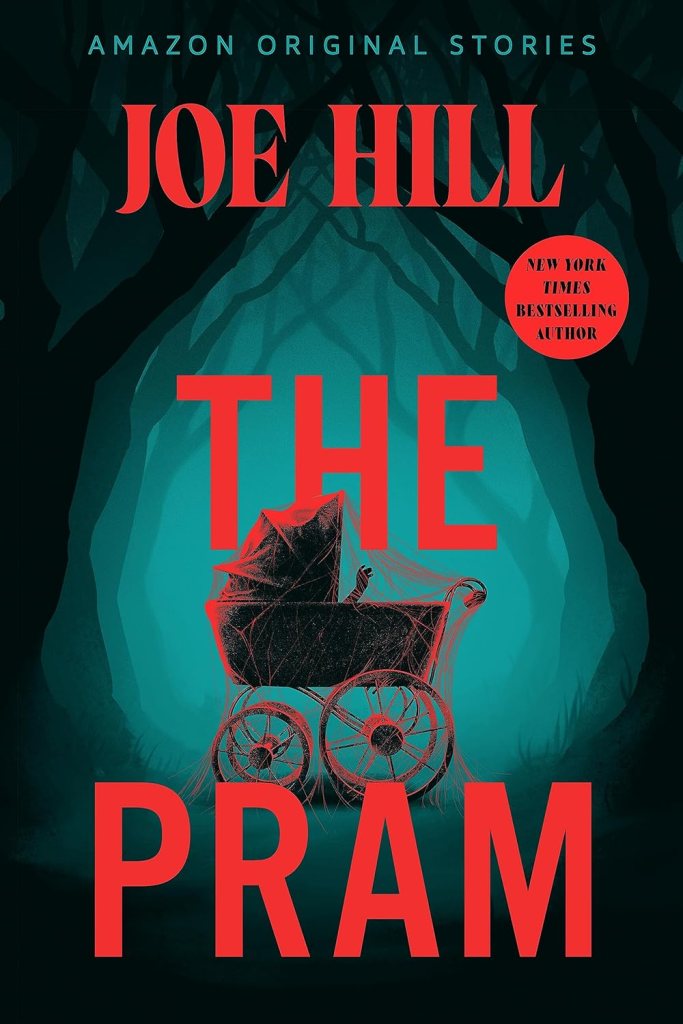
In the run-up to Halloween of 2023, Amazon released a series of six stand-alone short stories/novellas under the name Creature Feature Collection, by six popular horror authors, including Grady Hendrix, Josh Malerman, Paul Tremblay, Jason Mott, Chandler Baker, and the subject of this review, Joe Hill. All six of the stories are available to read for free with a Kindle Unlimited subscription, and as far as I could determine, you also get a free Audible version when you add the Kindle version to your library. This was actually a fantastic idea for spooky season reading, and I hope Amazon makes this a yearly thing; I’m also planning on reading and reviewing the other five stories in the 2023 offering over the next few weeks.
But let’s start with Joe Hill’s story, an evocative 58-page tale called “The Pram.” I’ve loved all of Joe Hill’s works that I’ve read—with Horns and Heart-Shaped Box being particular favorites—and this story was just as brilliant as his other stuff, though I will say that I dug the concept of this story so much that I almost wish it had been expanded into a full-length novel. On the other hand, there is something to be said for the brief, nasty shock delivered here, and the fact that the “lore” (if you want to call it that) was only explained in short strokes, leaving a lot to the imagination. Horror, as I believe I’ve mentioned a time or two (or fifty), generally works better when it’s left somewhat ambiguous. Don’t get me wrong, there is backstory and context provided in “The Pram,” but it’s minimal, and I think that works to its advantage, giving you just enough information to get the gist.
So the setup is this: Willy and Marianne are a married couple who had been living in a cramped condo in Brooklyn. At some point prior to the events of the story, Marianne suffered the miscarriage of a baby that was very much wanted by both husband and wife. Marianne, understandably, fell into a profound depression that took months to lift, and Willy, for his part, seemed to suffer the loss deeply as well but didn’t necessarily deal with it in a productive way because he was so focused on worrying about his wife that he neglected his own feelings and mental health. On top of that, he also came down with COVID and lost his sense of smell. All of this information, by the way, is given in bits as flashbacks.
During the aftermath of the miscarriage, Willy became preoccupied with getting his wife away from the condo where the tragedy had taken place because he was beginning to perceive their former home as a morgue. To that end, he eventually found a beautiful, inexpensive farmhouse in an isolated town called Hobomeck, in Maine. The weird thing about the place, though, is that Marianne grew up in Maine, only a few miles from where this town is, and she’s never heard of it. The realtor claims it’s just because the town is so off the beaten path, but Marianne seems to attribute some magical property to it, making the offhand comment that maybe the town only exists for those who need it. Hmmm.
When the couple sees the farmhouse, they’re both enchanted, and Marianne seems to perk right up, excited by the prospect of fixing it up and starting a new life. The town itself is also charming in a super nineteenth-century kinda way; while out and about, they see a couple that they at first think is Amish because of the old-fashioned duds, but the realtor tells them that this is a similar but slightly different religious sect that the townspeople call the Sin-Planters. There aren’t a lot of them, and most of the remaining ones are pretty ancient, but they contribute to the local economy by selling their produce and hand-churned butter to the local country store.
After Willy and Marianne settle into their new rural existence, Willy takes to walking to said country store through a lovely, tree-shrouded path in the woods. It feels so peaceful out there, and Willy eventually learns that the ancestors of the current Sin-Planters, true to their name, planted all these trees out here, and cut themselves to feed the trees with their blood. Which sounds a little…unsettling, to say the least.
During one of Willy’s grocery runs, the nice old proprietor of the store, an English chap named Brian, loans Willy a janky old pram to carry his groceries in, since the stuff is too heavy to carry on a walk through the woods. Over the course of the short tale, Willy starts to believe that the pram might have a baby in it, and becomes obsessed with the thing to the point of near madness.
This was a great story; Joe Hill is very, very good at conveying the eerie mood of the place with just a few words, and I could vividly picture the wooded path in my mind as I read. Willy, from whose perspective we see the story unfold (in limited third person, not first), is also a relatable character, clearly bitter about the terrible things that have happened to him and his wife, but trying to deal with it as best he can through a black sense of humor.
The themes of “The Pram” are somewhat similar to Pet Sematary—which of course was written by Joe Hill’s dad, Stephen King—in the sense that it’s written from the point of view of a father who has lost a child and is having a hard time coming to terms with it, which ends up leading him down a dark path. In fact, Willy seems, at least at first, completely unaware that he is also grieving the miscarriage, and this lack of awareness causes him to twist that grief and retreat into anger and resentment toward his wife that he isn’t even fully cognizant of. That in turn acts as the catalyst for the supernatural angle that plays into the story as it goes on.
While some readers might wish that the backstory of the Sin-Planters was fleshed out more, and Willy’s destructive emotions explored further, I thought this story was pretty much the perfect length, getting across the horror in a wonderfully economic fashion. It’s a short, free read, so if you like Joe Hill (or Stephen King, for that matter), there’s really no reason for you not to spend an hour or two relishing this; I enjoyed it a lot, and if it sounds like your cup of tea, then you just might too.
Until next time, keep it creepy, my friends.
 The Scare Salon