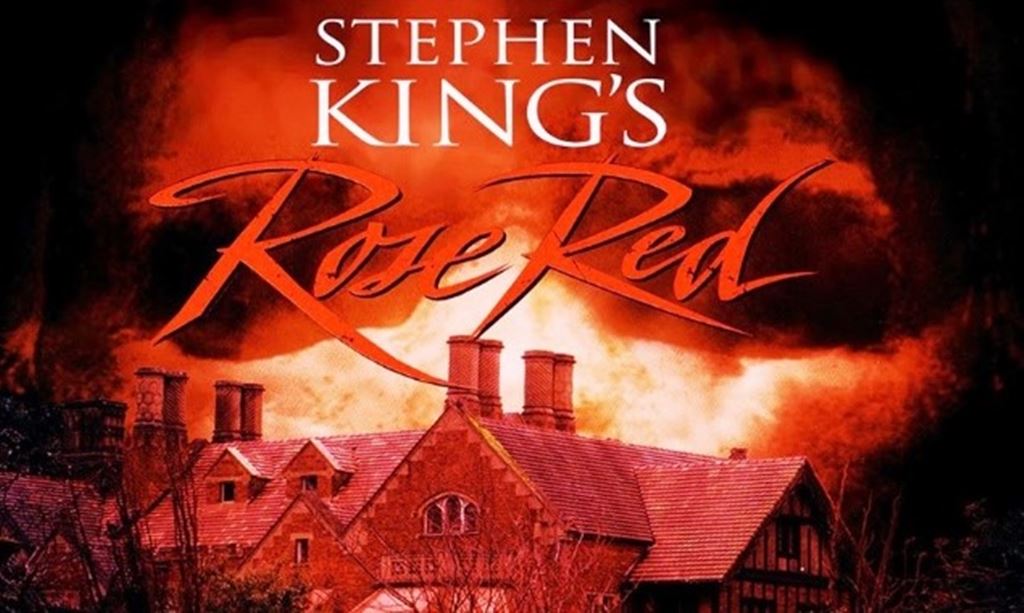
A few months ago on this very site, I did a revisit on the Stephen King miniseries from 1999, Storm of the Century, after it randomly turned up on Hulu. At around the time I was watching that, I thought to myself how I’d really like to have another look at a later three-part miniseries that I remembered really liking back when it first aired on network TV (ABC specifically), and I’m speaking of course of 2002’s Rose Red. For some reason, the miniseries seemed difficult to get hold of for a while there, but just recently, Hulu came through again and plopped it on their streaming platform with very little fanfare. With a little rush of excitement, I settled in for the four-and-a-quarter-hour spectacle.
While Rose Red was generally just as fun as I remembered from its debut more than twenty years ago, I did note that it suffered a couple of the same problems I had with both Storm of the Century (which overall I liked a lot), and King and Mick Garris’s 1997 miniseries take on The Shining (which I absolutely did NOT like much at all, for reasons I elaborated upon here). That said, though, in spite of some slightly strange acting performances, clunky dialogue, cheap special effects, and a somewhat baggy middle section, Rose Red is a pretty good little haunted house tale.
Most horror fans probably know this, but Rose Red was very openly billed as Stephen King’s take on the iconic 1959 Shirley Jackson novel, The Haunting of Hill House (and the subsequent film adaptation from 1963, The Haunting, directed by Robert Wise). The backstory and look of Rose Red are also heavily influenced by the legends and lore surrounding the real-life Winchester Mystery House in San Jose, California (which has also had its own fair share of movies made about it). The similarities between Rose Red, Hill House, and Winchester are pretty striking, so much so that some might find the miniseries nothing but a cobbled-together narrative combining already existing stories, and I guess that’s a fair criticism, but it actually didn’t bother me all that much as I was watching it.
Since this was 2002 and The Blair Witch Project had pioneered the whole metafictional internet marketing thing, the folks behind Rose Red did something similar, setting up a fake website for the university where the main character works, and publishing a book supposedly edited by this same character, which was ostensibly the diary of the woman who had built the house back in the early 20th century (which was in fact called The Diary of Ellen Rimbauer: My Life at Rose Red). Contrary to popular belief, The Diary of Ellen Rimbauer was not actually written by Stephen King (or his wife Tabitha, which was another rumor going around for a while), but by suspense and thriller author Ridley Pearson. There was also a mockumentary about the house and its legend called Unlocking Rose Red that aired on ABC a few weeks before the miniseries premiered. So yeah…this was a big deal at the time, and the network spent a lot of money and time marketing the thing. This seems to have paid off since the book was a big hit, and the miniseries itself got really decent viewing numbers.
The story of Rose Red, as I alluded to earlier, isn’t really anything we haven’t seen before, but that honestly doesn’t diminish the quality of it, which is actually very good for a miniseries of this type and falls in the range of the better Stephen King adaptations or projects.
Nancy Travis plays the nominal main protagonist, Dr. Joyce Reardon, a parapsychology professor at the fictional Beaumont University in Seattle, Washington, who is obsessed with proving the existence of the supernatural. She’s tenured, but some of her colleagues—particularly her sneering departmental chair, Professor Carl Miller (David Dukes) and his student newspaper reporter lackey Kevin Bollinger (Jimmi Simpson)—are convinced she’s a flaky loon and will pull pretty much any underhanded tactic available to undermine her research. While Miller in particular almost comes across like a cartoon villain, it must be said that Joyce herself isn’t the most pleasant character either, as she’s exceptionally condescending toward skeptics and really wants to find proof that hauntings are real so she can gleefully rub it in Miller’s stupid face. She also, at one point, commits something that I’m pretty sure would be categorized as assault (with blood smearing, no less) on said departmental chair, which at the very least would have gotten her immediately shitcanned in any workplace in America. What I’m saying is that for supposedly dignified academics, these characters’ interactions play out very much like a middle school class president election. Which I guess is kind of accurate, as far as that goes, though at least they didn’t start flicking boogers at one another.
Anyway, Joyce has secured a grant to do a three-day investigation of the infamous Rose Red, a crumbling, sprawling mansion in town that’s the source of tons of local legends. Similar to Hill House, the mansion was built by a shitty, two-timing man as a gift for his wife, and was cursed even before its construction was completed, being the scene of several strange deaths, disappearances, and bizarre paranormal manifestations. And, just like the Winchester Mystery House, once the shitty man kicked the bucket (under very suspicious circumstances), surviving widow Ellen Rimbauer became convinced that she needed to keep building onto the house in order to live forever. So Rose Red has similar architectural quirks to the real Winchester House, such as an upside-down room, doorways leading to sheer drops, staircases to nowhere, and that kind of thing.
Now, no one has lived in Rose Red for a very long time, and even some investigators who have gone in there recently haven’t reported any unusual activity. Joyce believes that the house has simply become dormant, and just needs a shot of juice to wake it back up and get all those ghosts kicking around for her cameras again.
What she decides to do is hire the best psychics and mediums in the country and put them all in the house over the three-day weekend to see if she can use their powers to jump-start the activity. Again, this is simply an expansion of the Hill House narrative, where a parapsychologist brought in a psychic and a poltergeist focus (as well as a relative of the house’s owner, a trope that also appears in Rose Red) to see if he could goad some manifestations into taking place.
The gang she assembles consists of suave Brit Nick Hardaway (Julian Sands), who can read minds; elderly Vic Kandinsky (Kevin Tighe), who has a talent for precognition; pretty young Pam Asbury (Emily Deschanel), who can glean information from objects when she touches them; middle-aged Christian Cathy Kramer (Judith Ivey), an automatic writer; and obnoxious mouth-breathing mama’s boy Emery Waterman (Matt Ross), who has visions of events after they’ve happened and often helps the police solve crimes.
The big fish that Joyce snares, though, is an extraordinarily powerful autistic girl named Annie Wheaton (Kimberly J. Brown), who is mostly non-verbal and profoundly disabled, but seems to be able to read minds and is also telekinetic to quite a drastic degree. This girl in particular was the one person Joyce was most hoping to get on board, as she felt the child’s tremendous powers were the most likely to stir Rose Red from its long slumber. Coming along for the ride and rounding out the team are Annie’s older sister/caretaker Rachel “Sister” Wheaton (Melanie Lynskey), and Steve Rimbauer, the last remaining descendant of the Rimbauer family and the man who now owns the property. He is also Joyce’s lover, though the story never specifies whether Joyce is banging him because she actually likes him, or because he owns Rose Red and she wants to get into that house more than anything. Given how her character is unveiled over the course of the narrative, I suspect it’s the latter.
As you might expect, the first 90-minute episode of the miniseries is all set up; we meet all of the principal characters and get into a bit of their histories and their specific talents. The history of Rose Red is neatly laid out in a lecture Joyce gives to her prospective team. The conflict with the department head is also filled in, with Miller and Bollinger plotting various schemes to undermine Joyce’s credibility in the lead-up to her big project. There’s also a prolonged back-and-forth over whether Annie will be able to accompany the researchers to Rose Red, as her parents don’t want her to participate and her sister isn’t entirely sure she should either, despite the large amount of cash Joyce is promising to the family.
Hardly anyone even goes into Rose Red at all in the first episode, other than Bollinger, who is tasked by Miller with sneaking in prior to the team’s arrival and either filming and/or sabotaging their entire investigation. You can tell right away that Bollinger is going to get it, though, because a woman actually lets him in the front door, and we as the audience recognize this woman as the ghost of Ellen Rimbauer’s maid and companion, Sukeena (Tsidii Le Loka). Sukeena lures Bollinger into the greenhouse, where something bad happens to the young journalist; the only remaining evidence of his presence is his busted cell phone on the floor.
In the second episode, the team finally arrives at the house and begins the tour. The paranormal activity starts happening pretty much right away, with various members of the team seeing different things depending on their location in the house and their particular proclivities. Pam, for example, has a disturbing dream where she sees the body of Kevin Bollinger hanging from a chandelier in the mirror library; Emery sees the ghost of an actress named Deanna Petrie who disappeared from a party in the house in the 1940s; and both Cathy and the Wheaton sisters see weird and clearly supernatural manifestations, such as things moving around under carpets and blankets.
It would appear, then, that Joyce’s theory about Annie’s psychic powers awakening the house is already starting to bear fruit, much to her excitement, but the problem is that Rose Red isn’t just haunted in the way of a few wispy ghosts flitting around here and there and not bothering anyone; oh no. Rose Red is actually a killer house, a hungry house; it tends to kill men who reside within or visit it, and women who go inside often never come out again. It’s implied, in fact, that they become absorbed into the mansion’s evil and become trapped there for eternity.
To wit, the house systematically begins picking off the researchers one by one. Pam is the first to vanish, and Emery attempts to tell the others that he saw a vision of her, meaning she’s already dead, but at first, they don’t believe him. To be fair to them, though, Emery is a horribly repugnant person, constantly berating people with the nastiest, most negative shit imaginable and running around with his mouth hanging open constantly, so I guess they can’t be blamed for blowing his ass off every time he starts flapping his jaws. In fact, Emery is such a hateable character that the most pleasure I got out of this miniseries was the running gag of Nick (Julian Sands’s character) verbally fucking with Emery with delightfully bitchy little bon mots at every opportunity. Julian Sands really was fucking awesome, man (RIP).
Soon afterward, though, they find they have to believe Emery’s vision whether they want to or not, because Vic also sees Pam in the garden, and she leads him to what appears to be her dead body lying in the pond; but when he goes to touch her, she isn’t really there. This rattles Vic so much that his weak heart gives out, and he expires on the patio while Emery watches him from behind the locked French doors, not letting him in because he thinks the whole thing is another vision the house is showing him.
Rose Red has also effectively shut off all means of egress for the people trapped inside; none of the doors will open, and the glass of the windows won’t break.
Meanwhile, department head Professor Miller is starting to wonder where his boy toy Bollinger went, since he isn’t answering his phone, and decides to go to Rose Red himself to see what’s what. Emery’s screeching harridan of a mother, Patricia (Laura Kenny), also arrives on the scene, believing that the researchers are doing something terrible to her beloved son. But because the house has a habit of showing people things that aren’t there, no one really realizes that these two living people are wandering around the grounds for quite a while. At the end of the second episode, Bollinger’s ghost (revenant? zombie?) knocks out Emery’s mom and presumably drags her into the house, though Miller is just running around in the garden, lost and freaking out, after seeing some fucked up shit. He eventually gets attacked by a dead Bollinger, however.
At the start of the third and final installment, Annie is knocked unconscious after falling off the back of the chair she was standing on to better investigate the fascinating miniature of Rose Red that’s been installed high up on a wall. Some of the remaining people realize that while Annie is unconscious, the doors and windows open back up, leading them to assume that the house is using Annie to keep them all trapped inside. By the time they become aware of this, however, Annie has come to and Rose Red has closed up again; Emery’s fingers are severed in a slamming door during his attempted escape. Then Emery, charming as ever, openly advocates knocking Annie out with a fireplace poker so they can all GTFO, and pretty clearly seems to imply that he’d be okay with killing her as well, even going so far as to tell her sister that the little girl is no good to anyone because of her disability.
Naturally, the other researchers balk at the idea of hurting the child, and Joyce in particular is adamant that she be protected at all costs since she’s the one that’s keeping Rose Red alive. Joyce herself undergoes something of a heel turn as the story goes on; even though I mentioned that she wasn’t the most likable character to start with, and was obviously using all the members of her team to further her own ambitions, she really goes to the dark side as the paranormal manifestations start to ramp up, not even caring when some of the researchers die and only wanting to focus on getting her data, come what may. Her boyfriend Steve, increasingly horrified by her callousness, discovers some psychic powers of his own when he finds that he can telepathically communicate with Annie without Joyce knowing what they’re saying.
Since this is the third act, the ghostly shenanigans go full tilt: the house begins to rearrange itself in places, a skeleton monster attacks Nick in the endless hallway upstairs, and several of the team members see a vision of the builder of the house, John Rimbauer, being chucked out the attic window to his death by Ellen Rimbauer and Sukeena (who was apparently having an affair with her master that Ellen discovered). They also see the somehow perambulatory corpse of April Rimbauer, Ellen’s daughter, who had a withered arm.
Additionally, Emery straight up tries to kill Annie, though she uses her telekinesis to thwart him; and a couple more people get killed, including Emery’s mom (who was dragged into the house and stuffed into the pantry earlier and then gets killed by Sukeena’s ghost) and Nick (who is killed offscreen by the skeleton monster that was chasing him, but turns up as a ghost later on).
At this point, the surviving researchers are desperate to get the hell out of this house of horrors, but Joyce gives not a single fuck about their wishes and thinks they should all stay put until they’ve gathered the proof they came for. Steve, sick of his girlfriend’s shit, telepathically communicates with Annie, and they devise a plan where Cathy will finally get to use her automatic writing talents to…I dunno, kind of write “Open the doors” over and over again on a piece of paper while Annie whips up a psychokinetic shitstorm with her mind. I guess the idea is that Cathy and Annie’s combined focus and power can override Rose Red’s control of the little girl, and to their credit, it does actually work. Annie is able to break free of the house’s spell and starts pulling the whole structure down around them. Once the doors open, the survivors are able to escape, though Joyce, who has gone completely round the twist at this point, refuses to leave. Steve tries to talk some sense into her, but she’s just not having it, so finally he shrugs his shoulders and is all, “Enjoy your eternity, bitch” (okay, not really), before fleeing the collapsing mansion with the others.
A bit later, we see Joyce surrounded by all the other ghosts of the house, and it seems she’s had a bit of a change of heart vis-à-vis getting the fuck out of Rose Red, but of course, it’s too late now and she’s stuck there. We later see her and the other apparitions looking out the windows, either mournfully or threateningly, it’s difficult to tell which.
There’s then a brief coda, where the survivors return to the site six months later and lay six red roses on the front lawn in remembrance of the six who died during the investigation. Steve has sold the property to developers who are going to raze Rose Red to its foundations and put up some modern condos. No word on how haunted those condos are going to be, but somehow the idea of creepy spirits lurking in the brightly lit corners of a charming breakfast nook doesn’t strike as much terror in the heart as the ghosts did in their original spooky mansion environment.
As I mentioned, this was definitely a very decent miniseries in the Stephen King universe and was actually just as good or better than I remembered. Sure, it’s derivative, some might say slavishly so, but I love a good haunted house story, and The Haunting of Hill House is one of the best ever written, so anything homaging that is going to be all right in my book (well, except for that horrible 1999 remake of The Haunting, but I’d rather not dwell too much on that). I also liked all the Winchester Mystery House touchstones, like the weird architecture of the place and the legend about having to keep building onto it to forestall death (or appease the ghosts, as in the original rumors about the mansion).
The acting here was mostly solid, though Emery’s constant “open mouth wide, flare nostrils and squint” facial expressions got a bit distracting. The dialogue was also a tad clumsy, as it generally is in any Stephen King joint; he writes good dialogue for the page, but sometimes when spoken aloud it sounds a little cringe, like the scene where Emery explained (and explained, and explained…) why his mother called her car a “little scootabout.” Oh, and the ghosts and monsters sometimes looked a little cheap and cheesy, though admittedly not as bad as the 1997 Shining miniseries, and I actually thought the dead Bollinger in particular looked pretty good, as did some of the other returning dead characters.
Overall, though, this is a damn good and entertaining haunted house story; nothing terribly original, of course, but if you’re in the mood for four-plus hours of ghostly adventures reminiscent of Hill House and Hell House and any number of other “investigators hole up in the mother of all haunted houses and hijinks ensue” flicks, then this is a solid watch and a must-see for any Stephen King aficionados.
Until next time, keep it creepy, my friends.
 The Scare Salon