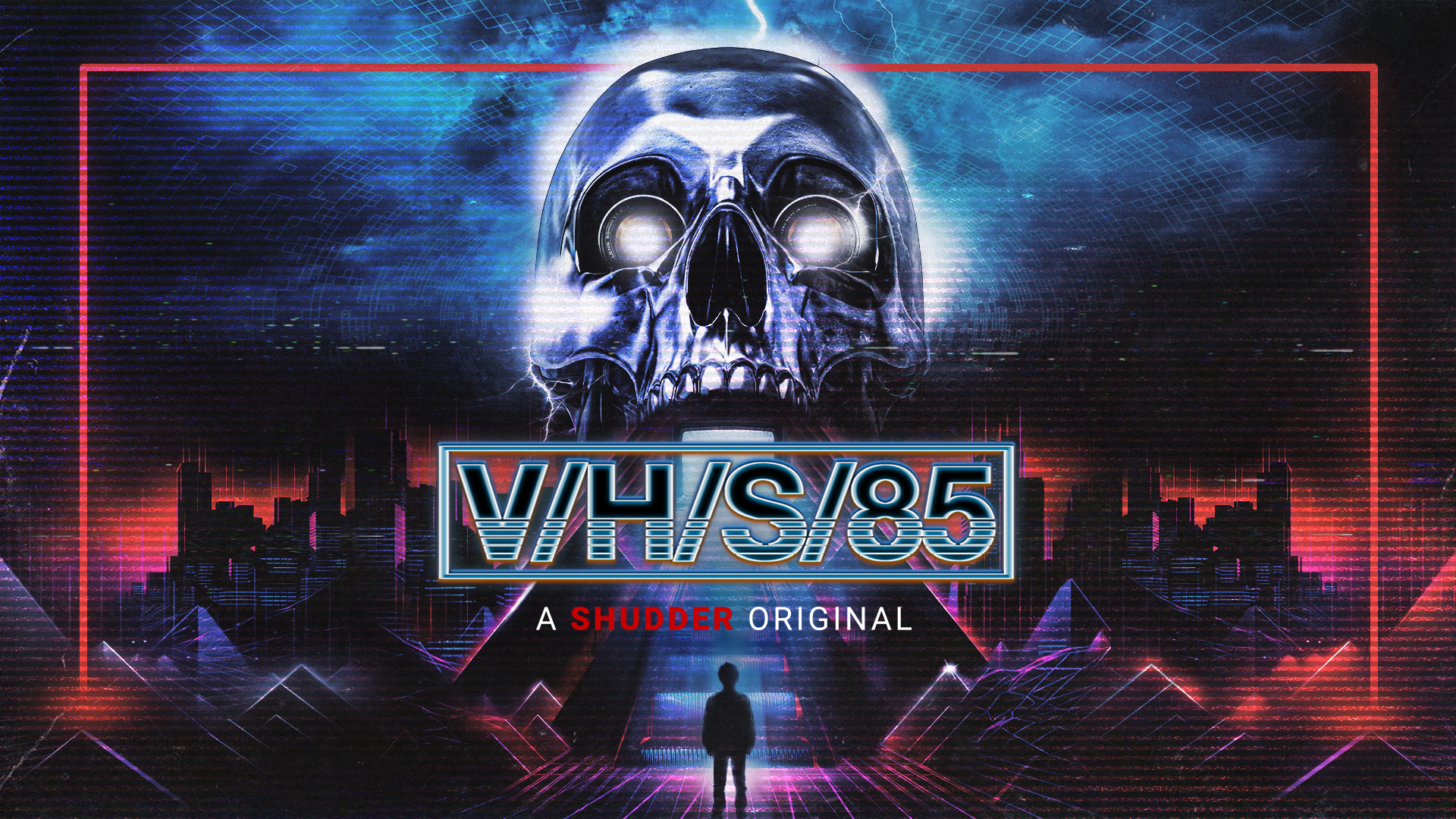
Not too long ago, I did a massive mega-review of all five of the found-footage V/H/S films, which varied in quality but were mostly pretty solid (other than Viral, which I didn’t like much at all). Although I’m not the world’s biggest fan of found-footage horror in general, I was intrigued enough by the series to be fairly excited when Shudder added the newest entry, V/H/S/85, to its lineup about a week before I wrote this. I had quite enjoyed the previous film, V/H/S/94, but I was more intrigued by this one since it was going to be set much earlier in time with more of an analog feel that would transport me back to my young teenage years (I was 13 years old in 1985, in case you wondered).
Right off the bat, I will say that V/H/S/85 is now my second favorite of the series (after the first one), and though a couple of the segments were just sort of okay, the bulk of the movie really went for broke and made up for the slightly weaker bits with copious gore, good storytelling, and some surprising twists.
Like the previous entries, there are a couple of horror heavy hitters represented here, including David Bruckner (The Ritual, The Night House), and Scott Derrickson (The Exorcism of Emily Rose, Sinister, The Black Phone), as well as a few up-and-comers like Gigi Saul Guerrero (La Quinceañera, The Purge series), Natasha Kermani (Lucky), and Mike P. Nelson (Wrong Turn from 2021).
This time out, the “wraparound” story is really just more of a segment in its own right, which honestly was fine with me; there are really only so many ways you can set up “someone finds a cache of creepy old videotapes and watches them,” after all, so why even bother with it? The movie seemed much more integrated this way. David Bruckner’s entry is called “Total Copy,” and presents itself as an In Search Of… style, made-for-TV documentary that’s been taped over here and there with the other segments, a conceit which I really liked.
The faux documentary follows a research team at a fictional institution called Stamer University, who are studying a presumably alien being who can replicate anything it sees, much like in Invasion of the Body Snatchers or The Thing. The scientists call the being Rory and have it held captive in a comfortable living room behind one-way glass, where they let it watch TV in the hopes that it will learn human culture and eventually be able to communicate with them.
After the narrator of the documentary hints that something horrifying is lurking on the horizon for our team of researchers, we cut to the first segment proper, which is called “No Wake” and was directed by Mike P. Nelson. In this one, a likable gang of young people blithely blow past some conspicuous “No Trespassing” signs in order to spend the day water-skiing on a beautiful, secluded lake.
But not long after starting the festivities, an unseen sniper on the shore begins shooting at their boat and picking them off one by one. At first, this would seem to be a fairly straightforward narrative, but things take a very unexpected turn that I don’t want to spoil. I also love that this segment will eventually circle around and connect with one of the later ones, a link that I was absolutely delighted by when I realized what was happening.
After another bit of the documentary about Rory and the scientists, we delve into the second full segment, Gigi Saul Guerrero’s “God of Death.” This one was somewhat compelling and bloody but went on slightly too long before the big reveal, and was hence one of the two lesser stories in the film.
In it, we’re watching a Mexican morning news program setting up to go live, complete with a flirtatious older anchorwoman named Lucia, a hard-working cameraman named Luis, and a perky on-the-street reporter named Gabriela (who’s played by the director herself). Minutes into the broadcast, however, the building is struck by a devastating earthquake, and Luis films the entire process of his rescue as he and the paramedics attempt to escape the building before it completely collapses.
This is all harrowing enough, but when the group gets down to the basement to try to find a way out, they discover an ancient evil that might have been released by the tremors.
As I mentioned, this one was fine, but I honestly thought the whole “escaping the collapsing building” storyline was pretty decent on its own, and I wasn’t sure I was on board when things went in an over-the-top, supernatural sort of direction toward the end. Your mileage may vary, of course, and I did notice that some reviewers chose this segment as their favorite, so naturally it’s all subjective.
We get a bit more footage about Rory the shapeshifting alien, and then we segue into what is probably the least effective segment of the movie, in my opinion: Natasha Kermani’s “TKNOGD.” It starts out as a recording of an unbearably pretentious performance art piece, given by a woman who tells the sparse audience that humans have killed all their old gods and have replaced them with a god of technology. Then, using an early set of VR goggles and gloves, the woman goes into the wire-frame “virtual” world in order to contact this supposed “god,” an enterprise that goes about as well as you would expect (as in, not well at all).
This one was fine, but it was a bit static and took a while to get going. I’ve never been a big fan of performance art or one-person shows that aren’t given by comedians, so this was a bit of a slog to sit through, though I have to say that as a parody of stuff like this that was going on in the 1980s, it’s hilariously spot on. The ending was pretty great and the story had an amusing punchline, but I think it took a bit too long to get there.
Rory and his tentacle make another appearance, and then we get into another Mike P. Nelson segment, “Ambrosia,” that ends up tying in with the earlier “No Wake” story in a really clever way.
This one is set at a big family party where the young woman holding the camera, Ruth, is being celebrated for something, though we don’t find out what until later on. There are several minutes of very realistic family get-together shenanigans, and then Ruth hands the camera over to her geeky cousin to film, after which they both go outside into the yard. At this point, a little boy named Adam (perhaps Ruth’s little brother, though this is never clarified) cheekily shoots her with a water pistol. When Ruth asks the kid where he got the water pistol from, he says a lady in an RV gave it to him, and we then see the RV belonging to the water-skiing young people from earlier vanishing down the street.
As I said, I won’t spoil what the connection between them is or what’s going on with this party, but suffice it to say that you probably won’t be able to guess, and it’s absolutely much better going into it without any foreknowledge of what’s happening because it really is a good and surprising twist that I in no way saw coming.
After more Rory, we get into the final proper segment and probably my favorite of the bunch, Scott Derrickson’s “Dreamkill.” In this one, we see a woman getting horribly murdered and mutilated from the POV of the killer, who broke into her house in the dead of night and is presumably filming the entire encounter.
When the cops show up shortly afterward, Detective Wayne is mightily disturbed by the whole scene, because he received a videotape of this exact crime in this exact house (in fact, the same videotape we watched at the beginning of the segment) three days before it happened, which of course is impossible, because the victim here has only been dead a couple of hours.
After a second videotape arrives at the station seemingly predicting another murder that follows days later, Wayne stakes out the public mailbox where the videotapes have been mailed from and picks up a stoic, soft-spoken goth kid by the name of Gunther, who is spotted dropping a package into the box. Gunther admits to sending the tapes, and although the cops naturally believe that he’s somehow the killer, the truth is far more bizarre than anyone could have anticipated.
This segment was fantastic; it was gruesome and violent, had a great premise, and kept you guessing the entire time. The analog look of the shots really enhanced the horror of this one particularly well, and it made good use of VHS tape interspersed with CCTV footage to keep it from getting too samey.
After “Dreamkill,” the movie reverts back to the quasi-wraparound, showing the end of the documentary that explains what happened with the scientists who were studying Rory. This was also a solid ending, with satisfactory amounts of grue, and wraps up with a little visual joke that actually made me laugh out loud.
All in all, I thought V/H/S/85 was a hell of a lot of fun, and is easily my second favorite of the six-film series. It had a consistent look and tone, with all the segments being more or less serious without much comedy, which was a big plus in my book as I’m not a huge advocate of anthology movies having to have one “funny” segment amid all the more overtly horror ones (which was something some of the other V/H/S movies struggled with to their detriment). All the stories here were worthwhile, and though “God of Death” and “TKNOGD” weren’t as awesome as the others, the remaining three stories and the wraparound more than carried the weight of the whole film. An entertaining return to form for the series, and a movie that shows that there’s still some life in the premise yet.
Until next time, keep it creepy, my friends.
 The Scare Salon