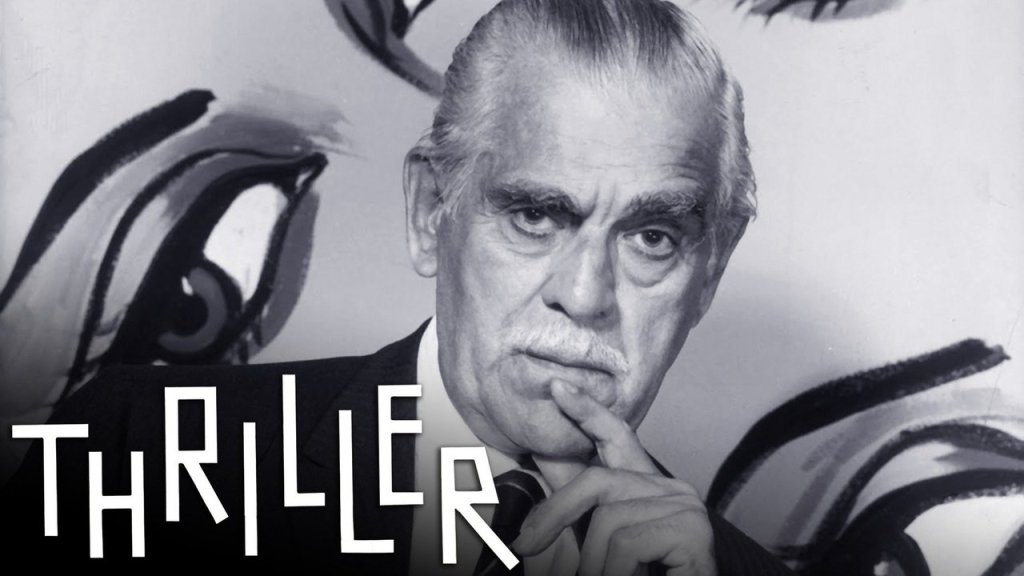
When we last discussed the Boris Karloff-hosted series Thriller, we had finished up all 37 episodes of season one, so now it’s time to plunge right into the second (and final) season. On we go!
Episode 1: “What Beckoning Ghost?”
The first episode of season two is admittedly something of a letdown from the excellent installment “The Grim Reaper” that wrapped up season one, but nonetheless it’s a fairly solid story, if a little bit generic, being yet another tale about grasping shitheels trying to bump off a rich relative with a really convoluted scheme to cash in on their wealth. At least this one has the benefit of actually having a supernatural angle to it (probably…?), so that’s a definite point in its favor.
Directed by the great Ida Lupino and adapted by Donald S. Sanford from another short story by Harold Lawlor, the plot revolves around a once-famous, very wealthy concert pianist named Mildred Beaumont (played by Judith Evelyn, who’s been in loads of things but who I specifically recognized from The Tingler with Vincent Price). Apparently Mildred has had some health issues and has been largely confined to bed, in something of a delicate physical and mental state. At the beginning of the story, though, it appears she’s on the mend, as she’s just returned from a fabulous night out—the first in a long while—with her seemingly adoring husband Eric (Tom Helmore of Vertigo and The Time Machine).
Hubby doesn’t want her to get overtired and tries to persuade her to get to bed, but Mildred is happier than she’s been in ages, and wants to stay up and have some champagne by the fire, like they used to do back when she was well. Eric indulges her, and goes to get the fire going while Mildred toddles down to get the bubbly. On her way there, though, she peers into the living room (drawing room? Parlor? Is there a difference?) and recoils in horror, because right there in front of the window is a coffin and a funeral wreath with a banner on it reading, “To My Dear Wife, Requiescat in Pace.” There’s even somber organ music emitting from somewhere. Mildred clutches her chest (it was earlier implied that she had a weak heart) and collapses to the floor.
The next morning, she wakes up in her room, with a very concerned Eric attending her. Also living in the mansion, by the way, is Mildred’s much younger, hotter sister Lydia (Adele Mara of Sands of Iwo Jima), who presumably moved in to help care for Mildred when her health started to decline. Eric and Lydia, who seem to have something of a contentious relationship as they can’t agree on what would be best for Mildred, tell the confused older woman that the doctor came to see her last night; it wasn’t her regular doctor, they say, because he’s out of town, but another guy named Dr. Bertoli. Mildred is troubled because she doesn’t remember the doctor coming there at all, even though she remembers the coffin and the funeral wreath with crystal clarity. Eric and Lydia tell her that she’s going to be fine; she probably just over-exerted herself and had a bit of a hallucination. No biggie, just take these sedatives that the doctor prescribed and you’ll be right as rain in no time.
Now, you know and I know that something sketchy as shit is going on with Eric and Lydia, and because they’re portrayed as disliking each other, you also know that they’re probably having an affair, because that’s one of the oldest tropes in the book. One of my main criticisms of the episode, as a matter of fact, is its predictability; in spite of Boris Karloff telling us in the intro that we shouldn’t think we’ve figured the story out because it’s going to surprise us, the plot does actually unspool more or less the way you expect it will, supposed ghost and all.
Anyway, the doctor allegedly comes again for a follow-up the next afternoon, but Mildred took one of the sedatives in the morning and slept until dinnertime, saying she again does not remember the doctor coming there, even though Eric says she was awake and talking to him the whole time. At this point she gets suspicious, as you would, but then the phone rings, and supposedly it’s the doctor himself. Eric takes the call out on the hall extension, and Mildred surreptitiously picks up the phone next to her bed to listen in. She’s relieved to hear Eric talking to someone who indeed sounds like a doctor, so she chastises herself for being skeptical of her darling spouse. The doctor tells Eric that Mildred might have to be institutionalized if she keeps having these memory lapses, so Mildred resolves to pretend she remembers everything that happened from now on, absolutely no doubt about it. Eric also basically tells her that even if she does see some crazy shit, she’s now aware that it’s not real and can thus get a handle on it.
As if we weren’t already looking sideways at this whole situation, Eric goes away for a week on a business trip, and while he’s gone, Lydia sits down for a serious talk with her sister. See, it turns out that Mildred is the one with all the money; she was the celebrity, after all, and Eric was originally her manager. She’s the one who signs all the checks, and this is apparently the way she and Eric have always operated. Lydia, though, insinuates that this setup is probably really emasculating for Eric, and shouldn’t Mildred put a portion of her wealth into an account for him so he doesn’t always have to come to her for cash like a kid begging for an allowance? Mildred admits she never really thought about it because Eric never complained, but she seems thoughtful and receptive to the idea. And at this point I’m like, damn, Lydia, could you be any more obviously shady? And could Mildred be any more unreasonably trusting?
When Eric returns, it’s made very clear (as if we hadn’t already figured it out) that he and Lydia have been playing hide the sausage behind Mildred’s back, because they smooch the hell out of each other on the staircase. Shortly afterward, Mildred surprises Eric with the announcement that she hasn’t just set up an account for him with half her money or whatever; oh no. She’s actually gone whole hog with it and given him complete access to ALL her money whenever he wants it, with no restrictions or caveats. Shit, not to victim-blame, but does this poor woman have SUCKER invisibly tattooed across her forehead?
In a startling twist, however, Eric refuses this generous offer, tearing up the paperwork and ostensibly calling the family lawyer to call off the agreement. Mildred is initially shocked, but then heartened by the knowledge that her husband is actually not after her money at all. But again, you know and I know that this is a calculated move to throw Mildred off the scent, and she totally falls for it.
So even though Mildred has been seemingly feeling much better lately, she’s still awakened in the middle of the night by another one of her purported “hallucinations.” To wit, she hears that funereal organ music again, and filled with dread, she creeps down to the drawing room to see what’s up. To no one’s surprise, the coffin and the ominous wreath have returned, but this time Mildred attempts to utilize Eric’s advice by fearfully approaching the tableau, telling herself none of it is real. Every time she opens and closes her eyes, though, it’s all still there, and it’s looking pretty fucking real at this point. The worst part, though, is that when she approaches the coffin, she sees that it’s open and her own dead body appears to be lying there! Well, this is finally too much for Mildred’s bum ticker, and she drops in a heap to the floor, dead as can be.
Moments later, Eric enters the room and kicks her corpse over onto its back, checking to make sure the old bat really has shuffled off her mortal coil. It’s then revealed, of course, that the coffin and wreath were absolutely real, and that the “body” in the casket was actually Lydia, wearing an extraordinarily realistic Mildred mask (which they must have purchased from the same manufacturer that the Mission: Impossible team sourced from, because damn). It’s then explained through visual clues and Eric and Lydia’s conversation that 1. the mask was made from a bust of Mildred she’d had sculpted years before; 2. there never was any Dr. Bertoli, and Eric had engineered the phone call with a recording of his own disguised voice that he spoke to; 3. Eric had never really called the lawyer or torn up the agreement saying he got all Mildred’s money, so now he’s a very wealthy man indeed. It also transpires that Lydia, who is one cold-hearted motherfucker, engineered the entire plot and is smugly satisfied with its outcome.
Naturally, though, we know that these two miscreants aren’t going to get away with their dastardly deeds, and not long after Mildred’s death, a sympathy card arrives with a bunch of others. Only this one is offering condolences not for Mildred’s death, but for Eric’s. Lydia thinks this is hilarious, figuring that someone just misread the obituary, but Eric is unsettled and angry, believing someone (perhaps Lydia) is playing a morbid prank on him. This perception isn’t helped by piano music he hears echoing through the house at night, and by the mysterious arrival of one of those funeral wreaths, this one addressed to “My Dear Husband.” Again, he think’s it’s a sick joke, but in the envelope attached to the wreath, he finds a wedding ring that he’s certain is Mildred’s. Lydia insists it must just be a copy, but Eric is starting to think that either his wife faked her death and is now fucking with him, or is actually dead and is taking her revenge from beyond the grave. The stress causes Eric to start hitting the bottle hard, which obviously doesn’t help his mental state much at all.
Perhaps to check whether a zombified Mildred crawled out of her crypt somehow, Eric goes to the cemetery, but there he finds to his distress that not only is her portion of the crypt intact, but the lower portion of the crypt that had his name on it now has a death date inscribed there…and it’s tomorrow!
He still doesn’t believe in ghosts, however, and basically accuses Lydia of pulling the same deal on him that she pulled on her sister. She insists it isn’t her; how would she even inscribe the crypt, she reasonably asks, and what about the piano music? She can’t play piano for shit, much less one of Mildred’s complex compositions. Eric is still giving her the side-eye, though, telling her that if she thinks she’s gonna frighten him into a heart attack like they did to poor old Mildred, she’s got another thing coming.
But later that night, a drunk-ass Eric is awakened by that spooky piano music again, and staggers down the hall toward the stairs. A concerned Lydia tries to stop him, saying she doesn’t hear anything, but he whacks her upside the head with a whiskey bottle (fuck!), which knocks her out for a bit. He then goes down to the drawing room, and is confronted with his own coffin and funeral wreath, and the piano nearby is also clearly playing all by itself.
He starts wigging out, now convinced that Mildred’s spirt has returned for some paranormal vengeance. Lydia recovers and hurries down to help him, claiming that he’s seeing things because there’s no music and no coffin, but then the drawing room doors close and lock on their own, leaving her outside in the hall and helplessly pounding to be let in. Subsequently, Eric appears to be hefted out the drawing room window to his death.
The cops arrive, and since Lydia has a torn sleeve and smells like booze (because of the bottle Eric broke against her head), the officers surmise that she and Eric had a fight and that she pushed his ass out the window. She tries to tell them what really happened, but of course they don’t believe her, and their assessment of her instability is only reinforced by her sudden insistence that she also sees the piano playing by itself. She’s hauled away for murder (or manslaughter I guess), ranting and raving about Mildred’s ghost.
So it’s pretty clearly implied that Mildred’s spirit is real and did all this shit, though I guess there’s some plausible deniability because the cops don’t see the coffin or hear the music, leaving open the possibility that Eric and Lydia’s guilt made them see and hear things that weren’t there (à la “The Tell-Tale Heart”). On the other hand, they apparently didn’t imagine that funeral wreath and the wedding ring in the foyer, though to be fair they were the only ones who saw it. I found myself sort of amused by the idea of a ghost calling up a funeral home and requesting the wreath be sent there; what did Mildred pay for the wreath with? Her American Express Afterlife account?
By the same token, now that I think about it, wouldn’t authorities have been suspicious about Mildred’s death from the jump, since presumably Eric and Lydia had to order a coffin and a funeral wreath from somewhere prior to her dying? I mean, you can’t just buy that stuff, have your wife die days later, and not expect to get some raised eyebrows directed toward you. Anyway.
Like I said, this was a pretty good episode, solidly middle of the pack. It’s not super original and it was very obvious where it was going to go despite the promise of twists and turns, but it was still entertaining enough, and the acting and camera work were definitely a highlight.
Episode 2: “Guillotine”
The second episode, also directed by Ida Lupino, was also decent and had some great suspense, although I have to admit I was somewhat familiar with the source story (by Cornell Woolrich), so I already knew roughly the direction it was going to go.
Set in 1875, the tale follows a condemned prisoner named Robert Lamont (Alejandro Rey), who has an upcoming date with Madame Guillotine, though like all the prisoners, he’s not sure when his number is going to be up. His cellmate gets carted off screaming at the beginning of the story, so he knows his time must be drawing nigh.
Shortly afterward, he’s visited by his wife Babette (Danielle De Metz), who bribes one of the guards to let her in to see him. It turns out that the reason Robert is in this predicament in the first place is because he caught his wife with another man and killed the guy; Babette testified against her husband at the ensuing trial. Babette seems contrite and Robert seems to forgive her, saying he knows she was forced to testify, but he’s obviously still bitter about the whole thing, because he keeps bringing it up in a really passive-aggressive way.
He tells her that maybe she can redeem herself, though. There’s something of an unwritten law or tradition, you see; to wit, if the executioner dies on the day of a particular prisoner’s scheduled chop, that prisoner is set free. Seems like a weird rule that’s ripe for abuse (as we’ll see from this story), but okay, nineteenth-century France, do your own thing.
So Robert tasks Babette with, first, finding out what the date of his execution is, since this is a fairly closely-held secret; and second, offing the executioner on the appointed day so he won’t be around to pull that lever and separate Robert’s body from its somewhat crucial top bit. Babette balks at having to straight-up murder a dude, but she did say she would do anything to help Robert because she feels so guilty, so she sorta walked into that one. She doesn’t give him a definitive answer about whether or not she’s gonna do it, though.
Well, it soon becomes obvious that Babette has indeed committed herself to this very dubious plot. She puts on a pretty dress and carries a basket of brightly-colored carnations to a café the executioner, Monsieur de Paris (Robert Middleton), is known to frequent. I don’t think this is mentioned in the story outright, but Babette must have got scuttlebutt from somewhere about the executioner’s passion for gardening, to take this particular tack in getting to know him.
Anyway, she approaches him with her wares, and he rhapsodizes over how beautiful the flowers are; she tells him she grows them herself, and that he’s welcome to have some cuttings if he wants some for his own garden. He’s over the moon about this, and Babette plays her part to the hilt, being sweet, interested, and subtly flirtatious. The executioner is old enough to be her dad, but he’s a lonely guy, mainly because his profession makes him an object of hatred in the area, so he appreciates any attention from a lovely young woman.
Babette cultivates a friendship with Monsieur de Paris, and wangles herself a dinner invitation to his house. Prior to this, we’ve seen her testing a poison powder on a bug, so we know exactly why she wants to get in close proximity to the dude’s food. A wrinkle in the plan appears, however, in the form of M. de Paris’s overbearing housekeeper, Madame LeClerc (Janine Grandel), who dines at the table with them and is extremely rude to Babette and openly suspicious of her intentions. And rightly so, granted, though she actually thinks Babette is after her employer’s money (which he doesn’t have a lot of), and not that she’s trying to kill him.
Babette protests to such a degree that Madame LeClerc eventually softens toward her, but the housekeeper’s looming presence means that Babette is unable to sprinkle the poison into the food at the dinner table. Thinking on her feet, though, she asks Mme. LeClerc to show her how to make some kinda apple pancake things that M. de Paris wants to have for breakfast, and while the housekeeper has her back turned getting paper and a pencil to write the recipe down, Babette puts the poison into the filling of the pancakes. She then sends a note to Robert in his prison cell, saying that the deed is done, which seems a tad presumptuous; personally, I would have waited until the guy was certifiably dead before popping off like that, but hey, different strokes.
Robert, unwisely, is so certain that Babette came through for him that he starts acting smug as fuck to his jailers, betting them large amounts of money that his execution isn’t going to happen. Since he already asked one of the jailers earlier about the whole “headsman dying on the day of the execution” rule, this seems a really stupid flex; again, if it was me, I think I’d keep all that cockiness on the down-low, to keep the authorities from getting suspicious, but what do I know.
It so happens that, in spite of what you may be thinking, Babette’s plan actually did work, but only up to a point. Monsieur de Paris did eat the poisoned pancakes, and does start to feel very ill while he’s getting ready to set out for the prison. Unfortunately, the poison was apparently not as fast-acting as Babette might have liked, because although the executioner clearly feels like total ass, he is bound and determined to get to that guillotine and slice Robert’s fool head off.
There then ensues a very tense sequence which alternates between Robert’s cocksure pronouncements to his increasingly uncertain jailers; and the steadily sickening executioner doing his damnedest to get to the prison to do his duty. This was the best part of the whole episode, because even though you were pretty sure how it was going to turn out, it still kept you on the edge of your seat.
The jailers are beginning to wonder what the hell is going on, because Monsieur de Paris is always punctual, and they’re at a loss as to what to do in this unprecedented situation. The overconfident Robert, again demonstrating that he isn’t the sharpest baguette in the bread box, tells them that just for shits and giggles, the jailers should tie his hands behind his back and march him out to the guillotine, so he can get the full experience. He still believes he’s going to skate, see, and how often does one get the opportunity to be on the very cusp of one’s execution? Must be the thrill of a lifetime!
You can probably guess what happens, even if you haven’t read the original Cornell Woolrich story. The executioner shows up at the prison, but he’s in bad shape, and by the time he gets to the guillotine, he can barely walk. Robert, by this point getting pretty fucking nervous, is placed into the contraption, and as he starts to realize that the executioner might just make it to the fateful lever after all, he starts to scream his bloody head off (pun very much intended).
Well, as fate would have it, Monsieur de Paris breathes his last the very moment before he’s able to pull the lever, and a triumphant Robert shrieks the nineteenth-century-France equivalent of, “SUCK IT!” But then, in a shocking (not really) twist, the guy checking the executioner for a pulse “accidentally” drops the dead man’s hand onto the lever, and Robert’s noggin goes swishing into the basket. Justice served!
As I mentioned, this was another solid episode; no surprises really, but the suspense was extremely well done, and the acting was decent as well. Some of the French accents seemed better than others, but none were distractingly bad, and I’ll note that the actor who played Babette was actually French; the guy who played Robert was Argentinian and sounded pretty legit, and Monsieur de Paris was an American but did okay. Another enjoyable but middle of the road offering.
Episode 3: “The Premature Burial”
Though you might think that this episode would also be somewhat predictable, given how familiar the original story by Edgar Allan Poe is to most people, screenwriter Douglas Heyes (who also directed) actually did something different with this adaptation, using some minor aspects of the source material to flesh the story out in directions you might not expect. Not all of it works, in my opinion, but it’s still another solid effort. This is also another welcome installment in which Boris Karloff gets to act in the story, rather than just host it, which is always a treat.
At the beginning, a fifty-year-old man named Edward Stapleton (Sidney Blackmer) has died suddenly, and at his funeral, his friend and physician Dr. Thorne (Boris Karloff) laments that he was out of town when the tragic event occurred. He then tells the attending physician Dr. March (William D. Gordon) that although he has every faith in his diagnosis, he (Thorne) still wants to figure out what happened to Edward. The man was healthy as a horse, and Dr. Thorne can’t figure out why the dude would have just dropped dead like that. He vows to break into the crypt to retrieve the body if he has to, which seems like it would run afoul of a law or two, but Boris don’t care about no jail, man; Edward was his friend, after all.
It’s then revealed to the audience that Edward is unreasonably fidgety for a corpse; inside his tomb, the coffin rocks back and forth, then falls off its little coffin shelf, at which point a grasping hand emerges from the casket, trying to open it from the inside. Say it with me: Edward is alive! ALIVE!!!
Anyway, Boris and Dr. March bring Edward’s seemingly dead body back to Frankenstein’s lab, where Boris proceeds to bust out the galvanometer. The shock immediately causes Edward to get up and stagger across the floor, before he tries to speak and then faints dead away (pun, again, very much intended). When he wakes up some time later, Boris tells him that he must have had an attack of catalepsy. Edward proceeds to tell Boris that he was completely aware of everything that was going on for the three days since he was pronounced dead, which Boris acknowledges must have been pretty damn horrible.
So while all this is happening, there are also a couple of other characters who are going to factor into the story going forward. Victorine Lafourcade (Patricia Medina) is Edward’s much-younger paramour who he’d very much wanted to marry. Unbeknownst to Edward, however, Victorine is actually trading fluids with a hot but penniless young artist named Julian Boucher (Scott Marlowe), and the only reason she even tolerates Edward’s old ass is because she wants his money so she can support her lover’s artistic ambitions. The conniving couple are actually super jazzed at the beginning of the story when Edward keels over, because I guess Victorine might have been in the will, but when Boris comes over and tells her that Edward is actually still alive, she’s all, “Fuuuuuu— I mean, awesome!” Boris tells her that she ought to marry Edward to make him happy and help him get over the trauma of being buried alive, though he warns that Edward mustn’t over-exert himself for fear of the catalepsy thing happening again. Victorine practically rubs her hands together with evil glee as she tells him that of course she will wed Mr. Moneybags… er, Edward; it’s all she’s ever really wanted.
Boris does Edward a solid and has some Life Alert type jewelry made for him, consisting of a necklace and a bracelet for each arm that basically tells people not to bury him, even if he appears dead. Boris also informs all the doctors and morticians in the area of Edward’s condition, to prevent him getting interred alive.
Edward and Victorine’s wedding takes place, and right afterward, Edward shows his bride yet another precaution he’s taken to ensure that he never wakes up in a coffin ever again. Just like in the original story, he’s had a vault constructed on his property that has every imaginable failsafe: a ventilation system, an easily-triggered bar that opens the vault door, a coffin that pops open at the slightest movement, a pull rope that rings a loud bell on the outside of the building, the whole works. Victorine is horrified by the morbidity of the place, but Edward is almost manic, begging Victorine to not bury him anywhere but this vault and giving her explicit instructions on everything she needs to do. A weirded-out Victorine reluctantly agrees.
Some time passes, though, and it seems like Edward and Victorine have settled into married life. Edward is so happy and relaxed that Victorine is easily able to persuade her husband to go against his doctor’s orders and do some exciting shit; she wants to travel and have a good time. The pair take a long vacation (of which very little is shown), and near the end of it, Edward insists they go hunting, a pastime he used to really enjoy before his health issues and his subsequent paranoia about a repeat of the cataleptic episode.
Well, hubby shoots a deer shortly after showering Victorine with praise for how happy she’s made him, and then the poor old codger crumples to the ground, apparently dead. Victorine, after a perfunctory attempt to wake him up, proceeds to remove his “Don’t Bury Me” baubles and buries them in the dirt under a big rock. She’s in a foreign country, after all, and the doctors round these parts don’t know about Edward’s condition, so all she has to do is contact the authorities and get his ass shoved in the ground just like a regular dead dude; no muss, no fuss.
Weeks later, she returns home and falls into Julian’s arms, telling him that her husband is finally dead for real and that they’ll soon be swimming in loot. Not so fast, though; Dr. Boris is pretty peeved with Victorine for going against her husband’s wishes and having him buried on foreign soil rather than in his purpose-built sepulcher. What if Edward was still alive, like he was last time? He would have been able to see and hear everything that was going on, but been unable to do anything about it; truly a fate worse than death. Boris also finds it extremely sus that Edward’s jewelry was gone, but Victorine tries to excuse it by saying that maybe one of the poor villagers stole the stuff. Boris isn’t really buying it, but retains his composure.
Boris also informs Victorine that she won’t see a penny of the inheritance until Edward is disinterred and brought back home to be laid to rest in his own vault; it was a condition of his will. Victorine is very put out by this stipulation, but she doesn’t have much choice if she wants to get her hands on her late husband’s cash. She reluctantly concedes.
Edward’s body is transported back from wherever it was, and put in the vault in its creepy white shroud. Victorine is already starting to get mightily spooked by this whole situation, and when Julian comes over to see her to celebrate all the money they’re getting, she’s acting real skittish and nervously peering out the window at the vault. Julian tells her she’s being ridiculous; even if her husband wasn’t dead when they buried him in whatever country they were in, he would sure as hell be dead now, since he’d been under the ground for six weeks. Victorine still isn’t convinced, though.
And it so happens that she was right to be anxious, because as she’s looking out at the vault, the bell begins to ring, signaling that someone inside has pulled the rope. Julian dismisses this as a gust of wind, but then the door to the vault opens as well, which is a bit harder to explain away. What’s more, when they go out to check the tomb, the coffin has been sprung open and is conspicuously empty. Victorine starts losing it, and Julian is starting to get pretty shaken as well. Both of them go out onto the grounds and very clearly see an old man in a white shroud walking around out there.
They run back to the house; Victorine is terrified, thinking Edward is either somehow still alive or has returned as a revenant, but Julian suspects more prosaic shenanigans. He thinks Dr. Boris dressed up in the shroud to frighten them, but this theory is shot down in short order when Dr. Boris himself turns up at the house while the shrouded dude is still standing outside the window.
Dr. Boris does seem surprisingly cavalier about the whole situation, calling after Edward and acting like the whole thing is no big, but Victorine just can’t deal. She runs upstairs and is shocked to see Edward’s “Don’t Bury Me” necklace draped across her pillow, and when the shrouded man comes into the room after her, she seems to accept that her husband has returned to her.
Long story short, Julian finally confesses that Victorine deliberately made Edward go abroad and talked him into engaging in strenuous activities, knowing it was likely he’d fall into one of his spells and be buried alive. Once he fesses up, Dr. Boris reveals that the shrouded man is not Edward at all, but Dr. March, who is wearing a mask that was molded from Edward’s face after he died. The two doctors cooked up this whole scheme in order to get Victorine and Julian to own up to what they’d done, which only partially worked; yeah, Julian spilled the beans, but by this point Victorine’s mind had been completely broken by the sight of her “dead husband” coming back to get her, and we’re led to assume that she’ll spend the rest of her days in an asylum somewhere rather than gallivanting about living high on the hog with her artistic boy toy.
Obviously this adaptation takes a lot of liberties with the source story, which is essentially just a first-person account of someone being buried alive and the precautions they took in order to keep it from happening again. However, at the beginning of the original tale, the narrator does talk about a few other people who had been buried alive, and screenwriter Douglas Heyes took those details and wove a narrative around those characters, which was a great idea. This was a suitably spooky tale, and I especially liked the look of the shrouded man in the death mask, which was pretty damn effective. I will say, though, that other than Boris Karloff, the other main actors came across as a little stagy and overwrought. I’m not sure if they went overly dramatic with the material because it was a period piece and they thought that would play better, but it was a tad much. Overall, though, this was a good, if loose, retelling of the Poe story, and though I actually like the Roger Corman-directed adaptation that came out a year after this much better, the Thriller episode was an enjoyable take on the classic tale.
Episode 4: “The Weird Tailor”
This particular installment is significant for being the first story in the Cthulhu Mythos ever put on television, though the connection isn’t all that pronounced other than the mention of a demon named Tsathoggua (from the works of Clark Ashton Smith) and a plot point involving a Necronomicon-type book called De Vermis Mysteriis (from Robert Bloch‘s stories).
Based on a story of the same name by the aforementioned Robert Bloch, this episode immediately set off alarm bells in my head because the tale was so familiar to me. I assumed it must have been adapted elsewhere, and lo and behold, I was correct: it appeared as one of the four segments making up the later 1972 British anthology film Asylum, which was made by Amicus and which I rewatched not too long ago. Mystery solved!
In both cases, Robert Bloch adapted his own story for the screen, and though both versions are very similar, they also have a few differences. In the Thriller version, we first meet a drunk young man by the name of Arthur (Gary Clarke), who returns home to his family mansion to find his father Mr. Smith (George Macready) right in the middle of some occult business, complete with a huge pentagram on the floor and candles flickering everywhere. Arthur just thinks the whole thing is a lark despite his father’s dire warnings to not get involved, but Arthur’s just trying to get to the booze across the room, man. Unfortunately, this takes him right through the center of the pentagram, at which point a whole bunch of smoke billows out and the young man collapses dead to the floor.
Mr. Smith is inconsolable, and goes to a blind psychic named Madame Roberti (Iphigenie Castiglioni) to ask her if she can somehow magic his son back to life. She’s horrified at the suggestion, telling Mr. Smith that’s some black magic shit and she don’t fool with that, even though he offers to pay her his entire fortune. He asks whether she might know somebody who could help him, and she reluctantly hands him a piece of paper with a name on it; at first, Mr. Smith thinks she must be joking, but she insists she’s as serious as a heart attack.
So the place she sent him is a cheesy used car dealership called Honest Abe’s, and the person supposedly able to penetrate the very veil of death is slick used car salesman Honest Abe himself, whose real name is Nikolai (Abraham Sofaer). On the down-low, Nikolai sells Mr. Smith a rare occult book called De Vermis Mysteriis (Mysteries of the Worm), of which only three copies are rumored to still exist in the world. All the remaining copies, Nikolai confides, were burned, “along with their owners.” This is some hardcore black magic reading material, in other words. Mr. Smith buys it for a cool million bucks, though Nikolai cautions him that he can’t guarantee that any of the spells will work, and even if they do, Mr. Smith might be very sorry that he fooled around with dark forces he doesn’t fully understand.
Mr. Smith only cares about bringing his son back, though, so he doesn’t really heed the warnings. The spell he has to do entails making a suit out of this bizarre, unearthly fabric; not only is the fabric implied to be magical, but the person making the suit can only work on it during certain dates and times, for astrological reasons. It’s here where the titular “weird tailor” comes into play, in the form of a squirrelly little fucker by the name of Erik Borg (Henry Jones). Borg runs a tailor shop with his wife Anna (Sondra Kerr), who he is exceedingly abusive toward. Poor Anna is so lonely and traumatized that she’s taken to interacting with a broken clothing mannequin she calls Hans as though he’s a real person. It’s pretty heart-wrenching.
So the landlord of the tailor shop, Mr. Schwenk (Stanley Adams), has had enough of Borg’s nonpayment and is threatening to throw Borg and his wife out on their asses unless they cough up what they owe by the end of the week. Borg is ready to throw in the towel and slaps his wife around some to presumably make himself feel better, but then, miraculously, Mr. Smith swans into the shop and offers to pay $500 for a very strange suit he claims he’s having made for his son.
Borg can hardly make heads or tails of the odd fabric and all the other peculiar stipulations Mr. Smith lays out for him, but the tailor needs the money badly and basically says he’ll do anything Mr. Smith asks for that kind of dough. He sets to work on it right away, and suggests to poor, long-suffering Anna that when he gets the money for the suit, he might just take off and leave her. He’s a charmer, this one.
Borg finishes the assignment right on schedule, and boxes the suit up to deliver it to Mr. Smith. The landlord is due that afternoon, but Mr. Smith promised he’d pay on delivery, so Borg isn’t worried; he’ll have the money in plenty of time.
Problem is, when he gets to Smith’s place, it’s a bit more down-at-heel than he was expecting, given his earlier perception that Smith was quite wealthy. Smith explains that indeed, he WAS wealthy, but he’s paid every penny he had in order to bring his son back, and too bad, so sad, looks like Borg isn’t gonna get paid for all of his work.
Borg is livid, pointing to an expensive and clearly new icebox in the room as proof that Smith has money. The tailor then whips open the icebox door and sees the frozen corpse of Smith’s son, Arthur, and he recoils in horror. A struggle ensues, and in the melee, Borg ends up stabbing Smith to death. In a panic, he quickly tries to rid the room of any evidence that he was there, then he scoops up the suit and gets the hell out of Dodge.
Back home, Anna asks him if he got the money, since the landlord’s due any minute, but a shaken Borg tells her what happened. She’s shocked, but adamant that he needs to call the police; Borg killed Smith in self-defense, after all, so there shouldn’t be anything to worry about. Borg insists that the cops won’t believe him, and when Anna tells him that she’ll call and explain things to them, he loses it and starts beating the crap out of her again. He then thrusts the suit box at her, telling her to burn the thing, and lurches out the shop to get drunk at the nearest bar.
In the bar, the landlord confronts Borg about his late payments, but Borg is acting so strangely that he can’t get any reason out of the man. Borg eventually flips out and flees the bar, guilty about killing Smith and simultaneously freaking out about Smith being a murderer. Oh, and the black magic connection; there’s also that.
Well, because it was implied that the suit would bring the dead son back to life, and because abused wife Anna had a broken mannequin as her only friend and confidante, you can probably guess what happens. While Borg was at the bar, Anna thought about burning the suit, but then decided to put it on ol’ Hans first to see what it looked like. So when a drunk, angry Borg returns home and starts whaling on Anna once again, the mannequin comes to life and kills him (offscreen), telling Anna that now they can be together. This is implied to NOT be a good thing, by the way, because obviously Hans was animated by dark magic, and that kind of thing always comes back to bite you in the ass. Do I speak from personal experience? Maybe.
This was another winner from Robert Bloch, with some really creepy imagery (especially Hans the mannequin when he comes to life), good acting, and some very dark subject matter (like spousal abuse) portrayed realistically and sensitively. I honestly think I like this adaptation a bit better than the one that turned up in Asylum more than ten years later, but they’re both good; it’s just an inherently solid story, and translates well to the screen.
Episode 5: “God Grante That She Lye Stille”
Even though I usually love old school witch stories, this particular installment—directed by Herschel Daugherty from a teleplay by Robert Hardy Andrews, which was in turn based on a 1931 short story by prolific English ghost story writer Lady Cynthia Asquith—didn’t really do much for me, and I found my attention wandering quite a bit as I was watching it. I think the main issue I had with it was just the amount of exposition, which was somewhat clunkily presented, and the excessive time it took to get through what was really a simple premise based on a classic witch curse.
The beginning of the story, set in 1661, has a wildly overacting Sarah Marshall as condemned witch Elspeth Clewer (who is also a vampire, by the way, because why not). Before Elspeth is burned alive, she laughs contemptuously at all the assembled people, basically telling them that they will never destroy her. She then throws out a curse: “First fire, then death—so it shall always be until my body is returned to me!” The weird thing about this curse, though, is that although you’d think she’d want to curse the townspeople who burned her with, I dunno, crop failure or their kids being deformed or something, she basically just places the curse on her own descendants? I don’t really get it either, but to be fair I’m not a powerful witch, so maybe she’s got some particular end game in mind that I’m not privy to. Anyway.
So we then jump ahead to the present day, and Lady Margaret Clewer (also Sarah Marshall, but with blonde hair instead of dark) has returned to the ancestral home a few days before her 21st birthday in order to accept her inheritance. Right from the beginning, though, there’s some shenanigans; her devoted maid Sarah (Madeleine Holmes) thinks she sees someone lurking around outside, though Margaret doesn’t see anything when she goes out on the balcony to look. Also, just a heads up: Margaret has a pair of pet birds in a cage and also a cute little dog named Sheen, none of whom make it to the end of the episode, though thankfully their deaths are not shown, only described.
As soon as Margaret is alone, a ghostly Elspeth hovers into the room and proceeds to screw with her ancestor, lying on her bed and making Margaret have no reflection in a mirror. She repeats the curse she uttered on the pyre all those centuries ago, then cackles a bit, after which Margaret passes out because she just can’t handle it.
The next day, help is summoned in the person of Dr. Stone (Ronald Howard), who tells Margaret that she has a weak heart and she needs to take it easy for a while. Margaret tells him she saw her own face outside the window and it’s kinda freaking her out a little bit; Dr. Stone asks her if she’s ever talked to a psychiatrist. Margaret seems mildly offended at first, but then sort of rolls with it, asking Dr. Stone with amusement if he’ll give his professional opinion of what’s the matter with her. He’s just a GP, but he takes a swing at it.
So Margaret’s little doggo has disappeared (uh oh), and in the course of looking for him, Dr. Stone runs across Elspeth’s grave in the family plot outside the manor. He gets curious because of the weird inscription on the headstone—God Grante That She Lye Stille—and while he’s pondering it, a creepy vicar named John Weatherford (Henry Daniel) pops up outta nowhere and lays some knowledge down about Elspeth, vis-à-vis her being BOTH a witch AND a vampire. Because it’s good to have more than one gig in this economy, right? Gotta diversify.
Of course the doc doesn’t believe in all of this supernatural balderdash, but even he has to admit that Margaret is starting to act mighty strange. For instance, she vanishes out of her room and is later found lying on Elspeth’s grave; she keeps complaining of seeing a face outside of her window; and at one point she locks herself in her room, screaming and talking to SOMEONE named Elspeth. Wonder who it could be?
Meanwhile, the magical appearing vicar keeps magically appearing at random times, trying to convince Dr. Stone that Margaret is in real mortal danger. The long and short of it is that Elspeth wants to bring herself back into the realm of the living by possessing the body of a direct ancestor. Again, Dr. Stone dismisses this outlandish idea, thinking that Margaret probably just needs a shrink.
And perhaps she does, because shortly afterward, Margaret’s two pet birds are found in their cage with their heads torn off, and the dog is found outside with its throat cut (told you the critters were doomed). Margaret is discovered in bed with blood on her mouth and mud on her feet, but doesn’t seem to remember anything that happened. At this stage, the maid Sarah decides to bounce, and who can blame her?
Dr. Stone brings in a replacement nurse, Miss Emmons (Avis Scott), and the first night she’s there, it appears that a possessed Margaret wanders over and stabs her in her sleep, but the next morning she seems completely fine, and it’s revealed that Margaret just stabbed her in the arm. Which…would still be really painful and would probably require stitches, so it’s a bit odd how cavalier the nurse is about the whole thing. Maybe she’s into extreme body mod or something and getting stabbed is just like Monday morning to her.
Anyway, Dr. Stone brings in a psychiatrist played by ubiquitous character actor Victor Buono, and the shrink not only says that Margaret is likely schizophrenic, but also drops the bombshell that the woman’s heart condition is far worse than anyone realized, and that Margaret is probably not gonna live much longer. Dr. Stone, who it’s implied has developed some squishy feelings toward Margaret, is shocked and saddened by this information, but Margaret seems to take it in stride, telling him that it would probably be better for her to die, so that she would finally be safe.
That damn vicar shows up again and informs Dr. Stone that he’s essentially the Van Helsing to Elspeth’s Dracula; in other words, his family over the generations has been tasked with ensuring that Elspeth doesn’t possess the body of any of her ancestors. And to their credit, they’ve done a bang-up job so far.
There then comes the climax where a cranky ghost-Elspeth sashays into Margaret’s room again, demanding to be “lodged,” and Margaret screams her head off, bringing Dr. Stone and the vicar running. They both see the ghost/witch/vampire leaving Margaret’s body, after which Margaret proudly tells them that she won, before she keels over dead. Dr. Stone is heartbroken, but the vicar tells him that it was the best thing; Margaret was the last of the Clewer line, and the fact that she died childless means that Elspeth has no one else to possess. Sure enough, when the vicar directs Dr. Stone to the window, the doc sees Elspeth’s grave smoking. The multimonster is defeated forever!
As I said, I didn’t love this episode; it dragged in places, and was a tad repetitive. The acting was okay, though Sarah Marshall was way over the top as Elspeth; she was normal in the Margaret role, though, so I guess she was just trying to distinguish the two characters. Dr. Stone, for his part, was kind of a bland character, honestly, and I felt like the episode focused too much on him instead of on the more interesting witch stuff. And even though the whole mechanics of the curse were fairly simple to understand, the vicar seemed to just go on and on about it, materializing whenever convenient to expound further upon details that were already pretty clear.
So not great, but still watchable. I haven’t read the original story, I’ll note, so I don’t have any idea how faithful an adaptation this is.
Episode 6: “Masquerade”
Much better was the next installment, again directed by Herschel Daugherty, and based on a short story by Henry Kuttner (probably best known for his 1936 tale “The Graveyard Rats,” which has been adapted to the screen twice: once in the 1996 anthology film Trilogy of Terror II, and more recently as a stand-alone episode of Guillermo del Toro’s Cabinet of Curiosities on Netflix).
While the story here is far more comedic than scary, it’s actually a delightfully entertaining and fast-paced “old dark house” type tale with a funny twist ending. And the witty back and forth between the two leads, a pre-Bewitched Elizabeth Montgomery and a pre-Newhart Tom Poston, is wonderful, and made me bust out laughing several times. John Carradine is also a highlight, playing a creepy but wisecracking hillbilly with obvious relish.
Montgomery and Poston star as a married couple named Charlie and Roz Denham, who are celebrating their second honeymoon by driving to some isolated resort. Along the way, they become lost in a rainstorm, and end up at some kind of inn (played, again, by the iconic Psycho house; its second appearance in the series) that has definitely seen better days.
Once inside, the Denhams joke (sort of) about the denizens of the place eating them, but proprietor Jed Carta (John Carradine) cracks that they don’t eat the guests; they just kill them and steal their money. Roz, who clearly uses her acid-tongued humor to stave off fear, isn’t entirely sure if the guy is kidding, which makes her a mite nervous. Charlie, though, thinks the whole thing is a bit of a laugh, believing that Jed and the other hicks in the joint are just getting their jollies by scaring the city folk. Jed also happens to mention that there have been some suspicious deaths in the area recently, and tells the couple that there’s likely a vampire prowling the environs. Again, the Denhams just wonder if Jed just has a morbid sense of humor, because obviously vampires aren’t real.
As the story goes on, every suspicion that Roz has about the danger they’re in seems to come to pass: for example, when she tries to leave, she finds that they’re locked in, and that the windows are all sealed tight. Both Charlie and Roz also hear a woman’s spooky laughter coming from somewhere, and they overhear a conversation between Jed and his relative Lem that sounds like they’re planning to slaughter the pair.
Upon searching the house for the source of the laughter, the Denhams discover an old woman named Ruthie (Dorothea Neumann, who I recognized from Roger Corman’s 1957 movie The Undead), who is chained to a wall in a dungeon. She tells the couple that she’ll show them the way out if they free her, but as soon as they do, she turns the tables on them and locks the Denhams into her cell, cackling as she skedaddles.
Not long after, Charlie and Roz manage to escape, and eventually discover a secret passage which leads down to the cellar. While down there, they find an ominous old guest book that has a list of names, along with an inventory of all the valuables each person had. Roz is vindicated, pointing out that this must be a record of all the previous victims the Carta family murdered, but again, Charlie simply thinks the whole thing is an elaborate prank. His opinion is not altered when Jed and Lem comes downstairs and chastise the couple for letting Ruthie out of her cell: she’s the vampire, they say, and the reason all the doors and windows in the house are sealed was to keep her from getting out.
The disbelieving couple then retreat to a bedroom, where Charlie takes several tipples from a bottle of very strong moonshine he found in the cellar, and seems unconcerned at finding a closet full of clothing and IDs from the previous guests whose names were in the book downstairs. The drunk Charlie then dozes off, much to Roz’s consternation.
During the night, though, Roz wanders out of the room, almost as though she’s sleepwalking, and Charlie is a bit panicked when he wakes up and finds her gone. As he goes out into the house to find her, he discovers Jed kneeling next to Lem’s dead body; from the marks on his neck, it looks like the vampire got him. Jed is freaking out, saying there wasn’t really a vampire and that he was just joking the whole time, but Charlie brushes him off and goes down to the cellar even though Jed warns him not to.
In the cellar, Jed is confronted with Ruthie, who cackles and draws a big-ass knife on him before everything fades to black. In the next scene, though, he’s back upstairs and has found Roz; he implies that he had to take care of Ruthie, as it was either him or her. Roz then produces the front door keys, telling Charlie that she snuck up on Jed and knocked him out in order to get them. The couple then flee the house, jump in their car, and peel out.
Shortly afterward, it appears that they’ve finally arrived at the resort they were initially heading for, and then the twist occurs: turns out Charlie and Roz were the vampires the entire time, and they settle down for the day in their shared coffin, after snacking on the entire Carta family.
This was easily one of my favorite episodes of the series so far; as I mentioned, it’s not scary, but it’s a lot of fun, playing out like an entertaining spook-show ride. The interplay between Elizabeth Montgomery and Tom Poston is so delightful that I’m surprised they didn’t get their own sitcom at some stage; their chemistry is amazing, and Elizabeth Montgomery in particular has such a cutting, wry sense of humor that I smiled like an idiot through most of the episode’s runtime. I sort of saw the twist coming, but not exactly, so it was a little bit of a surprise, and it actually makes me want to watch the story again with the knowledge that both of them were vampires so I can get even more enjoyment out of it. From a cursory glance through reviews and such, it seems clear that this episode is one of the most beloved in the whole run, and it’s easy to see why.
Well, that’s six episodes down in season two! Please keep watching this space for the next half-dozen, and until then, keep it creepy, my friends.
 The Scare Salon
I love this. I believe (for me) it’s on Tubi. There are so many great classic horror movies on Tubi, as well as the cheesy one’s.
LikeLike