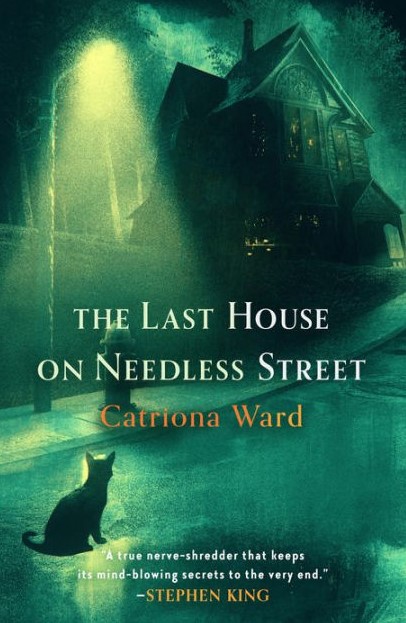
I remember hearing a a great deal about Catriona Ward’s novel The Last House on Needless Street back when it came out in autumn of 2021; there was a lot of buzz about it in the horror community, and I read that the movie rights got snapped up pretty quickly. I’m obviously a little late to the party (as usual…), for although the brief synopsis of the book sounded intriguing to me, I didn’t get around to reading the thing until it showed up on Kindle Unlimited for free. I’m kind of a cheap bitch like that.
I somehow managed to avoid any spoilers or in-depth plot summaries in the two years since it was published, and I’m glad I did, because this is yet another case of a story being much better if you don’t know exactly what you’re in for. That said, this novel has a pretty big “twist” that I’m not going to spoil (and that astute readers may be able to guess), as well as several unreliable narrators; it further utilizes a trope that has been done in horror stories (and thrillers) several times before. I didn’t mind the reveal, and some other readers seemed to like it as well, but I noticed some reviewers absolutely hated it, so caveat emptor.
The narrative is also not entirely straightforward, so it does necessitate close attention to detail. It’s not inscrutable by any means, and I found it fairly easy to follow despite it jumping from character to character and time period to time period, but those who prefer more linear storytelling might find it a bit frustrating.
On the surface, we seem to be following a lonely, youngish-to-middle-aged man named Ted Bannerman, who lives in a somewhat run-down house on the end of a dead-end street. From the beginning, we know something is kinda off about Ted; though he comes across as extremely socially awkward but very sympathetic, some of his conduct appears a tad sketchy, if not outright sinister, and the reader is pretty certain that things aren’t entirely as they’re being presented.
Though a couple of his neighbors seem friendly toward him, he’s also had rocks thrown through his windows and other vandalism perpetrated against him, as he’s something of the town weirdo. Near the beginning of the story, in fact, he’s heartbroken when someone cruelly hides glue traps in all his bird feeders, killing the birds that he loved so much. It should be noted that some of the reason for the community’s hostility toward him has to do with the fact that he was a suspect in the disappearance of a little girl from a nearby lake several years previously, though he was subsequently dismissed as such.
Ted’s parents are presumably dead, and he seemed to have had a complicated relationship with them, especially his mother. She was a nurse who had immigrated from a small village in France, and she had some interesting parenting techniques to say the least, though the extent of her trauma-generating behavior is only slowly unveiled through flashbacks.
In the present day, it seems that Ted’s only friend is a devoted cat named Olivia, who has several chapters written from her perspective. Anyone who knows me knows that I adore cats, and I have to admit that the sections delineating Olivia’s point of view were pretty delightful, even though, just like everything else in this novel, nothing is entirely as it appears.
Ted also has a teenage daughter named Lauren, who is only in the house sometimes; the reader is led to assume that she’s with her mother the rest of the time and just comes to see Ted for visits. She seems a rambunctious girl, though disabled, and Ted dotes on her, but he’s also quite overprotective, attempting to shield both her and Olivia from the dangers of the outside world. Some chapters are also from Lauren’s perspective.
But as previously alluded to, something is not entirely right about Ted. He drinks a great deal, for one thing, and has frequent blackouts, sometimes for days, in which he says and does pretty questionable things that he doesn’t remember when he comes back to himself. He also seems to believe there are presumed entities he calls “green boys” in his attic, which he never enters. Further, he spends a lot of time in the nearby woods with “the gods,” initially undisclosed objects he keeps buried and reveres quite highly.
There are also several instances where Ted, forlornly wishing for human companionship, uses fake pictures on dating sites to set up meetings with various women. The reader doesn’t really find out what happens with these dates until later.
While all of this is going on, we’re also following another character named Dee. Her six-year-old sister Lulu vanished from a family trip to the lake years ago, and has never been found. Dee’s mother abandoned the family shortly after the disappearance, and her father committed suicide, so Dee has been dealing with her own trauma. The only purpose remaining in her life is to find the person who took her sister, a pursuit she’s been single-mindedly involved in since she became an adult, with the grudging help of a police officer she refers to as “tired Karen.”
Close to the start of the story, after Dee has run through a laundry list of suspects and gotten nowhere, she focuses her attention on Ted, who was a person of interest back in the day, but was eventually cleared. Dee rents the empty house next door to Ted’s, and begins to obsessively surveil him, searching desperately for evidence of her missing sister.
That’s about as far as I want to go in revealing plot details, because the appeal of this book is in its constantly shifting mystery and its ever-changing perspectives. It’s fragmentary and sometimes almost dreamlike, but never less than enthralling, as new information unfolds slowly across multiple avenues. While I admit I had begun to guess what the twist was likely going to be (and was mostly correct), that didn’t diminish my enjoyment, as I was still interested to see how things were going to resolve themselves.
As I mentioned, the trope used here has been done many times before, so some might find it trite or disappointing, but I thought it worked well in this context. Though this is absolutely a horror novel, it’s also a fascinating exploration of the lingering effects of trauma and the survival mechanisms that different people employ to deal with it, for better or for worse. I’m not sure I’d go so far as to say the novel deserved all the hype it got, but I found it pretty engrossing, and I’m sure I’ll be thinking about its themes for some time to come.
Until next time, keep it creepy, my friends.
 The Scare Salon
I highly recommend this book! The suspense and buzz around it are well-deserved.
LikeLiked by 1 person
I did read this one, it’s good.
LikeLike