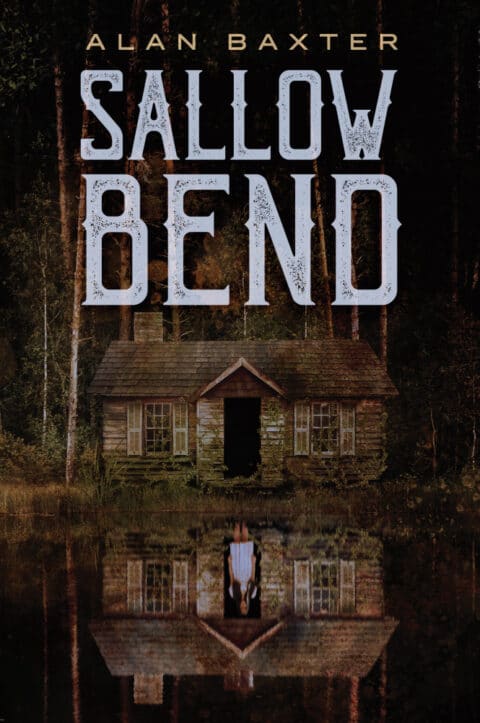
I feel as though choosing books at random like I do ends up netting me a higher-than-average percentage of novels by British authors, and I’m not entirely sure why that is. Maybe British writers are just better at coming up with titles and concepts that intrigue me, or at least are more capable of targeting my particular tastes, I dunno. But today’s book is by another English writer, Alan Baxter, who now makes his home in New South Wales, Australia. Interestingly, while I was reading this novel—which is called Sallow Bend and which came out in late summer of 2022—I had no idea that a Brit had written it, and the setting of it was so specific and yet also so generalized that I legitimately felt as though it was taking place in the United States somewhere, perhaps in the Northeast or Midwest.
It definitely gave me some Stephen King-esque, evil-small-town vibes (with IT and Doctor Sleep being the most obvious parallels), and also had subtle hints of Ray Bradbury’s Something Wicked This Way Comes, but it also had its own thing going on, so if you like those kinds of “cursed town” narratives, then you’ll probably really dig this, as it’s a really solid supernatural horror novel with a great setup that draws you right into its mystery.
Though the story switches back and forth between several characters depending on what’s going on, the main protagonist, for all intents and purposes, is a man named Caleb Jackson. Caleb is definitely a loner, and for good reason; he has some kind of…I guess you’d call it a disability, and though it shares some similarities with autism, it’s apparently something else. Basically, Caleb is extremely sensitive to other people’s emotions and deceptions, and can easily tell what someone is feeling (or hiding) just by looking at them. People’s emotions and the lengths they’ll go to just to cover them up actually really exhaust him, however, so he tries to minimize human contact as much as possible; when he’s forced to be in a crowd or interact with other human beings for any length of time, he starts getting a headache and has to be alone for a while to recharge (a situation I can absolutely relate to, by the way). He’s also not very good at social interaction, which is something else that resonated hard with me as I was reading it.
Caleb was born in a big city, but the noise and constant crush of people was too much for his mental health, so after an unfortunate incident that’s mentioned near the end of the book but that you don’t get much detail about, he decided to move somewhere he could have a quiet, solitary life, which is all he really wants. So he moved to this town, Sallow Bend, and now works as the school janitor, also living in a tiny apartment in the basement of the school. Most of the townsfolk think he’s peculiar, but he doesn’t mind, as long as he’s mostly left alone.
At the beginning of the story, the small town is all abuzz because two thirteen-year-old girls, Clare and Suki, have gone missing. Everyone is distraught, and search parties are being organized to fan out and try to track down the wayward teenagers. It also so happens that the annual carnival has just arrived in town, led by the no-nonsense Ashley Strong. The residents of Sallow Bend, as much as they love attending the carnival for two weeks every summer, have never completely trusted the carnival folk, and many of them find it very fishy that Clare and Suki disappeared on the same day that the carnival blew in and started setting up. Some think that perhaps the girls just snuck out of their houses to watch the carnival preparations and somehow got lost in the vast woods around the town, but some suspect that one of the carnies might be responsible. Knowing how the carnies are perceived, Ashley insists that all of her people help the folks of Sallow Bend in looking for the girls.
Caleb, working at the school and being acquainted with the two girls, feels obligated to join the community in the search for them. To this end, he’s sent on a reluctant errand to touch base with a local woman, Tricia, who’s supposedly organizing the search parties. She’s not really organizing anything, but she is heading down to the town square to join in, so she shanghaies Caleb into buddying with her, and attempts to bring him out of his shell a bit.
Tricia has her own horrific problems going on, by the way: a year before the events of the novel, her son Toby also vanished, and no sign of him has been seen since. Her husband Riley, unable to deal with the tragedy, hit the bottle hard, became abusive, and is also in danger of losing his job. Over the course of the book, a lovely friendship develops between Tricia and the reticent Caleb, and this friendship serves as the novel’s real heart, in my opinion.
A couple of days go by, and then, to everyone’s great relief, the girls are found alive by one of the carnies, a gentle giant of a man named Daniel. Clare and Suki had apparently gotten lost in the woods for two nights, and found shelter in a creepy old lakeside cabin out there that pretty much everyone in town has heard spooky stories and legends about.
Here’s the weird part, though: two girls went missing, but when Daniel found them, there were three. The third one is also thirteen years old, has a distinctive streak of white in her hair, and is named Hester. Caleb is immediately weirded out by this development, not only because this girl seemingly came out of nowhere, but also because almost everyone else in Sallow Bend totally acts like they’ve known her all their lives, like she’s always been there and did indeed go missing with the other two, even though Caleb is absolutely certain that’s not the case and that he’s never seen this girl before in his life.
It’s not a spoiler to say that there’s something strange about Hester, for sure, but for a long time, it’s not entirely clear what that might be. Shortly after the girls are found, the town is beset by a series of bizarre deaths that appear to be accidents or suicides, but every time Caleb tries to talk to someone about how he believes Hester might be involved somehow, the person he’s talking to tends to get very forgetful or uncomfortable, and changes the subject or straight up spaces out completely about what they were discussing. It’s all very disquieting.
While all of that is going on, we’re also following some of the carnies, and in particular a man named Saul, who’s a bit of an oddball himself and who Caleb suspects might have some kind of possibly supernatural thing going on. As the story unfolds, Caleb and Tricia essentially have to team up to try to stop the evil that’s been unleashed in Sallow Bend, as they seem to be the only two people really aware that something completely uncanny might be occurring.
As I mentioned, this definitely features elements of other classic stories, like the cyclical town curse of IT, and the carnival angle of Something Wicked. But Sallow Bend takes all these ingredients and concocts its own recipe with them, so although there are similarities to other works, this was also a compelling story in its own right. The character of Caleb was particularly relatable and sympathetic, being socially very awkward but a really good-hearted dude, and you could really feel his distress and frustration when he felt as though he was the only person in town who could see what was going on. His friendship with Tricia was also great, and I particularly liked that the author didn’t try to shoehorn in a romance subplot, but was content to just make them friends; that was very refreshing. Some of the carny characters—specifically Daniel and a little person named John Barrow—were also very well-delineated and interesting, though I will say I would have liked a bit more character development for Ashley Strong, the owner of the carnival, and I also would have liked slightly more information about what exactly Saul’s deal was, since it was all left pretty ambiguous. But overall I enjoyed this novel a lot, and was even surprised by a couple of brutal deaths at the end that I totally wasn’t expecting.
I would recommend this for fans of old-school horror in the vein of Stephen King’s small-town stories; it’s also very cinematic in its imagery, so I think it would make a great movie. My Kindle Unlimited subscription came through for me again!
Until next time, keep it creepy, my friends.
 The Scare Salon